
A sidewalk can pose a trip concern even when it is not badly broken. Under the Americans with Disabilities Act, a vertical change of one-quarter inch can be considered a trip hazard, so a small raised edge may affect safe access. Addressing sidewalk trip hazard removal in Beaverton starts with identifying what caused the uneven surface and assessing its condition.
Tree-root growth, ground compaction, and weather can contribute to cracked or uneven sidewalk panels. These changes can make walking harder, particularly for people who use mobility aids. Responsibility for maintenance varies under local rules.
This guide covers common causes, accessibility concerns, and factors that can affect responsibility for repairs in Beaverton. It also explains how professionals assess raised or damaged slabs and when grinding may be considered instead of replacement, helping you identify an appropriate next step.
Key Takeaways
- Clarify whether the sidewalk’s upkeep falls to a property owner or municipality before deciding how to address the hazard.
- Use accessibility needs and the shape of the raised edge to understand why even a localized defect can matter.
- Consider what caused the unevenness: surface-level wear and movement beneath a slab call for different repair approaches.
- Compare grinding with replacement by weighing the slab’s stability, the extent of damage, work time, and disruption.
Property-owner and municipality liability
In Beaverton, sidewalk maintenance responsibility depends on local rules. City and state ordinances may assign duties to adjacent property owners or municipalities. The location of a concrete panel alone does not determine who must address it. A raised section beside a house, for example, may still be covered by rules that assign maintenance differently. The applicable jurisdiction and ordinance matter.
Separate the sidewalk’s location from responsibility for its upkeep. Note the street address and exact segment, such as the panel near a driveway or corner. Then determine whether it falls within Beaverton or another jurisdiction. These details help direct a maintenance question to the appropriate public office or property representative. A nearby property line does not, by itself, establish responsibility.
Before arranging work, clarify who handles the affected section. This can prevent confusion about authorization, repair arrangements, and follow-up. A homeowner who notices a raised panel outside a property, for example, should not assume they are automatically required to pay for concrete work. Similarly, a public sidewalk is not necessarily the municipality’s responsibility to repair. The local ordinance is the key reference for assigning maintenance.
- Record the location: Use the street address and identify the specific sidewalk segment.
- Identify the jurisdiction: Confirm whether the site is within Beaverton or another municipality.
- Clarify the assignment: Determine whether local rules place maintenance duties on the property owner or municipality.
- Coordinate work: Once responsibility is clear, arrange the appropriate next step with the responsible party.
Liability questions can involve more than the repair itself, so maintenance responsibility does not automatically resolve every legal issue. Duties vary by city and state, and the applicable Beaverton ordinance and responsibility for an individual sidewalk depend on the specific location and circumstances. First establish the location and applicable maintenance assignment. This gives property owners and municipal staff a clearer basis for coordinating a response.
ADA accessibility and sidewalk hazards
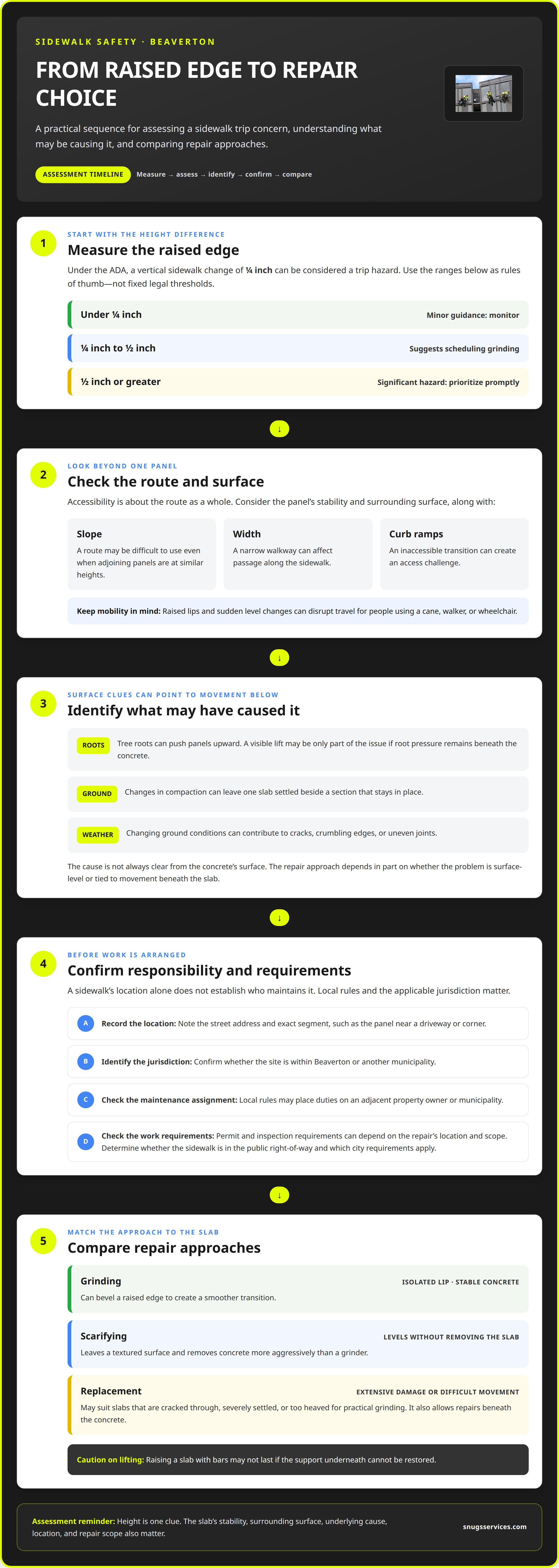
Under the Americans with Disabilities Act, a vertical sidewalk change of one-quarter inch can be considered a trip hazard. That small lip may disrupt a pedestrian’s step or make wheelchair travel less smooth. Accessibility depends on the route as a whole, not only one raised edge. A clear, even surface helps people move along the walkway with greater ease.
ADA-accessible sidewalks also address slope, width, and accessible curb ramps. A route can therefore present access challenges even when adjoining concrete panels sit at similar heights. For example, a narrow walkway or a curb ramp that does not provide an accessible transition can affect passage. These features should be considered alongside cracks, lifted edges, and sunken panels.
Displacement measurements can help describe a concern, but the ranges below are rules of thumb, not fixed legal thresholds. A shift under 1/4 inch is minor guidance to monitor; 1/4 inch to 1/2 inch suggests scheduling grinding; 1/2 inch or greater indicates a significant hazard to prioritize promptly. The panel’s stability and surrounding surface also matter.
For an isolated raised lip on stable concrete, grinding can bevel the edge to create a smoother transition. A scarifier levels slabs without removing them and leaves a textured surface, but removes concrete more aggressively than a grinder. Replacement may suit slabs that are cracked through, severely settled, or too heaved for practical grinding. It also allows repairs beneath the concrete. Lifting a slab with bars may not last if the support underneath cannot be restored.
Beaverton permit and inspection requirements can depend on the repair’s location and scope. Before work begins, determine whether the sidewalk is in the public right-of-way and which city requirements apply.
Do not assume assistance or cost-sharing applies to every Beaverton sidewalk repair. Eligibility depends on the terms of any current program, and a hazard alone does not establish qualification.
Common causes and risks of sidewalk trip hazards
Tree roots can push sidewalk panels upward as they grow underneath. A small lift may form a raised edge between adjoining slabs, while continued root growth can cause broader upheaval. The surface change is visible, but root pressure may remain beneath it. This matters because smoothing the edge alone may not address the cause.
Changes in ground compaction can also leave adjoining panels at different heights. If the support beneath one section changes, that slab may settle while its neighbor stays in place. Weather and repeated changes in the surrounding ground can contribute to cracks, crumbling edges, or uneven joints. The cause is not always obvious from the concrete’s surface.
These defects affect more than appearance. A raised lip can catch a pedestrian’s foot, while a sudden level change can disrupt travel for someone using a cane, walker, or wheelchair. Crumbling concrete can also make footing less predictable. A cracked panel beside a driveway, for example, may create a hazard along a frequently used route.
- Root-related movement: Look for lifted panels near trees and broad changes in slab height.
- Compaction-related settling: Notice whether one section has sunk beside a stable panel.
- Weather-related changes: Watch for new cracks, crumbling edges, or altered joints after ground conditions change.
Regular inspections can reveal cracks, crumbling concrete, and height differences before damage progresses. The cause and slab stability also guide the repair choice: an isolated lift may suit grinding, while extensive damage or unstable concrete may call for replacement. An on-site assessment helps distinguish a surface-level lip from movement beneath the slab.
For a stable, isolated lift, sidewalk grinding in Beaverton can often take a few hours. Full replacement may take several days, including curing time, and the sidewalk remains closed until the concrete cures. The extent of damage and any work needed to correct underlying problems affect the timeline.
How much does sidewalk trip hazard removal cost in Beaverton?
There is no single price for every sidewalk repair in Beaverton. An estimate for sidewalk trip hazard removal in Beaverton depends on the affected area, slab condition, access, and repair method. A stable panel with one raised edge requires a different scope from a cracked, heaved slab that needs replacement. The cause matters too, since work beneath the concrete may involve more than surface leveling.
Grinding is generally faster and less expensive than full replacement. It removes concrete from a raised edge to create a smoother transition, which may suit an isolated lift on stable concrete. Replacement involves removing the affected area, preparing and leveling the ground, and pouring new slabs. It may suit extensive damage or an unstable panel. Each sidewalk trip hazard removal project in Beaverton needs an estimate based on its actual scope.
Several project details shape the estimate:
- Repair area: The size and number of affected sections influence the amount of work.
- Concrete condition: A stable slab may allow grinding; severe cracks or upheaval may call for replacement.
- Access: The work area and ability to reach it affect how the job is completed.
- Underlying cause: Root movement or inadequate support may require attention below the surface.
- Work disruption: Replacement requires the sidewalk to remain closed while new concrete cures.
The estimate depends on the individual project and is provided after a quote request. The affected area, concrete condition, access, repair method, and any underlying work can all affect the scope. An estimate should reflect the actual repair, not just the visible edge. Grinding a small lift and replacing unstable panels are different projects, even when both address a trip concern.
For a clear assessment of concrete grinding needs, request a sidewalk repair quote.
Snugs Services: sidewalk cleaning
Snugs Services provides sidewalk cleaning to remove grime and buildup from concrete walkways. Cleaning can help when a sidewalk looks dirty, but it does not level a raised slab or repair structural damage. A trip hazard caused by uneven panels calls for appropriate concrete repair, not washing alone.
Choose sidewalk cleaning for surface buildup; consider concrete grinding or replacement for a raised, cracked, or unstable section. Distinguishing these needs helps you request work suited to the walkway’s condition. Snugs Services can clean sidewalks when the goal is a cleaner, well-maintained surface.
For sidewalk cleaning in Beaverton, contact Snugs Services to discuss your needs.
Take the next step toward a safer walkway
A sidewalk concern is easier to address when the next step matches the problem. Start by gathering the location, responsible party, and condition that needs attention. This gives the conversation a clear focus, whether you want to clean a dirty surface or address a damaged section. A sound plan also helps prevent cleaning from being mistaken for concrete repair.
If you’re considering sidewalk trip hazard removal in Beaverton, choose a next step that reflects the walkway’s condition and the work needed. Snugs Services can discuss sidewalk concerns and cleaning, helping you determine whether cleaning fits your needs.
Contact Snugs Services about sidewalk hazards to discuss your walkway and the service you need. A clear conversation is a practical place to begin, and a well-cared-for sidewalk can support a more welcoming property.
Frequently Asked Questions
What Is a Sidewalk Trip Hazard?
A sidewalk trip hazard is an uneven or damaged walking surface that can catch a foot, disrupt a step, or impede travel with a mobility device. A lifted joint between concrete panels, for example, creates an abrupt edge. A cracked, crumbling corner can also make footing less predictable. The concern is how the change affects people using the walkway, not just how the concrete looks.
Does the City of Beaverton require property owners to repair sidewalk trip hazards?
Whether an adjacent property owner must arrange repairs depends on the applicable local maintenance rule. Sidewalk duties may be assigned to property owners or the municipality, so do not assume that every sidewalk outside a property is the owner’s responsibility. Identify the affected segment and jurisdiction first, then determine which party the local rule assigns to handle maintenance.
Who is responsible for sidewalk maintenance and repair in Beaverton: the property owner or the city?
Depending on the applicable local ordinance, responsibility may fall to an adjacent property owner or the municipality. The address alone may not settle who must coordinate the work. For a panel beside a driveway, distinguish the property boundary from the sidewalk segment itself. Establishing responsibility helps clarify who should arrange repairs and manage related coordination.
What sidewalk height difference counts as a trip hazard in Beaverton or Oregon?
Under the Americans with Disabilities Act, a vertical sidewalk change of one-quarter inch can be considered a trip hazard. This is a useful accessibility reference, not a universal Oregon repair threshold. The displacement, slab condition, and route accessibility features help describe the concern. Displacement ranges are rules of thumb, not fixed legal limits.
What are the risks of delaying repair of an uneven sidewalk in Beaverton?
An uneven panel left unaddressed keeps an abrupt transition in the walking route. A person may catch a foot at a raised joint, while someone using a cane or wheelchair may find the route harder to navigate. If roots or changing ground conditions continue to move the slab, the defect may worsen. Prompt attention can address the hazard before damage progresses.
Recent Comments