
What should a government building exterior cleaning plan cover beyond a basic wash? Government building exterior cleaning services should reflect the facility’s surfaces, condition, access needs, and maintenance priorities. A site assessment helps create a plan for windows and other exterior areas without treating every building the same.
It’s reasonable to want more than a clean appearance. You also need confidence that the work is planned thoughtfully and carried out with attention to the building and its surroundings. Team training and insurance are important topics to discuss when evaluating a cleaning plan.
This article explains how facility assessments guide customized cleaning plans, which exterior services may be included, and what can affect scope, scheduling, and cost. You’ll also find practical questions to ask about training and insurance, so you can make a clear, informed decision for your government facility.
Key Takeaways
- Match the cleaning plan to the facility’s surfaces, condition, access needs, and maintenance priorities.
- A focused assessment helps define the work and set practical expectations for scheduling and scope.
- Consider window washing alongside related exterior upkeep to address the building as a whole.
- Ask how the cleaning team is trained and insured so you can assess whether its approach suits your facility.
Customized government facility cleaning programs
A facility assessment turns visible maintenance needs into a practical scope of work. A customized program can then set priorities for each building and surface.
Customized Cleaning Proposals
A strong proposal connects assessment findings to specific tasks instead of applying one routine to every site. It should identify included areas, surface types, cleaning methods, access needs, and the proposed schedule. For example, a building with public entrances, glass frontage, and a separate service area may need distinct priorities. Compare proposals by their scope, exclusions, scheduling assumptions, and records of completed work.
Environmental Rules for Washing and Wastewater
Pressure-washing and wastewater requirements depend on the facility’s location, discharge route, and applicable local and state rules. A proposal should explain how wash water will be managed, where it may flow, and how the work will keep debris or cleaning products out of storm drains. Before work begins, align the scope with site-specific requirements and applicable environmental procedures.
Compare proposals against the same written scope and evaluation criteria. Review the methods, schedule, documentation, relevant experience, and stated training and insurance details. Note differences in exclusions and assumptions before making a decision.
Procurement follows the agency’s purchasing process and solicitation requirements. The agency defines the scope, submission instructions, evaluation criteria, and contract terms; vendors respond in the required format and by the stated deadline.
To find opportunities, search the agency’s procurement portal, public bid notices, and local vendor registration system. Try terms such as exterior washing, window cleaning, and facility maintenance, then match each notice’s location and scope to suitable local vendors.
Facility assessment and cleaning plan design
A useful assessment connects each facility’s condition and access needs to a clear work plan. The scope should distinguish exterior maintenance from janitorial tasks inside offices.
Facility Cleaning Scope
Define the work by building area, surface, and service type. An office entrance may need attention alongside exterior glass, while a loading bay may require separate scheduling. Janitorial work covers interior upkeep; commercial exterior cleaning addresses building surfaces and nearby areas. A clear scope identifies included locations, access arrangements, service methods, and how completed tasks will be recorded.
Cleaning Frequency for Exterior Areas
No single schedule suits every facade, window, roof, or sidewalk. Set frequency according to visible buildup, material condition, weather exposure, foot traffic, and the facility’s appearance priorities. A busy sidewalk may need attention sooner than a sheltered facade, while roof cleaning depends on accumulated debris or growth. Review these conditions during facility assessments and adjust the plan as they change.
During an assessment, record each exterior area, its surface type, access constraints, and visible maintenance needs. Separate urgent issues from routine cleaning, then assign each task a suitable method and schedule. For facilities with multiple buildings, note their differences instead of applying one blanket plan.
Facility access also shapes the work plan. Identify entry procedures, restricted areas, operating hours, and the staff member who coordinates access. Agencies can specify any background-screening requirements in procurement documents, then ensure the proposed team follows the facility’s access process. This clarity helps prevent avoidable disruption in active offices.
For government building exterior cleaning services, a written scope makes responsibilities easier to track. Agencies can use a facility assessment to shape practical exterior maintenance support around actual site conditions.
Window washing and exterior maintenance
Window washing and other exterior maintenance address different surfaces, so the method should suit the material and soil. A thorough plan separates glass, painted siding, masonry, and walkways rather than treating every area alike.
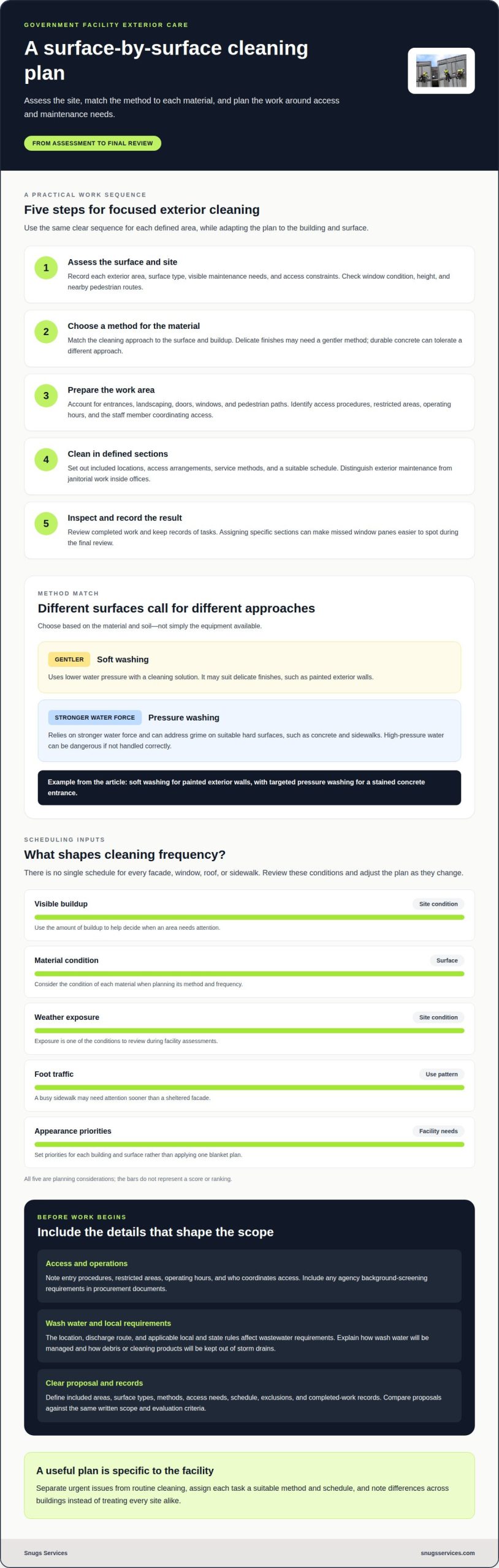
Before choosing equipment and methods, trained professionals assess window condition, height, access, and nearby pedestrian routes. A high-rise office may require specialized access planning, while ground-level windows can be reached differently. The work plan should account for entrances and operating areas to help crews clean systematically and reduce disruption. Assigning specific sections also makes missed panes easier to spot during the final review.
Soft washing uses lower water pressure with a cleaning solution, while pressure washing relies on stronger water force. The surface and buildup guide the choice: delicate finishes may call for a gentler approach, while durable concrete can tolerate a different method. For example, soft washing may suit painted exterior walls, with targeted pressure washing for a stained concrete entrance. Choose a method for the material, not simply the equipment available. High-pressure water can be dangerous if not handled correctly.
Professional pressure washing can address grime on concrete, sidewalks, and other suitable hard surfaces. Before work begins, identify nearby windows, doors, landscaping, and pedestrian paths. This helps define where water can be directed and where protection or controlled access is needed. At a government building in Portland, for example, the plan can distinguish a public walkway from a more sensitive facade instead of applying one method across both. Snugs brings its own water for pressure-washing jobs.
Ask how the team selects methods, protects adjacent surfaces, and reviews completed work. A practical sequence is to assess the surface, choose the cleaning approach, prepare the work area, clean in defined sections, and inspect the result. Pairing window washing with suitable exterior maintenance gives each surface focused attention without assuming one process fits the entire facility. Our team follows OSHA-compliant procedures.
Commercial building surfaces and exterior cleaning inclusions
A clear scope names each surface and the work planned for it. Government properties may include glass entrances, masonry walls, metal panels, sidewalks, parking areas, roofs, and gutters. These materials collect different soils and need suitable care. Group similar surfaces, then identify areas requiring separate methods. A public entrance and a sheltered loading area, for example, have different cleaning priorities.
Commercial cleaning proposals should distinguish exterior services from interior janitorial tasks. They should also specify the structures and adjoining areas included, how access will be handled, and what completion records the agency will receive. “Building exterior” alone can leave important areas ambiguous. Name specific locations, such as the main facade, window surrounds, sidewalks, and parking garage, to make proposals easier to compare.
- Facades: Identify material and areas with visible staining.
- Windows: Define included elevations, entrances, and accessible glass.
- Grounds: Name sidewalks, parking lots, and garage surfaces.
- Drainage: Include gutters where they form part of the planned work.
Each task should connect to a practical result. Sidewalk cleaning can address tracked-in grime at an entrance, while parking lot cleaning can target accumulated debris in vehicle areas. Include roof and gutter work when those surfaces need attention. Separate the tasks so property managers can see what is covered, which method applies, and what falls outside the work plan.
Before approving commercial cleaning, match the written scope to the facility map or site list. Confirm that named areas reflect the agency’s priorities and access arrangements. A concise scope reduces gaps between the requested work and the completed work. Plan exterior cleaning for your facility with clearly defined surfaces and inclusions.
Snugs Services
Snugs Services helps government facilities manage exterior upkeep with practical cleaning and maintenance services. For surface cleaning or drainage-system needs, services include Pressure Washing, Gutter Cleaning, Gutter Installation, and Gutter Repair.
These services can fit into a broader facility plan that identifies priority areas and separates different types of work. For example, a property manager can coordinate pressure washing of exterior surfaces with gutter maintenance as part of the site’s upkeep. Clear scope details help align the work with the facility’s priorities.
Contact Snugs Services to discuss the exterior maintenance needs of your government facility.
Set a Clear Next Step for Your Facility
A well-maintained government property starts with a scope that reflects how each area is used. Identify exterior priorities, clarify access needs, and align the requested work with your facility’s maintenance plan. This gives your team a practical starting point for discussing government building exterior cleaning services.
Snugs Services provides Pressure Washing, Gutter Cleaning, and Gutter Installation to help facilities address exterior upkeep. These services can support surface cleaning or gutter maintenance as part of a broader property plan. Share the areas that need attention and the outcomes your team is seeking to focus the conversation on relevant work.
Contact Snugs Services about cleaning and take a clear next step toward a cleaner, well-cared-for facility.
Frequently Asked Questions
Are your cleaning teams insured and trained?
Our team follows OSHA-compliant procedures. Include insurance requirements and proof in procurement documents, including the coverage limits and certificates the agency requires. Evaluate submitted insurance records against the solicitation terms before awarding work. High-pressure water can be dangerous if not handled correctly, so the work plan should also explain how crews manage site hazards.
What can affect a government building cleaning quote?
A quote reflects the requested work and the site conditions. Relevant details include the areas and surfaces involved, buildup, access requirements, and whether the work spans separate buildings. A request covering an entrance, parking structure, and upper-level windows has a different scope from one focused on a single walkway. A clear site list helps shape a useful quote.
What exterior cleaning services do government buildings typically need?
Government building exterior cleaning services can include window washing, pressure washing, gutter cleaning, roof cleaning, and care for sidewalks or parking areas. The right mix depends on the facility’s surfaces and maintenance needs. A building with solar panels needs specialized attention: Solar panels require specialized low-pressure cleaning; high-pressure can crack glass, damage seals, or void warranties. Include each priority area in the project scope.
How much does government building exterior cleaning cost per square foot?
There is no single per-square-foot figure for every public facility. A quote depends on the areas, surfaces, access, and work requested, so a site-wide rate may not reflect the actual scope. A defined list of buildings and tasks gives Snugs Services a basis for preparing a project quote. Quotes are provided on request.
What factors affect exterior cleaning costs for public buildings?
Beyond the amount of surface area, cost depends on how crews reach each area, the condition of its materials, and how the work must fit facility operations. A site with restricted entrances or several buildings may require more coordination than a single open area. Procurement requirements, such as documentation or site access procedures, can also shape the work plan and its quote.
What licenses, insurance, and certifications are required for government exterior cleaning contractors?
Requirements depend on the jurisdiction and procurement contract, so no single list applies to every government project. The solicitation should identify applicable licensing, insurance documentation, and any required credentials. Compare submitted records with those stated terms. For a Portland-area facility, the relevant public agency’s procurement instructions and the facility’s location determine which requirements apply.
Recent Comments