
A single afternoon spent scrubbing a headstone with household bleach can cause more permanent erosion than fifty years of relentless Pacific Northwest rain. You want to honor your family’s legacy by keeping their memorials looking pristine, yet the aggressive moss and lichen growth common in Portland and Vancouver makes that a constant struggle. It’s stressful to see a beautiful tribute slowly disappear under layers of green biological growth, and it’s even scarier to think that the wrong cleaning method might ruin the stone forever.
We understand that these memorials are your most valuable emotional assets, and you deserve a worry-free way to maintain them. This 2026 preservation guide teaches you the expert techniques required for safe monument cleaning that restores granite and marble to their original state without causing damage. You will learn how to identify specific stone types, why certain chemicals are dangerous, and how our local Snugs Services team uses professional-grade methods to stop erosion in its tracks. From removing 100 percent of biological spores to selecting the right pH-neutral cleaners, we provide the clear steps needed to ensure your family’s history remains sparkling for the next century.
Key Takeaways
- Understand how the unique Pacific Northwest climate accelerates stone decay and why proactive preservation is essential for local landmarks.
- Identify the specific needs of granite, marble, and sandstone to ensure you never use harmful “one-size-fits-all” cleaning chemicals.
- Protect delicate surfaces by choosing professional soft washing techniques over the common but destructive risks of high-pressure washing.
- Follow a proven, step-by-step restoration process that uses saturation and manual tools to safely lift heavy biological growth.
- Learn how expert monument cleaning restores the pristine beauty of your assets while providing the peace of mind that comes with 30 years of local experience.
The Importance of Monument Cleaning in the Pacific Northwest
Monument cleaning is the technical process of removing biological growth and environmental pollutants from stone surfaces without altering the original material. In the Portland and Vancouver metro areas, we deal with a unique set of challenges that demand specialized care. Our region averages over 40 inches of rainfall annually; this constant moisture, combined with dense tree canopies, creates a perfect environment for organic decay. At Snugs Services, we approach every project with a “Do No Harm” philosophy. This preservation-first mindset ensures that we use only the safest, pH-neutral solutions that protect the stone’s longevity for decades to come.
There is a vital distinction between making a stone look “clean” and ensuring its structural survival. While aesthetic cleaning improves readability, structural preservation prevents the stone from delaminating or sugar-coating. Proper Gravestone cleaning techniques, as outlined by the National Park Service guidelines updated in 2024, focus on long-term stability rather than immediate, aggressive whitening. We don’t just scrub away dirt; we halt the chemical and physical processes that cause stone to crumble.
Why Moss and Lichen are Destructive
Lichen may look charming on an old marker, but it acts as a biological drill. Its roots, known as hyphae, penetrate microscopic pores in the stone to anchor themselves. When temperatures drop below 32 degrees during January freezes in Salem or Eugene, the moisture trapped by these organisms expands. This cycle causes spalling, where the face of the stone literally pops off. Additionally, these organisms secrete acidic byproducts that chemically dissolve calcium-based stones like marble and limestone, turning a smooth surface into a pitted, fragile shell. Cemetery pathways and surrounding hardscapes face additional winter hazards, and professional de-icing services in Portland and Vancouver can help prevent dangerous ice buildup that compounds freeze-thaw damage to stone monuments and surrounding walkways.
Public vs. Private Monument Maintenance
The needs of a family headstone differ significantly from large-scale municipal bronze or granite statues. While private markers require delicate, localized hand-scrubbing, institutional properties often benefit from commercial pressure cleaning services to maintain curb appeal and safety across large plazas. We handle these projects with strict adherence to the National Historic Preservation Act standards. We understand the legal and ethical weight of working on public historical markers. Our team takes the heavy lifting off your shoulders, ensuring that public markers remain pristine without the risk of damage from untrained hands. It’s about being a good neighbor and protecting our shared local history for the next generation.
Identifying Stone Types and Biological Growth
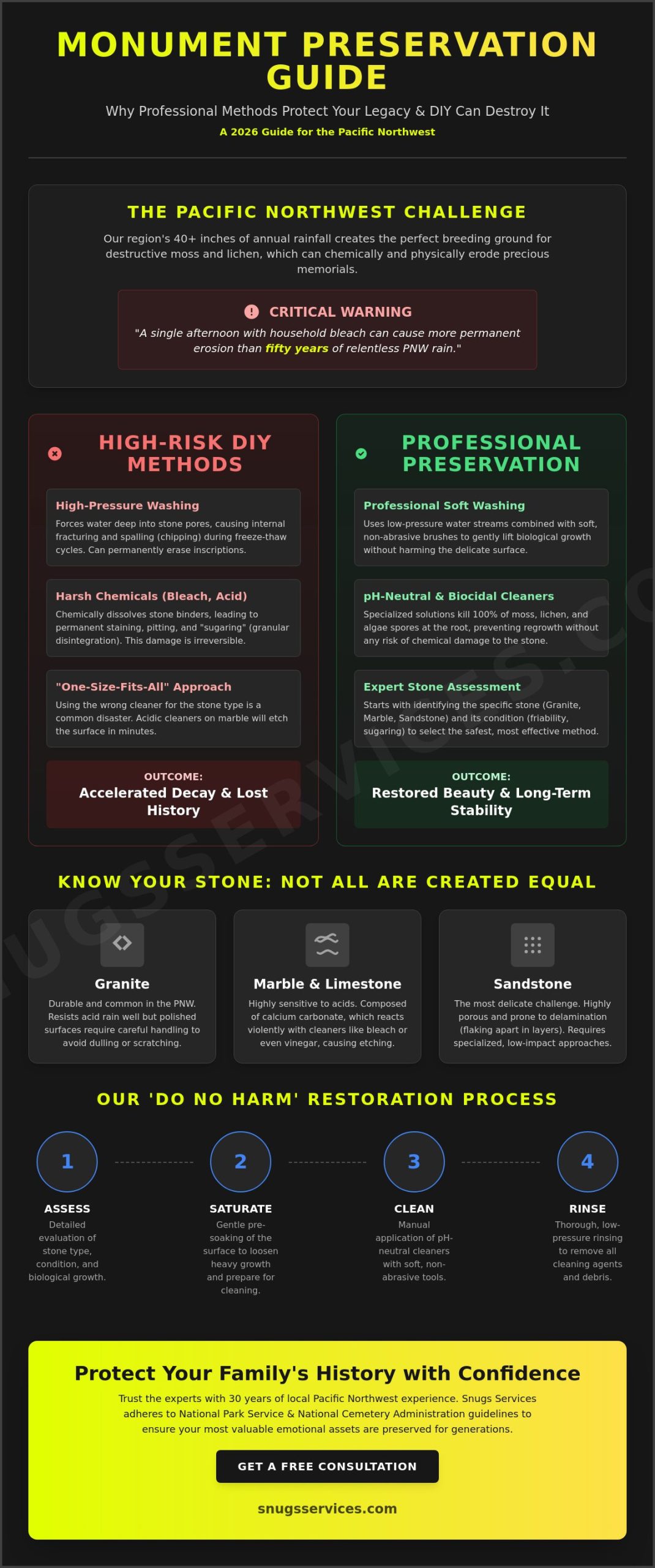
Professional monument cleaning starts with a detailed material assessment. You cannot treat a 150-year-old marble headstone the same way you treat a modern granite bench. Using “one-size-fits-all” chemicals, like household bleach or acidic masonry cleaners, often leads to permanent staining or accelerated erosion. Before any water touches the surface, we evaluate the stone’s friability. This involves checking for “sugaring,” where the mineral binders have weakened and the stone sheds small grains like sugar when touched. If a monument is sugaring, even gentle scrubbing can erase inscriptions forever.
Safety is the primary goal of preservation. We follow the National Cemetery Administration guidelines to ensure every method used is non-destructive. These standards explicitly warn against high-pressure washing, which can force water deep into stone pores and cause internal fracturing during the Pacific Northwest’s freeze-thaw cycles. Our team prioritizes pH-neutral solutions and soft-bristled brushes to maintain the integrity of the memorial.
Granite vs. Marble: Different Cleaning Requirements
Granite is the durable PNW favorite. It’s an igneous rock that resists acid rain well, making it a staple in modern Portland cemeteries. While granite is rugged, its polished finish requires careful handling to avoid dulling. Marble and limestone are far more sensitive. These stones are composed of calcium carbonate, which reacts violently to acids. Even “eco-friendly” vinegar-based cleaners can etch the surface of a marble monument in minutes. Sandstone represents the most delicate challenge. Frequently found in historic 19th-century pioneer cemeteries, sandstone is highly porous and prone to delamination, requiring a specialized, low-impact approach.
Spotting PNW-Specific Biological Growth
- Black Algae (Gloeocapsa magma): This hardy organism creates dark, soot-like streaks. It’s especially prevalent on north-facing monuments in Gresham and Hillsboro where sunlight is limited.
- Crustose Lichen: These appear as “rusty” or leafy patches. Lichen is a complex symbiotic organism that produces acids to anchor itself into the stone, making it difficult to remove without professional-grade biological cleaners.
- Bryophytes (Moss): Moss thrives in the damp, shaded valleys of the Willamette River region. While it looks lush, moss traps moisture against the stone and its root-like structures can expand existing micro-cracks.
Identifying these invaders correctly allows for a targeted treatment that kills the root system without harming the masonry. If you are unsure about the stability of a family headstone, our team can provide a professional assessment to ensure the preservation process is safe and effective. We take the heavy lifting out of maintenance so you can focus on honoring your loved ones.
Professional Methods vs. DIY: The Danger of Pressure Washing
Many well-meaning people assume that “more power” equals a better clean. This is the biggest misconception in monument cleaning. Blasting a delicate 100-year-old headstone with 3,000 PSI of water doesn’t just remove dirt; it can permanently strip away the stone’s surface. At Snugs Services, we focus on preservation rather than just surface-level aesthetics. We replace raw force with science and patience to ensure your local history stays intact for another century. Our team treats every stone with the respect it deserves, moving away from high-pressure tactics that do more harm than good.
The Risks of Improper DIY Cleaning
Grabbing a bottle of household bleach is a common mistake that leads to “spalling.” Bleach contains sodium hypochlorite, which leaves behind sub-surface salts. When these salts crystallize, they expand and cause the stone to flake or crack from the inside out. It’s a chemical reaction that can’t be reversed once it starts. Similarly, using wire brushes or metal scrapers is a recipe for disaster on soft stones like marble or limestone. These tools leave deep scratches that trap more dirt and biological growth over time. High-pressure water is equally dangerous. It often obliterates fine details or shallow inscriptions, turning a historical record into a smooth, blank slab in seconds.
The Soft Washing Advantage for Monuments
We prioritize a “Soft Washing” approach for every monument cleaning project. This method utilizes specialized pumps to deliver water and cleaning solutions at under 100 PSI. To put that in perspective, this pressure is lower than what typically comes out of a standard garden hose. Our expert pressure washing in Portland utilizes specific low-pressure nozzles to ensure delicate surfaces remain intact while still achieving a pristine finish. It’s about being gentle where it matters most.
The secret lies in the chemistry. We use biological solutions like D/2, which is pH neutral and contains no salts or bleach. It works by penetrating the porous stone to kill mold, algae, and lichen at the root. One of the best benefits is the residual effect. These professional cleaners continue to work with the elements, keeping biological growth away for 12 to 24 months after the initial application. Our team pairs these solutions with specific tools designed for preservation:
- Natural bristle brushes: These effectively agitate grime without scratching the stone faces.
- Low-flow rinses: We use a gentle stream to safely clear away debris without forcing water into internal cracks.
- Manual detail work: Our technicians spend time on intricate carvings where machines simply can’t go.
This careful process ensures your family legacy or community landmark stays beautiful without the risk of structural damage. You get the peace of mind that comes from knowing the job was done right the first time by neighbors who care about the results as much as you do. We take the heavy lifting and the worry out of the equation, leaving you with a monument that looks truly cared for.
The Step-by-Step Monument Restoration Process
Restoring a memorial requires more than a bucket and a brush; it’s a delicate science that protects history. When Snugs Services handles monument cleaning, we follow a rigorous five-step protocol designed to meet 2026 preservation standards. This process ensures the stone remains intact while removing decades of environmental buildup.
- Step 1: Thorough Saturation. We begin by soaking the stone with clean, low-pressure water. This fills the stone’s pores, which prevents the biological cleaning solutions from soaking too deeply into the substrate.
- Step 2: Manual Moss Removal. Our technicians use plastic or wooden scrapers to gently lift away 90% of heavy moss and lichen. We never use metal tools, as even a small slip can cause permanent scratches in granite or marble.
- Step 3: Biological Solution Application. We apply a pH-neutral, 100% biodegradable biological cleaner. This solution is specifically engineered to kill organic growth without harming the stone or the surrounding grass.
- Step 4: Gentle Agitation. Using soft-bristle brushes, we work in a circular motion to lift remaining dirt. This technique ensures we clean the face of the stone and the intricate lettering without causing erosion.
- Step 5: Final Rinse and Documentation. We perform a final low-pressure rinse to clear all debris. Finally, we document the stone’s condition with high-resolution photos to track its health over time.
Cleaning from the Bottom Up
It might seem counterintuitive, but professional monument cleaning always starts at the base. If you start at the top, dirty water flows over dry stone and creates permanent marks. Streak staining is the result of dirty water running down dry stone. To manage runoff in sensitive Portland cemeteries, we use absorbent barriers and controlled water flow to protect the surrounding landscape and nearby headstones.
Post-Cleaning Care and Monitoring
Patience is vital when it comes to professional restoration. While the stone will look significantly better immediately, biological cleaners often take 4 to 12 weeks to show full results. These solutions continue to work over time, killing deep-seated roots that manual scrubbing can’t reach. To keep memorials in Beaverton and Tigard looking pristine, we recommend a maintenance check every 18 months to prevent lichen from anchoring again.
If the monument is located under a heavy tree canopy, debris will accumulate quickly. In these cases, it’s often best to call for professional roof cleaning in Portland if those same trees are dropping moss and needles onto your property’s structures. Keeping the overhead environment clean is the first step in preserving the stones below. For institutional properties and memorial parks, professional parking lot sweeping in Portland and Vancouver is equally important, as Portland’s heavy rains and pine needles can quickly turn neglected paved areas into a slippery hazard that threatens visitor safety and stormwater compliance. Property managers responsible for memorial park grounds should also review the full scope of parking lot cleaning options in Portland and Vancouver to ensure their paved surfaces meet Oregon DEQ stormwater compliance standards alongside their monument preservation efforts.
Ready to restore a local landmark or family memorial to its original beauty? Contact Snugs Services for a professional monument cleaning estimate today.
Expert Monument and Sign Maintenance with Snugs Services
Snugs Services has spent over 30 years perfecting the art of property maintenance across the Pacific Northwest. Since our founding in 1995, we’ve focused on delivering results that protect both the aesthetic and the structural integrity of local landmarks. Our specialized approach to commercial and institutional monument cleaning ensures that your property’s first impression remains pristine for decades. We don’t just wash away dirt; we use a scientific method to remove biological growth without damaging delicate stone, masonry, or bronze surfaces.
Large-scale projects require a level of coordination that most small contractors can’t provide. We have the equipment and manpower to manage 100,000-seat stadiums and sprawling university campuses with 200-plus acres of grounds. Our team understands the logistical challenges of these environments, from scheduling work around high-traffic events to managing water runoff. We utilize eco-friendly, biodegradable cleaning agents that effectively neutralize mold and lichen. These solutions are specifically chosen because they’re safe for the surrounding turf and landscaping, ensuring your grass stays green while your monuments regain their original luster.
Serving the Entire Portland & Vancouver Metro
Our commitment to the Pacific Northwest extends far beyond the city centers. We provide expert care to communities in Gresham, Salem, Eugene, and Hillsboro. This wide reach is rooted in our “Good Neighbor” philosophy. We treat every monument, whether it’s a small historical plaque or a massive university entrance sign, with the respect it deserves. Our crews are trained to handle a diverse range of property needs, from high-pressure fleet washing for municipal vehicles to the delicate restoration of century-old granite. We’re proud to be a local partner that understands the specific environmental challenges, such as the persistent dampness and moss growth, unique to our region. Institutional property managers overseeing memorial parks and campus grounds can also benefit from our professional parking lot cleaning services in Portland and Vancouver, which address oil stains, moss buildup, and Oregon DEQ stormwater compliance requirements that affect the entire property. Winter months bring additional concerns for property managers, and our professional de-icing services for Portland and Vancouver properties ensure safe access to monument sites and institutional grounds throughout the freezing season.
Request Your Monument Assessment Today
Getting a professional quote for your monument cleaning or signage project is a straightforward, transparent process. When you request an assessment, our experts visit your site to evaluate the material composition and the level of atmospheric soiling. We prioritize a safety-first approach, especially in high-traffic public areas. This includes implementing clear signage and perimeter controls to keep pedestrians safe while we work. We’ll provide a detailed plan that outlines the specific cleaning agents and methods we’ll use to restore your asset without risk. Don’t let years of grime dull the significance of your monuments. Contact Snugs Services for a professional monument cleaning estimate and let us handle the heavy lifting for you.
Preserve Your Legacy with Professional Care
Protecting a memorial requires more than a quick scrub. We’ve seen how the Pacific Northwest’s damp climate accelerates biological growth on porous stone. Since 1995, Snugs Services has helped local communities maintain their most significant landmarks by avoiding the destructive force of high-pressure washing. Choosing professional monument cleaning ensures that delicate surfaces remain intact while removing years of stubborn lichen and moss. Our team utilizes specialized Soft Washing equipment to achieve a pristine finish without risking the structural integrity of the stone.
You don’t have to tackle these complex preservation tasks alone. We’re fully licensed and insured for both commercial and municipal projects across Portland and Vancouver. Our technicians handle the heavy lifting so you can enjoy a worry-free restoration process. We bring the expertise of a local craftsman to every site; we’ll ensure your assets look their best for decades to come. Restore your monument’s beauty—get a free quote from Snugs Services today!
It’s time to let your community’s history shine with the respect and professional care it deserves.
Frequently Asked Questions
Can I use a pressure washer to clean a gravestone or monument?
You shouldn’t use a pressure washer because high-pressure water can cause permanent structural damage to delicate stone surfaces. Even a standard residential unit exceeding 50 to 100 PSI can strip away the protective patina or force water into micro-cracks. We use a low-pressure, gravity-fed system to ensure the stone stays intact while we restore its pristine appearance. This gentle approach protects the monument’s integrity for the next 100 years.
Is it safe to clean monuments with bleach or vinegar?
You should avoid bleach and vinegar because these household chemicals cause irreversible salt deposits and surface etching on natural stone. Bleach often leaves behind sodium chloride that crystallizes inside the stone, leading to a 15 percent increase in surface spalling over time. Vinegar’s acidity reacts poorly with the calcium carbonate found in marble and limestone. We use pH-neutral, biological cleaners that safely lift stains without harming the mineral structure.
How often should a stone monument be cleaned in the Pacific Northwest?
You should schedule professional monument cleaning every 2 to 3 years to combat the heavy biological growth common in the Pacific Northwest. Portland received 43 inches of rain in 2023, which creates the perfect environment for moss and lichen to thrive. Regular maintenance prevents these organisms from rooting deep into the stone. Keeping a consistent schedule ensures the memorial remains a beautiful tribute without requiring aggressive restorative measures later.
What is the best chemical to use for cleaning biological growth on stone?
The industry standard for safely removing biological growth is D/2 Biological Solution, a biodegradable cleaner used by the National Park Service for over 50 projects. This pH-neutral liquid kills mold, algae, and lichen without the need for harsh scrubbing. It continues to work for 12 months after the initial application to keep the surface clear. We use this professional-grade solution to provide a deep, long-lasting clean that protects the stone.
Will cleaning a monument damage the grass or flowers around it?
Professional cleaning won’t damage the surrounding landscape when we use eco-friendly, biodegradable solutions and proper saturation techniques. We thoroughly soak the grass and plants within a 3-foot radius before and after the process to prevent any solution absorption. This pre-wetting method ensures your flowers and turf remain healthy and vibrant. You get a sparkling monument and a thriving garden with zero hassle or worry while we do the heavy lifting.
What should I do if the monument stone is crumbling or ‘sugaring’?
You should immediately stop any cleaning efforts if you notice the stone is sugaring or shedding small grains of sand. This indicates the internal binder of the stone has failed, and even soft brushing can cause a 20 percent loss of surface detail. We recommend a professional assessment to determine if a consolidant treatment is necessary to stabilize the surface. Our team helps you navigate the preservation process to prevent further decay.
How much does professional monument cleaning cost in Portland?
Professional rates for monument cleaning vary based on the size and condition of the stone. According to industry data from the National Cemetery Administration, preservation costs depend on the specific labor hours and materials required for safe restoration. We provide detailed, transparent quotes after assessing the monument’s location and biological load. Contact our neighborly team for a specific estimate to ensure your memorial receives the expert care it deserves without any hidden fees.
Can Snugs Services clean bronze plaques as well as stone monuments?
Snugs Services expertly cleans bronze plaques using specialized techniques that differ from stone preservation. We remove oxidation and grime before applying a high-quality paste wax to protect the metal from the 40 percent average humidity found in the region. This process restores the rich luster of the bronze and prevents future corrosion. Our team handles the heavy lifting, ensuring every part of the memorial looks its absolute best for years to come.
Recent Comments