
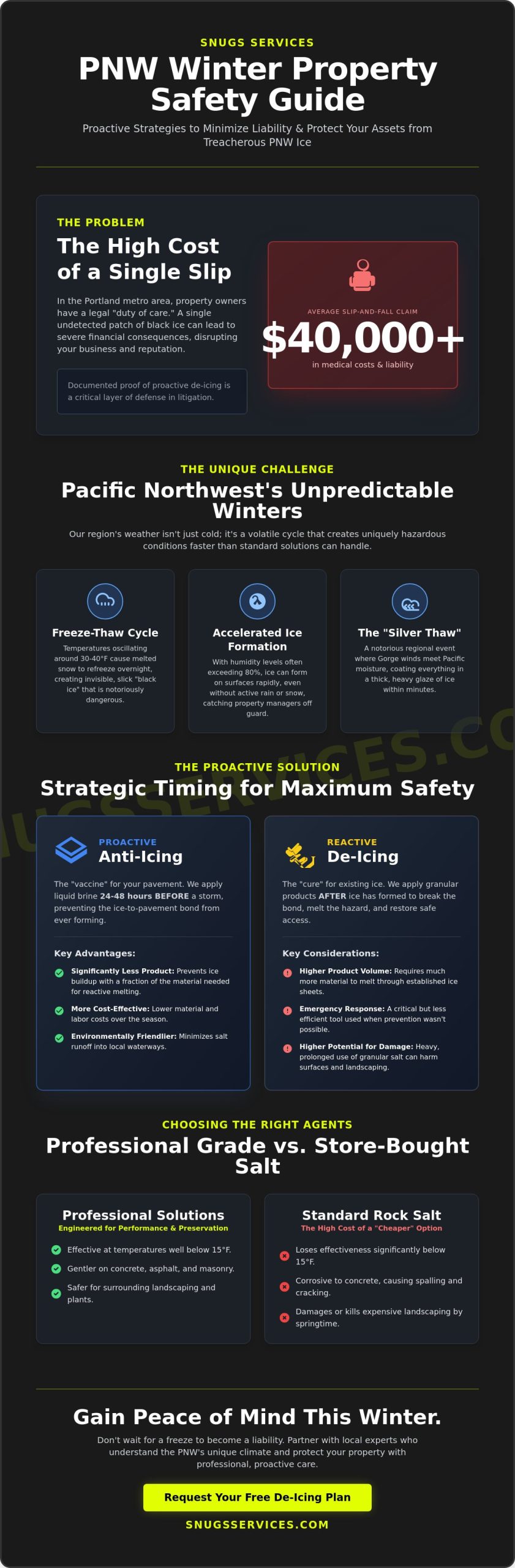
Last January, a Portland property manager discovered that a single patch of undetected black ice could lead to a legal claim exceeding $40,000 in medical costs and liability. It’s a heavy burden to carry when you’re just trying to keep your business running. You already know that Pacific Northwest winters are notoriously unpredictable. Between the freezing rain in Vancouver and the sudden slush in Portland, professional de-icing becomes a race against the clock. You want to ensure safe access for every visitor. However, you also worry that standard rock salt will crumble your expensive concrete or wither your landscaping by springtime.
At Snugs Services, we believe you shouldn’t have to choose between safety and property preservation. This 2026 guide provides a clear plan to secure your property and minimize liability with expert strategies tailored for our local environment. We’ll walk you through selecting the right professional materials, setting up a proactive response for emergency freezes, and keeping your surfaces pristine all winter long.
Key Takeaways
- Understand the specific slip-and-fall risks in the Portland metro area and how proactive management protects your business from costly winter liabilities.
- Learn the strategic timing behind professional de-icing to effectively break ice-to-pavement bonds and restore safe access to your property.
- Discover which specialized agents provide the best balance between melting power and the long-term preservation of your concrete and landscaping.
- Use our winter readiness template to prioritize high-traffic zones like ADA ramps and main entrances for a seamless, worry-free response.
- Gain peace of mind by partnering with local experts who understand the unique micro-climates of the Pacific Northwest.
The High Cost of Ice: Why Professional De-icing Matters in the PNW
Winter in the Pacific Northwest brings more than just rain; it brings treacherous layers of ice that coat Portland and Vancouver storefronts overnight. For local business owners, professional de-icing acts as a proactive liability management tool rather than a simple maintenance chore. De-icing is the process of removing ice or preventing its formation on surfaces, which is vital for keeping your property accessible and safe for everyone who visits. By treating surfaces before the temperature drops, we help you avoid the chaos of a sudden freeze.
To see how professional-grade solutions outperform basic store-bought options, watch this practical comparison:
Understanding Local Liability Standards
Property owners in Oregon and Washington carry a legal “duty of care” to maintain safe premises for visitors. When a winter storm hits the Portland metro area, the risk of slip-and-fall incidents spikes, often leading to costly litigation. Professional de-icing services provide a critical layer of defense by maintaining detailed logs of every application, including timestamps and product quantities. These records serve as documented proof that you took reasonable steps to mitigate hazards. According to the National Floor Safety Institute, the average cost of a slip-and-fall claim is approximately $30,000 to $40,000 per incident.
The PNW Freeze-Thaw Cycle
Our local weather creates unique challenges that constant sub-zero climates rarely face. In Gresham and Hillsboro, temperatures often oscillate between 30°F and 40°F. This creates a dangerous cycle where rain or melted snow refreezes into “black ice” as soon as the sun sets. Humidity levels in the valley often exceed 80%, which accelerates ice formation even when there is no active precipitation.
The “Silver Thaw” events are particularly notorious in our region. These occur when cold air from the Columbia River Gorge meets Pacific moisture, coating everything in a thick glaze of ice within minutes. Waiting for the sun to melt the hazard is a high-risk strategy for commercial parking lots. By the time the ice melts naturally, your morning foot traffic has already been exposed to significant danger.
While many homeowners rely on residential-grade rock salt, these products often fail in professional settings. Standard rock salt stops working effectively once temperatures dip below 15°F and can cause significant damage to concrete surfaces and local landscaping. We utilize professional-grade ice melt solutions that are engineered to be more effective at lower temperatures while remaining gentler on your property. Our team handles the heavy lifting, ensuring your walkways are pristine and your business remains a safe, welcoming part of the community.
Anti-Icing vs. De-Icing: Strategic Timing for Maximum Safety
Timing isn’t just a detail in winter property management; it’s the foundation of a safe environment. When a Pacific Northwest winter storm approaches, your strategy determines whether your parking lot remains a functional asset or becomes a major liability. The most effective approach involves a calculated transition from proactive prevention to reactive clearing.
Anti-icing serves as the “vaccine” for your pavement. By applying specialized liquid solutions before the first snowflake falls, we prevent ice from ever forming a bond with the surface. In contrast, de-icing is the “cure.” It’s the process of breaking an existing bond once ice has already gripped your walkways and lots.
Choosing pre-treatment is a financially smart move for property managers. Professional data shows that anti-icing often requires significantly less product to achieve a safer surface compared to reactive melting. This efficiency doesn’t just lower your seasonal costs; it also minimizes the environmental impact of road salt on our local Portland ecosystems and waterways. Getting the timing right ensures your facility stays open while others are forced to close.
The Science of Pre-Treatment
Liquid brines work by lowering the freezing point of moisture on contact. When we apply these brines 24 to 48 hours before a predicted weather event, the solution dries into a fine film that waits for the storm. This proactive layer is why anti-icing is the preferred method for high-traffic areas like Beaverton shopping centers. It ensures that even during heavy snowfall, the bottom layer remains slushy rather than freezing into a dangerous sheet of ice. Our team monitors local forecasts around the clock to hit this 48-hour window perfectly, providing a seamless transition into the storm.
Reactive De-icing Techniques
Once ice has accumulated, the strategy shifts to mechanical and chemical removal. For heavy accumulation, we plow the bulk of the snow before applying granular melting agents. Handling “black ice” in shaded areas or downtown Portland parking garages requires a different level of precision. These areas often stay colder than the surrounding streets, creating hidden hazards for pedestrians. Granular de-icers create a “burn through” effect by melting vertically through the ice layer to reach the pavement, allowing the brine to spread horizontally and break the bond from underneath. Let Snugs Services handle the heavy lifting to keep your property safe and pristine
Choosing the Right Agents: Surface Preservation and Environmental Safety
Selecting the correct compounds for winter safety involves more than just melting ice. It requires a deep understanding of chemistry and material science to protect your investments. In the Portland and Vancouver metro areas, temperature fluctuations often hover around the freezing mark, creating a cycle of melting and refreezing that tests the limits of traditional de-icing methods. Our team prioritizes a tailored approach, selecting agents based on the specific needs of your property’s surfaces and the surrounding ecosystem.
Property owners often face a choice between three primary chlorides. Sodium Chloride is the traditional “rock salt” that works effectively down to 15 degrees Fahrenheit, yet its high corrosive profile can damage local vegetation. Magnesium Chloride offers a more advanced solution, remaining effective at temperatures as low as -13 degrees Fahrenheit while reducing chloride runoff by nearly 40 percent compared to standard salt. For extreme cold, Calcium Chloride is the powerhouse, working down to -25 degrees Fahrenheit. It releases heat as it melts, though it requires professional application to prevent a slippery residue on non-porous surfaces.
Protecting Your Infrastructure
Standard salt-based products often lead to concrete spalling, a process where the surface layers of your walkways peel or pit. This damage occurs because salt increases the number of freeze-thaw cycles concrete endures by up to 100 percent in a single season. When saltwater seeps into pores and hits the internal rebar, it triggers corrosion that can compromise structural integrity. For high-end masonry or sensitive monument cleaning projects, we utilize Calcium Magnesium Acetate (CMA). CMA is as corrosive as tap water and works by preventing snow particles from sticking together, making it the gold standard for preserving pristine stone and historic architecture.
Environmental and Pet-Friendly Considerations
Properties near the Willamette or Columbia Rivers carry a unique responsibility to protect our local waterways. We help clients meet strict runoff regulations in Eugene and Salem by utilizing eco-friendly agents that minimize the “salt footprint” on groundwater. These professional-grade solutions are also designed to be gentler on the environment and the community. We choose agents with lower pH levels to ensure they are less corrosive to tenant vehicles and significantly safer for pet paws. By using calibrated, professional equipment, we achieve even distribution across your property. This precision prevents the “over-salting” that often happens with hand-tossing, which can waste up to 50 percent of the product and cause unnecessary damage to your landscaping. We provide a seamless, worry-free de-icing service that keeps your property safe without sacrificing its long-term beauty.
The Property Manager’s Winter Readiness Template
Managing a commercial property in the Pacific Northwest requires more than a reactive mindset. When the temperature drops in Portland or Vancouver, you need a proactive framework to protect your tenants and your bottom line. A well-documented plan ensures safety while reducing the risk of slip and fall liability. Effective winter management isn’t about guessing when the ice will arrive; it’s about having a tested framework ready to deploy the moment the forecast shifts.
Step 1: Site Mapping and Hazard Identification
Begin by walking your property before the first frost, ideally by October 15th. You need to identify north-facing walkways and areas where shadows linger, as these spots often hide black ice well into the afternoon. Pay close attention to drainage issues. Standing water that freezes creates a recurring hazard that de-icing alone won’t solve. We recommend utilizing commercial pressure cleaning services during the fall to clear away moss, slick algae, and debris that trap moisture. Prioritize your high-traffic zones: ADA ramps, main building entrances, and loading docks must be the first areas treated. Documenting existing cracks or uneven pavement before the first freeze prevents confusion over damage claims later in the season.
Step 2: Service Level Agreements (SLA)
Your contract should clearly define what “service” looks like. We aim for a “Clear to Bare Pavement” standard, which means surfaces are safe for foot traffic, not just covered in grit. For overnight freezes in Vancouver, WA, establish a response time that ensures treatment is complete by 6:00 AM. This timing protects your early-shift employees and commuters. Ensure your de-icing plan integrates seamlessly with your snow plowing schedule. These two services must work in tandem to prevent ice from bonding to the asphalt, which makes removal significantly more difficult. A comprehensive lot maintenance strategy should also include professional parking lot sweeping to remove the grit, sand, and debris that accumulate throughout the winter season and contribute to drainage problems. For a complete overview of keeping your pavement clean and compliant year-round, our guide to professional parking lot cleaning in Portland and Vancouver covers the essential methods for protecting your property’s value and meeting Oregon DEQ stormwater requirements.
Establishing “trigger points” is the final piece of the readiness puzzle. Most managers in our region choose a 34-degree threshold when precipitation is present. Once this trigger is met, follow a strict communication protocol:
- Send email or SMS alerts to tenants at least two hours before a predicted weather event.
- Deploy “Caution: Ice” signage at every major pedestrian entrance.
- Brief on-site maintenance staff on their specific roles for salt application in secondary areas.
This “good neighbor” approach builds trust and ensures everyone on-site knows that their safety is your top priority. By handling the heavy lifting of preparation now, you can rest easy when the winter storms finally arrive.
Get your property winter-ready with a professional site assessment from Snugs Services
Why Snugs Services is Your Local De-icing Expert
Since 1995, Snugs Services has served as the backbone of winter safety for the Portland-Vancouver metro area. We aren’t a national chain that flies in when the clouds turn gray. Our crews live here. We understand how a temperature drop in the Columbia River Gorge affects Gresham differently than it does Beaverton. This local insight allows us to deploy resources with surgical precision. Our industrial-grade fleet stays ready for action through 24/7 weather monitoring, ensuring we arrive before the first layer of frost turns into a hazard.
We don’t just stop at winter maintenance. A truly safe property requires year-round attention. Once the ice melts, our team transitions into deep cleaning, providing expert pressure washing to remove the brine, grit, and grime that winter leaves behind. It’s about protecting your investment from January through December. We take pride in being the helping hand that restores the beauty and safety of your most valuable assets.
Advanced Equipment and Technology
Reliability comes from the tools we use. We calibrate every spreader in our fleet to ensure precise application of de-icing agents. This prevents over-application, which protects your landscaping and keeps your costs predictable. For our commercial partners in Salem and Eugene, we utilize GPS-tracked fleets. This provides transparent service verification so you know exactly when your property was treated. We only use the highest-grade, surface-safe agents that prioritize the integrity of your concrete and asphalt while effectively melting ice at lower temperatures.
The Snugs Peace of Mind
Managing a property is demanding. Winter weather shouldn’t add to your stress. We handle the heavy lifting so you don’t have to. We use a simple framework to keep your site safe and your schedule clear:
- The Problem: Sudden ice storms create liability risks and prevent customers from accessing your business safely.
- The Solution: Our team provides proactive de-icing treatments and rapid emergency response to clear paths before the workday begins.
- The Benefit: You gain a pristine, accessible property and the freedom to focus on your core operations while we manage the elements.
Our goal is to make your winter maintenance feel seamless. We show up on time, do the job right the first time, and leave you with a sense of relief. Get a custom de-icing quote for your property today and see why your neighbors have trusted the Snugs name for over 30 years.
Secure Your Property Before the First Freeze
Winter in the Pacific Northwest is unpredictable, but your property’s safety shouldn’t be a guessing game. By prioritizing strategic timing and selecting surface-safe agents, you protect both your visitors and your pavement investments. Professional de-icing is about more than just clearing a path; it’s about the relief that comes from having a proactive, reliable safety plan in place before the storm hits. Taking these steps now ensures your business or home remains accessible when the temperature drops.
Snugs Services has been family-owned and operated since 1995, bringing over 30 years of local expertise to our community. We proudly serve 15+ PNW cities, including Portland, Salem, and Vancouver, with a full-service maintenance approach that covers everything from snow plowing to professional pressure washing. We’re the hardworking experts who show up on time to do the job right the first time. You can trust our team to handle the heavy lifting while you stay warm and focused on what matters most. Let’s make sure your property stays safe, accessible, and pristine through every winter blast.
Request Your Winter Readiness Quote from Snugs Services
We’re ready to help you navigate the season with total confidence and ease.
Frequently Asked Questions
Is de-icing safe for my new concrete driveway or parking lot?
New concrete requires a full 365 days to cure and reach its maximum structural strength before it’s ready for chemical treatments. According to the Portland Cement Association, applying harsh salts to concrete less than 12 months old can cause scaling or surface pop-outs. We recommend mechanical snow removal for these newer surfaces to protect your investment while keeping your property accessible and safe during the winter season.
What is the difference between rock salt and professional de-icing liquid?
Professional de-icing liquid works significantly faster and adheres better to paved surfaces than traditional rock salt. While rock salt relies on friction and moisture to create a brine, our liquid solutions begin melting ice immediately upon contact. This specialized method reduces material waste by 30 percent compared to granular applications, ensuring more efficient coverage and better results for your Portland area property.
How far in advance should I schedule de-icing services before a storm?
You should schedule your service at least 48 hours before the National Weather Service predicts a freezing event. Pre-treating surfaces prevents the ice-to-pavement bond from forming, which makes later removal much easier. Our team monitors local forecasts 24 hours a day to ensure we apply treatments at the optimal moment, keeping your walkways clear and safe before the first snowflake falls.
Can de-icing chemicals harm my landscaping or the local river system?
We use eco-conscious products designed to minimize impact on the Willamette and Columbia River ecosystems. Standard chlorides can increase soil salinity, but our precision application methods reduce runoff by 25 percent compared to traditional broadcast spreading. We focus on targeted treatments that keep your plants healthy while ensuring your parking lots remain slip-free and safe during the harsh winter months in Vancouver.
Does Snugs Services offer 24/7 emergency response for ice storms?
Yes, our crews provide 24/7 emergency response during every major winter storm in the Pacific Northwest. We maintain a fleet of 15 specialized vehicles ready to deploy the moment conditions become hazardous for your tenants or customers. You’ll rest easy knowing our team is working through the night to restore safety to your commercial or residential property with reliable, professional care.
What happens if it rains immediately after a de-icing treatment?
Heavy rain can wash away topical treatments, requiring a secondary application once the temperature drops. Our technicians monitor real-time radar data to time applications between rain cycles for maximum effectiveness. If a 0.5-inch rainfall occurs after treatment, we re-evaluate the surface to ensure the anti-icing barrier remains effective against flash freezing, which often happens when temperatures plummet after a storm.
Are your de-icing products safe for pets and high-foot-traffic areas?
Our de-icing solutions are selected for their safety in high-traffic areas and are gentler on paws than traditional industrial salts. We prioritize products that meet modern safety standards to prevent irritation for local pets and damage to interior flooring. This approach ensures your customers and four-legged neighbors stay safe without the worry of harsh chemical burns or messy residues being tracked into your clean building.
How do you determine the price for a commercial de-icing contract?
Pricing is determined by the total square footage of the treated area and the specific frequency of service your property requires. We conduct a site walk-through to measure 100 percent of the paved surfaces and identify high-priority zones like ADA ramps or shaded walkways. This detailed assessment allows us to provide a transparent, customized plan that fits your property’s exact needs without any hidden fees.
Recent Comments