
A snow removal service in Camas can clear driveways, walkways, and entrances at homes, townhouses, residential complexes, and commercial properties. The work area depends on the property layout and the access routes that need attention. The goal is to keep essential paths around the property usable after snowfall.
A clear driveway matters, but it is only one part of a property people need to access. Walkways and entrances also shape how residents, visitors, and customers move around. A sound snow plan considers the whole property, not just one surface.
This guide explains which areas snow removal can cover and how needs differ between homes, townhouses, residential complexes, and commercial properties. It also outlines what to consider when arranging service and how snow plowing and de-icing can help manage exterior areas during winter conditions.
Key Takeaways
- Map the driveway, walkways, and entryways people need to access so snow-clearing priorities fit the property.
- Learn how snow service needs differ between commercial sites and residential properties.
- See which driveway features shape a practical snow-plowing plan.
- Understand how homes, townhouses, and residential complexes call for different approaches to shared and private areas.
Clearing driveways, walkways, and entryways
In winter, a clear route from the street to the entrance starts with identifying each surface and its boundary. Camas, Washington, had a population of 26,065 at the 2020 census, according to the U.S. Census Bureau.
Responsibility depends on the location: the responsible public agency handles public streets, while property owners or managers arrange clearing for private driveways and walkways. Do not assume a driveway plan includes the adjoining sidewalk or street.
Driveway and Sidewalk Clearing
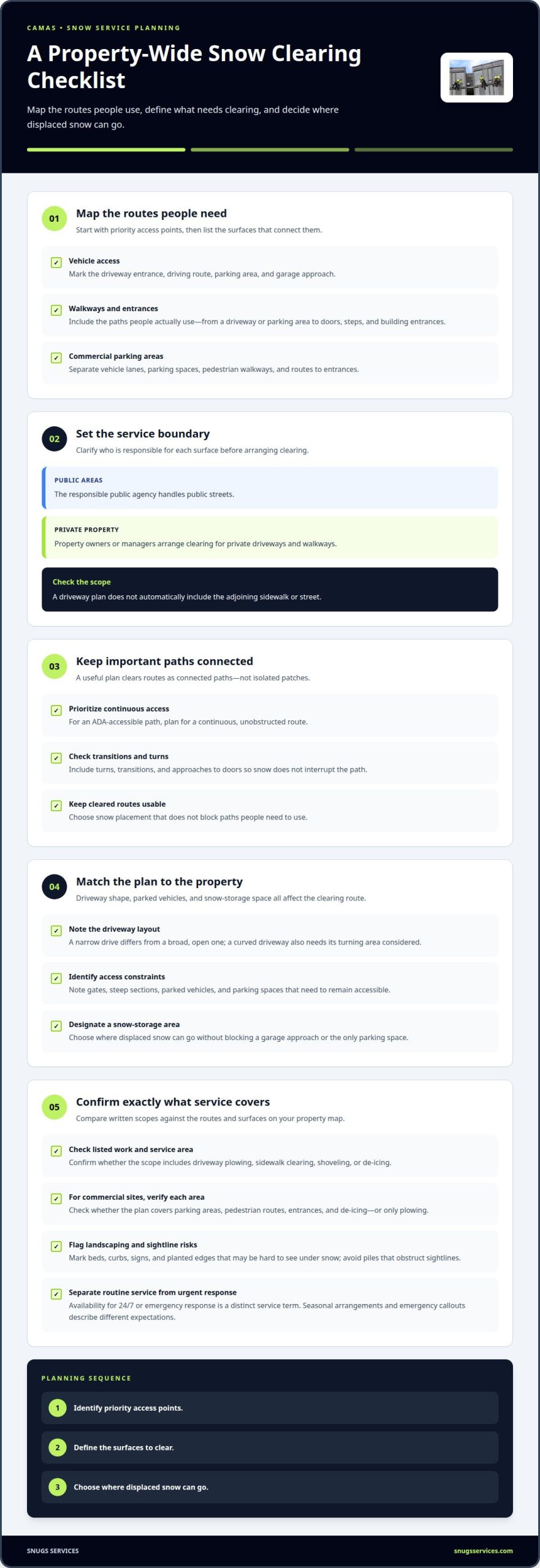
Driveway clearing maintains vehicle access, while sidewalk clearing keeps pedestrian routes open. A useful plan identifies the driveway entrance, parking area, sidewalk, and places where snow can be moved without blocking access.
For example, a narrow driveway beside a sidewalk needs a different clearing sequence from a broad, open drive. Marking the route and its edges helps define the work and reduces the chance of a snow pile blocking a usable path.
Sidewalk and Entrance Clearing
Clearing sidewalks and entrances connects public-facing paths to doors, steps, and other access points. Include the routes people actually use, such as the walk from a driveway to the front door or from a parking area to a building entrance.
For an ADA-accessible path, prioritize a continuous, unobstructed route rather than clearing isolated patches. Within the work area, check transitions, turns, and approaches to doors so snow does not interrupt the path.
Commercial sites also need parking lots included in the route map. A clearing plan should distinguish vehicle lanes, pedestrian walkways, and paths to entrances rather than treating the lot as one open surface. Keep snow piles away from routes people need to use.
A practical sequence is to identify priority access points, define the surfaces to clear, then choose where displaced snow can go. This coordinates driveway, sidewalk, parking lot, and entrance clearing across the property.
Residential and commercial snow service
Residential and commercial properties need different snow plans because traffic, access points, and parking layouts vary. In Camas, define the required work by property type and by the routes people use.
Homeowners should compare the listed work, service area, and approach to snow and ice. Look for a clear scope that specifies driveway plowing, sidewalk clearing, or de-icing, then consider whether it addresses the property’s access needs.
For Camas, the relevant companies are local providers that list snow removal for the property type and surfaces involved. Services available can include driveway plowing, shoveling, and de-icing; the exact work depends on the selected service scope.
Commercial Snow and Ice Removal
Commercial snow and ice management can include plowing parking areas, clearing pedestrian routes, and de-icing icy surfaces. A site plan should identify vehicle lanes, parking spaces, building entrances, and places where snow can be moved without blocking access.
Commercial landscaping also affects the plan: beds, curbs, signs, and planted edges can be hard to see under snow. Mark these features before winter to guide plowing and help protect landscaped areas.
Choosing a Snow Removal Company
Compare written service scopes, not just general descriptions. For example, confirm whether a commercial plan covers the parking lot, sidewalks, entrances, and de-icing, or only plowing. A clear scope makes it easier to see which access routes remain outside the plan.
Risks include snow piles that obstruct sightlines, plowing that damages landscaping, and untreated transitions that remain difficult to cross. A site-specific plan should identify sensitive edges and the paths that need attention.
Emergency Service Availability
Availability for 24/7 or emergency response is a distinct service term. Providers that explicitly list those options are the ones to compare for urgent needs; seasonal arrangements and emergency callouts describe different service expectations.
For a commercial property, list priority entrances and parking areas in the service plan, then specify how urgent requests are handled. For related parking lot services, align routine lot maintenance with the property’s snow and ice plan.
Residential driveway snow plowing
Residential driveway plowing clears a vehicle route from the street toward a garage, parking pad, or home entrance. Snugs Services provides snow plowing in Camas, with the work planned around the driveway shape, parked vehicles, and suitable places for displaced snow.
Before snowfall, identify the areas that need to stay accessible. A straight driveway may need a clear vehicle lane, while a curved drive also needs its turning area cleared. Note gates, steep sections, and parking spaces so the plowing route suits the property.
One-time storm plowing addresses a specific snowfall rather than a recurring seasonal arrangement. It can suit a household that needs its driveway cleared after a particular storm. Specify the property entrance, vehicle access point, and any areas that must remain open.
How quickly a snow removal service can reach Camas during a storm depends on road conditions, snowfall, route order, and property access. Snugs Services offers day, night, or weekend service, and last-minute calls can be accommodated. Arrival timing still depends on storm and route conditions.
Snow plowing moves accumulated snow from the driving surface to a designated area. Placement matters: a pile across the garage approach or beside the only parking space can undo the benefit of clearing. Identify a snow-storage area before plowing begins.
For a shared household, keep the plan practical: identify which vehicles need access, which entrance matters most, and where snow can be pushed. A narrow driveway with one parking pad, for example, needs a different route from a wide drive with space beside the garage.
After snowfall, the goal is a continuous, usable vehicle path, not just a cleared strip at the street. Clear boundaries and a designated snow-placement area help keep the driveway accessible while preserving room for parking and entry. Share these details with Snugs Services to clarify your plowing needs in Camas.
In Washington, seasonal snow removal contracts are usually arranged before the first storm. Planning ahead gives households time to identify the driveway route, priority access points, and snow-storage area.
Snow removal for homes, townhouses, and residential complexes
Homes, townhouses, and residential complexes need different winter plans because their entrances and shared routes vary. A detached home may prioritize its private driveway and front walk. A townhouse row may need a continuous path connecting several doors. A complex must coordinate resident access with parking and shared walkways.
For a single home, identify the route from the street to the main entrance. Include the driveway, front walk, steps, and any path to a secondary door. If the household uses a side entrance, include that route even when the front door is the primary entrance.
Townhouses bring shared edges into the plan. A clearing route can follow the row’s sidewalks while preserving access to each unit’s doorway and assigned parking area. Identify where a private driveway ends and shared pedestrian space begins to clarify which areas need coordinated attention.
Residential complexes benefit from a property-wide map. Mark entrances, internal walkways, parking areas, mail or delivery points, and accessible routes. Set priorities next: connect key entrances first, then identify where snow can go without narrowing paths or blocking parking. Managers can use the map to communicate one consistent plan to residents.
Tailor the plan to the layout. A compact townhouse development may need a continuous sidewalk route; a larger complex may need separate plans for buildings, lots, and shared paths. Clear service boundaries help prevent gaps between private and common areas and make it easier to adjust the plan when entrances or parking arrangements change.
Before winter weather, prepare a simple property list: private routes, shared routes, priority entrances, and snow-storage areas. For worn concrete on shared walkways, arrange concrete grinding as a separate surface-maintenance task.
Snugs Services: Graffiti Removal
Snugs Services supports property owners with exterior maintenance, including graffiti removal when unwanted markings affect a building’s appearance. For a home or shared property, arrange snow access planning separately from exterior cleaning and maintenance.
Pressure washing cleans exterior surfaces, while gutter cleaning, installation, and repair address gutter upkeep. These services complement property maintenance but are separate from snow clearing. For example, a building manager may arrange graffiti removal for a marked wall or gutter repair as a distinct maintenance project.
Contact Snugs Services to discuss exterior cleaning or gutter work for your property.
Plan ahead for a more accessible winter
Plan your service by identifying the property, the access routes you need, and the snow work that matters most. Snugs Services provides snow plowing and de-icing in Camas, helping keep residential and commercial properties prepared for winter conditions.
Snugs Services also handles exterior upkeep beyond snow plowing, including pressure washing, gutter cleaning, and gutter installation. Organizing these needs separately helps you care for your property throughout the year without confusing seasonal snow work with other exterior projects.
For snow removal and related property maintenance, contact Snugs Services to discuss your needs. Take the next step toward a cleaner, more accessible property and a winter plan that suits your space.
Frequently Asked Questions
How much does residential snow removal cost in Camas, WA?
The quote depends on the property and the work included. Factors include driveway size, access, snow placement needs, and whether the request covers additional areas. For a useful quote, describe the property and the specific snow-plowing work you need. This defines the service scope before you decide how to proceed.
Do Camas snow removal companies offer per-visit, seasonal, or on-call pricing?
Service arrangements can vary, so make sure the quote defines visits and seasonal coverage. A one-time request differs from planned winter service, while on-call work depends on how requests are arranged. Snugs Services provides snow plowing; describe your property and preferred arrangement when requesting a quote. Review the scope to ensure it covers the access areas you want cleared.
Recent Comments