
A raised slab edge can turn an ordinary route across a commercial property into a recurring trip concern. Commercial walkway grinding in Tualatin can smooth localized uneven concrete by removing high spots and easing abrupt transitions. At a driveway, the pedestrian access route must ramp down to street level to keep its cross slope below 2%, according to the U.S. Access Board. Grinding addresses surface height differences, but it doesn’t correct every slope or underlying pavement issue.
Uneven walkways can make it harder for people to move comfortably through an entrance, along a storefront, or between parking and a building. This guide explains how grinding can smooth raised concrete edges, how to assess a walkway, and when surface work may not be enough. It also covers how to plan maintenance around a busy commercial property in Tualatin.
Key Takeaways
- Learn when grinding can smooth a walkway and when broader pavement damage calls for a different repair approach.
- See which project details shape a per-square-foot estimate, including the affected area and condition of the concrete.
- Understand why trip-hazard pricing depends on each hazard’s size, location, and grinding needs.
- Find out how pressure washing can complement walkway maintenance by helping keep commercial exterior surfaces clean.
Commercial sidewalks and walkways
Grinding can smooth raised concrete edges along commercial walkways and sidewalk joints. It addresses surface differences, not every drainage, slope, or structural problem.
Per-Square-Foot Grinding Cost
A per-square-foot estimate accounts for the selected surface area, but area alone doesn’t define the work. The concrete’s condition, the height and spread of uneven sections, and access around storefronts or parking lots all shape the project scope. A broad, shallow transition differs from a small area with a sharply raised edge.
Pricing depends on the job and is provided after a quote request. For commercial walkway grinding in Tualatin, identify affected sections and note whether they connect to driveways, entrances, or residential areas. Weather and scheduling needs can also affect how work fits around daily property access.
Trip Hazard Grinding Price
A per-hazard estimate focuses on each uneven transition rather than treating the entire walkway as one uniform surface. The location, concrete condition, and grinding needed to create a smoother transition shape the scope. A raised joint beside a building entrance may require a different approach from an edge near a driveway.
Pricing depends on the job and is provided after a quote request; the number and nature of hazards help define the scope. Before requesting an estimate, mark visible raised edges across sidewalks, parking lots, and industrial paths. This list helps distinguish localized grinding from broader concrete repair.
Grinding Process and Project Timeline
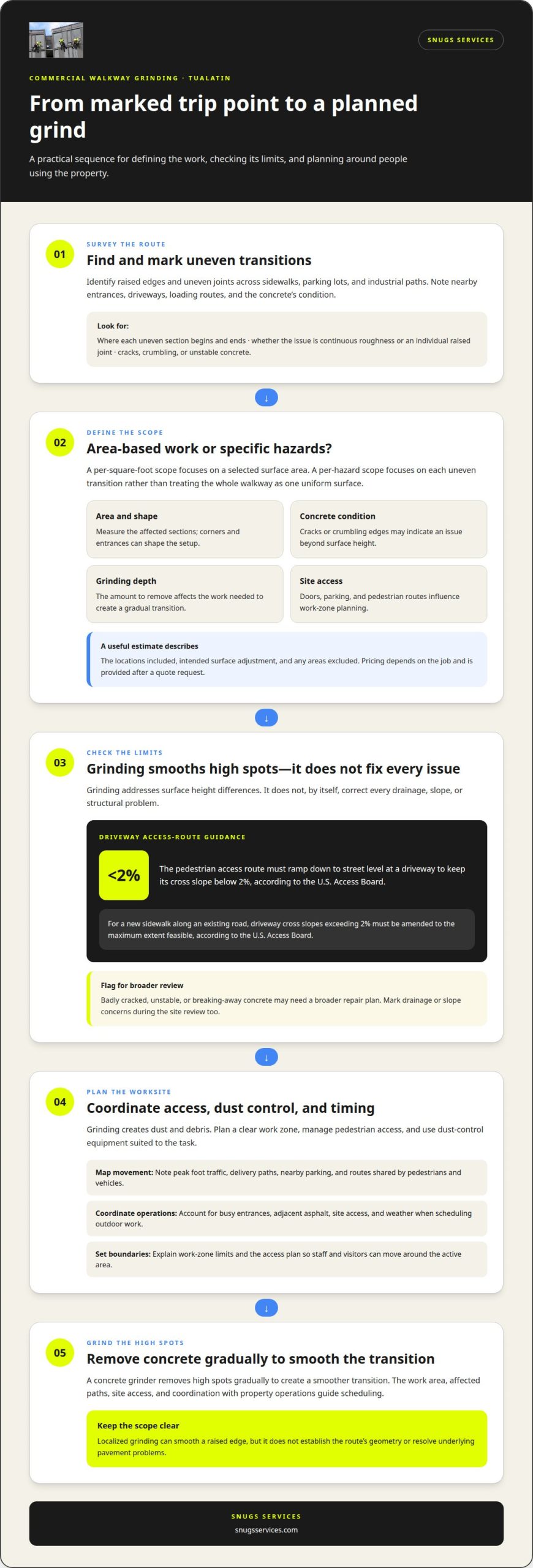
The process starts with identifying raised edges, nearby access routes, and the concrete’s condition. A concrete grinder removes high spots gradually to create a smoother transition. The work area and affected paths guide scheduling, especially where pedestrians and vehicles share routes.
For a new sidewalk along an existing road, driveways with cross slopes exceeding 2% must be amended to the maximum extent feasible, according to the U.S. Access Board. The pedestrian access route must ramp down to street level at a driveway to keep its cross slope below 2%, according to the U.S. Access Board.
Commercial walkway grinding in Tualatin can smooth a raised edge, but that alone doesn’t establish the route’s geometry. Timing depends on the grinding scope, site access, and coordination with property operations. A work plan can account for busy entrances and adjacent asphalt surfaces.
Dust Control and Worksite Safety
Concrete grinding creates dust and debris, so the work area needs careful planning. A contractor can define a clear work zone, manage pedestrian access, and use dust-control equipment suited to the task. These steps matter near entrances, driveways, and occupied commercial buildings.
Owners can identify peak foot traffic, delivery paths, and nearby parking lots before scheduling. Tualatin weather also matters when planning outdoor work and keeping routes orderly. An insured contractor should explain work boundaries and the access plan, helping staff and visitors move around the active area.
Concrete Walkway Grinding Cost/Sq Ft in Tualatin, Oregon
A per-square-foot figure can help organize a walkway project, but it doesn’t tell the whole scope. Grinding a broad, slightly uneven stretch differs from correcting a few deep, localized high spots. In Tualatin, a useful estimate starts with the concrete area that needs work and its condition.
Before requesting an estimate, map the affected sections rather than automatically measuring the entire sidewalk. Note where uneven concrete begins and ends, then distinguish continuous roughness from individual raised joints. For example, a storefront route may have one uneven panel near the entrance and a longer, smoother section beyond it. This helps define the work area.
- Area and shape: A narrow route with corners or entrances may take different setup than a straight walkway.
- Concrete condition: Crumbling edges or cracks can indicate issues beyond a high spot’s surface height.
- Grinding depth: The amount of concrete to remove affects the work required to create a gradual transition.
- Site access: Nearby doors, parking, and pedestrian routes can shape work-zone planning.
Pricing depends on the job and is provided after a quote request. Key scope factors include measured area, concrete condition, grinding depth, and site access. A clear estimate should describe the locations included, the intended surface adjustment, and any areas excluded, making it easier to compare the proposed scope with your walkway map.
Square footage is less informative when the project involves isolated trip points. A small patch may need careful edge shaping, while a longer section may need a consistent transition across several panels. Ask the estimate to identify whether it covers a defined area or specific uneven locations. These describe different scopes, even when both involve concrete grinding.
Grinding has limits. If concrete is badly cracked, unstable, or breaking away, removing more surface may not address the underlying problem. Mark those conditions during the site review, along with drainage or slope concerns. A precise scope helps determine whether grinding suits the walkway or whether the affected area needs a broader repair plan. For property owners evaluating broader structural issues, seeing how exterior restoration specialists like royaltyconstructionco.com approach comprehensive property improvements can provide a useful reference for when surface work is insufficient.
Commercial sidewalk trip hazard grinding price per hazard
A per-hazard estimate focuses on each raised edge or uneven joint, not the full sidewalk’s square footage. This helps identify which locations need attention and compare the proposed work with the marked hazards. In Tualatin, the estimate should describe the specific transitions included, such as a lifted joint beside an entrance or an uneven slab near a loading route.
There isn’t one universal charge for every hazard. Pricing depends on the job and is provided after a quote request; key factors include the hazard’s shape, concrete condition, grinding needed, and access to the work area. A clean, stable edge may call for a different scope than a cracked or crumbling slab. The written estimate should make these distinctions clear.
Before requesting an estimate, create a simple site map. Mark each location and add a short note describing what you see. This gives the assessment a practical starting point and helps distinguish one continuous problem from several separate work areas.
- Mark the transition: Note whether the raised edge sits at a slab joint, doorway, curb, or driveway approach.
- Describe the surface: Record visible cracks, loose concrete, or edges that continue breaking away.
- Show access conditions: Identify nearby doors, delivery paths, and pedestrian routes that affect work-zone planning.
- Clarify the scope: Ask the estimate to identify each included hazard and the planned grinding area.
Counting hazards alone doesn’t describe the full task. For example, two raised joints may look similar from a distance but differ in width, surrounding surface, or proximity to a busy doorway. The assessment should connect each marked location to the proposed work, rather than relying only on a hazard count.
Grinding suits raised concrete edges that can be smoothed by removing material. It won’t restore a slab that’s unstable or badly deteriorated, and it shouldn’t be treated as a fix for every drainage or slope concern. Clear descriptions help distinguish localized surface correction from issues that need a different repair scope.
For a commercial property, keep the estimate with the site map and note any access constraints for scheduling. To discuss the marked walkway and request an estimate, request a walkway grinding quote.
Broader paving figures can provide context, but they are not per-hazard grinding rates. In the page’s 2026 baseline, Tualatin retail strip-center repaving is priced at 3 to 7 per square foot. Tualatin mid-size commercial lots are priced at 3 to 6 per square foot, while Tualatin large industrial warehouse pads are priced at 2.50 to 6 per square foot. These figures describe repaving by area, rather than the cost of correcting an individual raised edge. Use them only as a distinction between larger paving work and localized grinding; the marked hazards, their condition, and access still need to be assessed for the requested estimate.
Snugs Services: Pressure Washing
Snugs Services can help when a commercial walkway needs cleaning alongside its concrete maintenance. Pressure washing removes surface grime from exterior areas, while grinding addresses raised concrete edges. Consider pressure washing when dirt and buildup make an entrance or adjoining pavement look neglected, and plan grinding separately for uneven transitions. Treating these as distinct needs helps you choose the right work for each surface without mistaking a clean walkway for a level one.
If your property also needs gutter cleaning, installation, or repair, Snugs Services provides those services as part of broader exterior upkeep. For pressure washing or other exterior maintenance, contact Snugs Services through snugsservices.com.
Make Safer Walkways Part of Your Next Maintenance Plan
A practical first step is to note the walkway areas that need attention and consider them alongside your property’s broader maintenance needs. For commercial walkway grinding in Tualatin, a clear picture of the site helps focus the conversation on surfaces affecting daily access and the work that fits your plans.
Think beyond a single repair visit. Keeping exterior upkeep on your maintenance calendar can help you spot changing surface conditions and organize work around how people use your property. If cleaning is also on your list, Snugs Services offers pressure washing, gutter cleaning, and gutter installation as part of its exterior maintenance services.
Ready to discuss your walkway needs? Contact Snugs Services about walkway grinding and take a clear next step toward a well-maintained commercial property.
Recent Comments