
A parking lot can look clear after a mild winter night and still have slick patches where customers, tenants, or staff need to walk and drive. In Wilsonville, changing winter conditions can make ice management as important as snow removal. A plan based only on snowfall may overlook entrances, crossings, or other frequently used areas. Parking lot salting services Wilsonville businesses rely on should be planned around the property’s layout and daily use.
Property managers often need to decide when de-icing is appropriate, which areas to prioritize, and how treatment fits with plowing. A practical plan starts with those site-specific decisions, then adapts to changing pavement and weather conditions. Snugs Services provides commercial de-icing and snow plowing in Wilsonville, backed by regional experience since 1995.
This guide explains how to plan winter access around your operating needs, how de-icing and snow removal address different conditions, and what to include when arranging seasonal maintenance. The aim is a clear, property-specific plan that keeps access priorities in view.
Key Takeaways
- Build a winter access plan around how changing conditions affect your Wilsonville property, not snowfall alone.
- Understand how salting, broader de-icing, and snow plowing serve different purposes in maintaining access.
- Map entrances, pedestrian routes, loading zones, parking areas, and drainage features before winter weather arrives.
- Plan parking lot salting services Wilsonville businesses need as part of coordinated maintenance tailored to site priorities and operating needs.
- Snugs Services provides commercial de-icing and snow plowing for Wilsonville properties and has served the region since 1995.
Why Wilsonville Parking Lots Need a Planned Winter Salting Strategy
Wet winter weather can leave pavement damp before temperatures shift and create icy conditions. That change can affect access even when snow is not the main concern. A plan helps property managers look beyond open parking stalls and identify the routes people and vehicles rely on.
Commercial lot salting is the targeted application of salt as a de-icing treatment on selected paved areas when site and weather conditions make it appropriate. It can form part of a wider winter plan alongside snow clearing and attention to priority access points. Results depend on weather, pavement, and application, so salting should not be treated as a promise that a lot will remain ice-free. For a basic explanation of how road salt works, see the overview of its effect on water’s freezing point.
What does commercial parking lot salting do?
When conditions suit the treatment, de-icing can help address ice on selected parts of a commercial property. Priorities might include a sloped entrance, a pedestrian route between parking and a building, or a frequently used loading area. A site plan helps distinguish these areas from lower-priority zones instead of treating every part of the lot as if it has the same function.
Routine surface maintenance and winter treatment have different purposes. Parking lot sweeping removes everyday debris and supports a cleaner surface, but it does not replace a weather-responsive response to icy conditions. A winter plan considers current conditions and site access needs, then coordinates de-icing with snow removal when both are appropriate.
Which Wilsonville properties may need a winter plan?
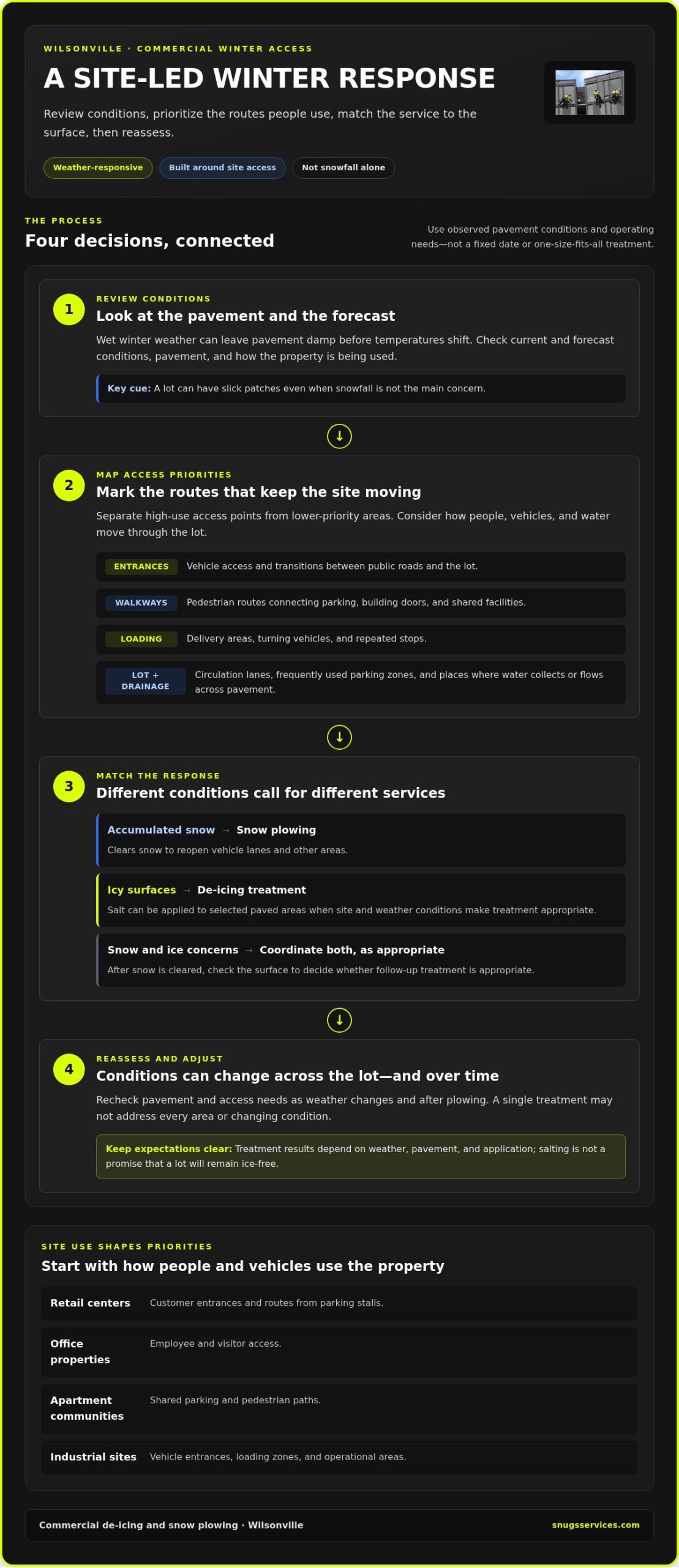
Retail centers need to consider customer entrances and routes from parking stalls. Office properties may prioritize employee and visitor access, while apartment communities need to account for shared parking and pedestrian paths. Industrial sites may have distinct priorities around vehicle entrances, loading zones, and operational areas.
Properties differ in how people and vehicles move through them, so one treatment approach may not suit every site or every area within a site. A useful plan separates priorities:
- Entrances: Consider vehicle access and transitions between public roads and the lot.
- Pedestrian routes: Identify walkways connecting parking, building doors, and shared facilities.
- Loading areas: Note where deliveries, turning vehicles, or repeated stops shape access needs.
- Parking zones: Account for circulation lanes and the spaces visitors or staff use most.
For property teams evaluating parking lot salting services Wilsonville, begin by considering how weather, pavement, and daily operations intersect. That context makes it easier to coordinate winter de-icing and snow plowing around the way a property functions.
How Parking Lot Salting and De-Icing Work in Wilsonville
A practical winter response follows a clear sequence: review current and forecast conditions, identify areas that matter most for access, choose an appropriate response, and reassess as conditions change. This keeps decisions tied to the property instead of relying on a fixed calendar or a one-size-fits-all application.
For a Wilsonville commercial lot, consider vehicle lanes, pedestrian routes, entrances, and drainage areas. A main drive lane may need attention for vehicle movement, while a building entrance or crossing may call for a different priority. Drainage patterns matter because water that collects or flows across pavement can affect where icy conditions develop.
A single treatment may not address every changing condition, because weather, pavement, and site use can vary across the lot and over time. Build reassessment into the plan rather than assuming one pass will cover every need.
When should a Wilsonville lot be treated?
Timing depends on observed and forecast conditions, not a universal winter date or schedule. Before conditions change, use a site plan to mark priority areas such as entrances, crossings, and heavily used routes. Then base the response on what is happening on the pavement and the access the property needs, rather than treating every area identically.
Why salting may need to work alongside snow removal
Snow plowing and de-icing address related but different conditions. Plowing clears accumulated snow to reopen vehicle lanes and other areas. De-icing addresses icy surfaces when conditions make treatment appropriate. A lot may need one service, the other, or both as weather and pavement conditions change. Once snow is cleared, reassess the surface to determine whether follow-up treatment is appropriate.
Coordination also helps account for the paths that connect different parts of a lot. Clearing a drive aisle without considering a nearby pedestrian crossing may leave part of an important access route untreated. Focusing on entrances alone may not address the lanes vehicles need to reach them. Parking lot salting services Wilsonville property teams arrange should fit into a broader plan for how people and vehicles move through the site.
Snugs Services provides commercial de-icing and snow plowing in Wilsonville, helping property teams coordinate winter maintenance around access needs. Explore commercial de-icing and snow plowing as part of a practical plan for your property.
Salting, De-Icing, or Snow Plowing: What Does Your Wilsonville Lot Need?
These services address different winter conditions. Salting is one possible de-icing treatment, broader de-icing refers to measures used to manage icy surfaces, and snow plowing clears accumulated snow that blocks access. The right combination depends on pavement conditions and how customers, tenants, staff, and delivery vehicles use the property.
| Service | Purpose | When it may fit | Role in maintaining access |
|---|---|---|---|
| Salting | Apply salt as a de-icing treatment to address ice when conditions make it appropriate. | Icy pavement is the concern, and site and weather conditions suit the treatment. | Supports access on selected areas; it doesn’t clear accumulated snow. |
| Broader de-icing | Manage icy surfaces with an appropriate de-icing response. | Ice is present or a concern on priority parts of the property. | Complements a winter plan focused on usable vehicle and pedestrian routes. |
| Snow plowing | Clear accumulated snow from areas where it obstructs movement. | Snow is affecting parking, circulation, entrances, or operations. | Reopens space for vehicles and people; follow-up de-icing may still be relevant if ice remains a concern. |
When is salting the relevant service?
Salting may be relevant when icy conditions are the primary concern and treatment suits the site. Material choice and application should account for applicable site and weather requirements. There is no universal threshold or fixed application that suits every lot, and treatment is not a guarantee against ice. Identify the routes that matter most and consider their conditions when setting priorities.
When should plowing or another de-icing response be considered?
Plowing addresses accumulated snow that obstructs access. If snow affects customer parking or a delivery lane, clearing may be needed to restore movement. If icy surfaces remain a concern, de-icing can complement that work. The sequence and coverage should reflect how the property operates, not just how much snow has fallen.
For a retail center, customer entrances and walking routes may be central priorities. An office or apartment property may also need to consider tenant movement, while an industrial site may place greater emphasis on loading zones and vehicle circulation. A treatment suited to one area may not address conditions across the entire lot. Assess the site and use surface conditions to guide follow-up decisions.
Property managers comparing parking lot salting services Wilsonville should consider the condition to address, the routes that need to stay accessible, and whether snow clearing, de-icing, or both fit the situation. Snugs Services provides commercial de-icing and snow plowing to support a coordinated winter maintenance plan.
How to Plan Parking Lot Salting Services for a Wilsonville Property
A useful winter plan starts with the site itself. Clear notes about traffic flow, access priorities, and operating constraints help shape a practical maintenance scope instead of assuming every commercial lot needs the same response.
- Map the lot layout. Mark entrances, exits, parking areas, drive lanes, pedestrian routes, and connections between the lot and building doors.
- Identify priority access points. Note crossings, slopes, loading zones, and areas that customers, tenants, staff, or delivery vehicles rely on.
- Record drainage features. Locate catch basins and areas where water collects or flows across pavement. Include these in treatment planning and review applicable local requirements before deciding how to manage the site.
- Document operating constraints. Record business hours, delivery schedules, tenant needs, and any areas that require continued access. This helps coordinate winter work with property use.
- Set communication steps. Decide how staff and tenants will receive winter-maintenance updates and how access priorities or changing site needs will be shared.
What information helps scope a commercial lot?
Make site notes specific. A retail property may need to prioritize customer entrances, while an industrial site may depend more on loading access and vehicle circulation. Apartment and office properties may have several shared pedestrian paths to account for. Record which areas are essential for deliveries, tenants, or customers, and distinguish them from lower-priority parking zones. This gives the maintenance plan a clear operational purpose.
How can managers prepare before winter weather?
Set communication roles before conditions change. Staff should know where to direct access concerns, and tenants or business users should understand how winter work may affect their usual routes. Include drainage areas in the site review and check the local requirements that apply to your property rather than assuming one approach fits every location.
Winter planning also fits into year-round surface care. Parking lot sweeping can help manage routine debris between seasons; Snugs Services’ professional parking lot sweeping guide offers additional context for maintaining commercial surfaces. Keep routine sweeping distinct from weather-responsive de-icing and snow plowing, which address winter conditions.
For a property-specific winter maintenance plan, plan commercial winter maintenance with Snugs Services. Parking lot salting services Wilsonville property managers arrange can be coordinated around site access, operating needs, and the areas that matter most.
Choose Snugs Services for Wilsonville Parking Lot Salting and Winter Maintenance
Winter access needs differ from one commercial property to the next. A retail center, office complex, apartment community, and industrial site each have their own traffic patterns and operating priorities. Snugs Services provides commercial de-icing and snow plowing in Wilsonville, helping property managers plan winter maintenance around how their sites are used.
Snugs Services has served the region since 1995, providing commercial and residential exterior maintenance. The company serves communities including Portland, Gresham, Salem, Eugene, Vancouver, WA, Beaverton, Tualatin, Tigard, Hillsboro, Longview, Richfield, Battle Ground, Camas, Wilsonville, and Keizer. For a commercial lot, planning can account for the layout, entrances, pedestrian access, loading areas, and routes most important to customers, tenants, staff, and deliveries.
What makes a winter service plan property-specific?
A useful plan starts with the property’s operating priorities. De-icing addresses icy surfaces when treatment is appropriate, while snow plowing clears accumulated snow that interferes with movement. Depending on conditions, a site may need one service or a coordinated combination. The scope should reflect which areas are important to keep usable and how the property functions during winter weather, without assuming a fixed treatment or outcome.
For example, a business with frequent deliveries may prioritize truck access and loading areas, while a multi-tenant property may focus on shared entrances and routes between parking and building doors. Identifying those differences gives the winter plan a clear purpose. Parking lot salting services Wilsonville managers arrange should fit the actual site, not a generic template.
How do you get started with Snugs Services?
Share practical details about your property type and Wilsonville location, main entrances, pedestrian routes, parking and loading areas, and operating priorities that affect access. Note business or tenant schedules and where deliveries or customer traffic are concentrated. These details help shape a project-specific scope for commercial winter maintenance.
Planning ahead gives your team a clearer framework for coordinating de-icing and snow plowing with property use. It also makes winter priorities easier to communicate to tenants, staff, and other site users.
Plan Wilsonville winter maintenance with Snugs Services and coordinate commercial de-icing and snow plowing around your property’s access needs.
Plan Ahead for Safer Winter Access
A practical winter plan starts with your property’s access needs. Map entrances, pedestrian routes, loading areas, and drainage features, then use current surface and weather conditions to guide whether de-icing, snow plowing, or both are appropriate. Salting can support an overall response, but it does not replace clearing accumulated snow or reassessing changing conditions.
With parking lot salting services Wilsonville property managers can plan around their specific site, winter maintenance is easier to coordinate with tenants, staff, customers, and deliveries. Snugs Services provides commercial de-icing and snow plowing in Wilsonville and has served the region since 1995.
Prepare your site priorities and operating needs, then plan commercial winter maintenance with Snugs Services. A clear plan helps your team approach the season with greater confidence and keep essential access needs in focus.
Frequently Asked Questions
When should a commercial parking lot in Wilsonville be salted?
Salt a commercial lot when icy conditions are present or anticipated and treatment is appropriate for the site. Wet pavement and changing temperatures can make conditions shift, so use observed surface conditions and the forecast rather than a fixed calendar date. Prioritize areas such as entrances, pedestrian crossings, and frequently used routes, then reassess as conditions change.
Is salting enough to keep a commercial parking lot safe in winter?
No. Salting is one part of a winter access plan, not a guarantee that a lot will remain ice-free. It does not clear accumulated snow, and results depend on weather, pavement, and application. Consider the full site, including vehicle lanes, walkways, entrances, and loading areas, and combine de-icing with snow clearing when conditions and access needs call for it.
Can parking lot salting be combined with snow plowing?
Yes. Snow plowing and de-icing can work together because they address different conditions. Plowing removes accumulated snow that interferes with parking or vehicle movement; de-icing may help address icy surfaces when appropriate. For example, clearing a drive lane may restore vehicle access, while remaining ice near an entrance may need separate attention. Surface conditions should guide follow-up decisions.
How often should a commercial parking lot be salted?
There is no one salting frequency that fits every Wilsonville property. The need depends on changing weather, pavement conditions, the areas being treated, and how the site is used. Identify high-priority access routes and reassess after conditions change or snow is cleared. Avoid relying on an automatic schedule alone; treatment should respond to the lot’s condition and operating needs.
What should a property manager include in a parking lot de-icing plan?
Document the lot layout, entrances, vehicle lanes, pedestrian routes, parking zones, loading areas, and drainage features. Note which areas are essential for customers, tenants, staff, and deliveries, along with business hours and communication steps for site users. These details help shape a property-specific plan and coordinate de-icing with snow plowing when needed. Review applicable local requirements as part of planning.
Can salt affect concrete, landscaping, or storm drains?
Salt can affect nearby materials and vegetation, and runoff can carry de-icing materials toward drainage areas. Treatment planning should account for pavement, landscaping, and the location of drains rather than applying the same approach across every surface. Follow the selected treatment’s instructions and review applicable local requirements. A site-specific plan helps keep these considerations in view.
Does Snugs Services provide parking lot salting in Wilsonville?
Snugs Services provides commercial de-icing and snow plowing in Wilsonville, supporting winter access planning for local properties. The company has served the region since 1995 and serves communities across the Portland and Vancouver metro areas, including Wilsonville. Share your site location, access points, property use, and operating priorities to help shape a project-specific winter-maintenance scope for your commercial lot.
Recent Comments