
That green carpet creeping across your driveway isn’t just an eyesore — it’s a slip-and-fall waiting to happen. If you’ve been searching for how to rid moss from concrete without scorching your flower beds or cracking your patio, you already know the frustration: most advice online is either too aggressive or too vague for the Pacific Northwest’s relentless wet season.
You’re right to be cautious. The PNW’s damp, shaded climate creates near-perfect conditions for moss to take hold fast and dig in deep. A heavy-handed approach can etch the surface or send harsh chemicals straight into your landscaping. A timid one leaves the roots behind, and the moss is back before summer ends.
This guide cuts through the noise. You’ll find the most effective DIY removal methods, learn which treatments are safe for surrounding plants, and discover when it makes sense to call in a professional. Whether you’re tackling a mossy front walkway yourself or weighing your options for a larger driveway, what follows gives you a clear, honest path from green and slippery to clean and safe.
Key Takeaways
- Knowing how to rid moss from concrete the right way means addressing both the visible growth and the underlying conditions — moisture, shade, and porous surfaces — that invite it back season after season.
- Not all removal methods are equal: some common DIY solutions can damage your concrete or harm surrounding PNW landscaping if applied incorrectly.
- Pressure washing removes moss fast, but technique matters — the wrong PSI or angle can do more harm than the moss itself.
- Sealing your concrete after a deep clean is one of the most effective long-term defenses against moss regrowth in the Pacific Northwest’s wet climate.
- For large driveways, steep walkways, or commercial surfaces, professional moss treatment from a local expert can save time, protect your property, and deliver results that last.
Why Moss Loves Your Concrete (and Why It Is Dangerous)
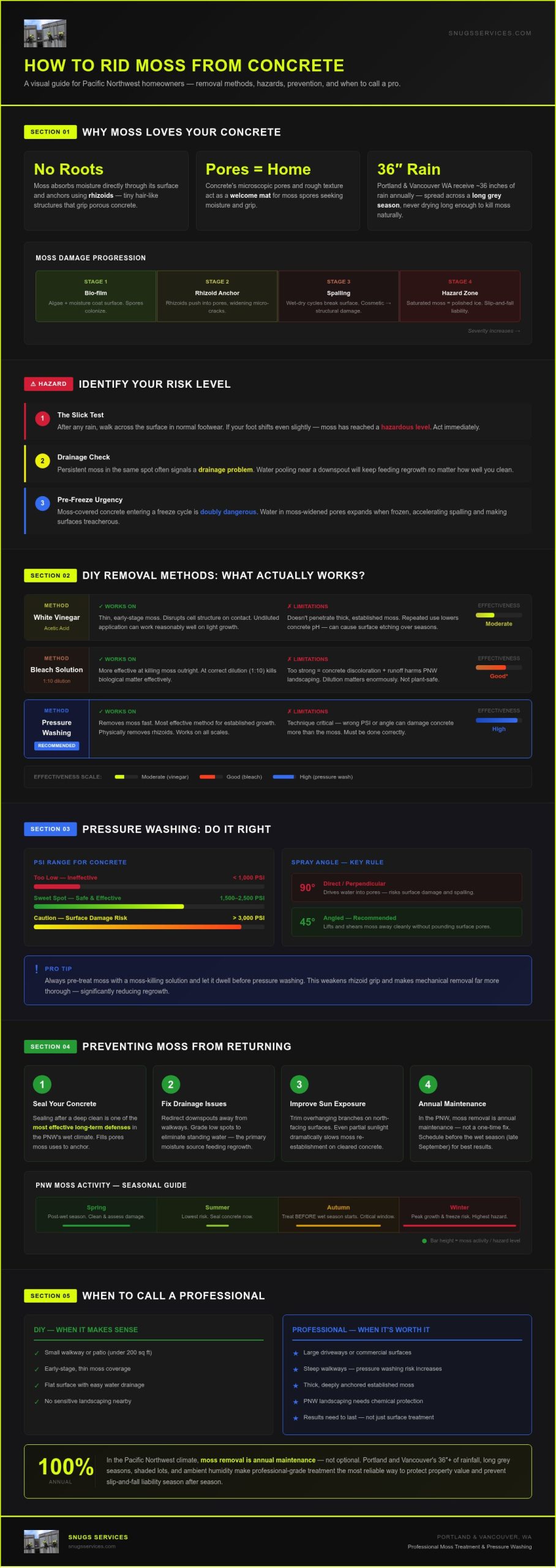
Moss isn’t a weed. It’s a non-vascular plant, meaning it has no root system in the traditional sense. Instead of drawing water through deep roots, it absorbs moisture directly through its surface and anchors itself to porous materials using tiny hair-like structures called rhizoids. Concrete, with its microscopic pores and rough texture, is essentially a welcome mat. Once a thin bio-film of algae and moisture establishes itself on the surface, moss spores have everything they need to colonize fast.
The damage mechanism is slow but serious. As rhizoids push into the concrete’s pores and expand with each wet-dry cycle, they widen existing micro-cracks. Over time, this leads to surface spalling: small chunks and flakes breaking away from the slab. What starts as a cosmetic issue becomes a structural one, quietly shortening the lifespan of your walkway or driveway.
Then there’s the immediate hazard. Wet moss doesn’t just reduce traction — it eliminates it. A thin layer of saturated moss can make a concrete surface behave like polished ice. That’s a genuine liability risk for any property owner, not just a nuisance to manage when you get around to it.
The PNW Moss Factor: Portland and Vancouver Challenges
Portland averages around 36 inches of rain annually, and Vancouver, Washington sits in nearly identical conditions. More importantly, that rainfall is distributed across a long, grey season rather than concentrated in short bursts. Concrete surfaces in these neighborhoods rarely get the sustained dry periods needed to kill off moss naturally. Add mature shade trees, north-facing exposures, and poor drainage from older lot grading, and you’ve created conditions where knowing how to rid moss from concrete isn’t optional — it’s annual maintenance.
Local humidity compounds the problem. Even on dry days in fall and winter, ambient moisture keeps concrete surfaces damp enough to sustain moss growth. Shaded driveways in Portland’s Eastside neighborhoods or Vancouver’s older residential streets can stay chronically wet for weeks at a stretch.
Safety First: Identifying the Hazard Level
Before you plan your removal approach, assess the actual risk on your property:
- The Slick Test: After any rain, walk across the affected surface in normal footwear. If you feel your foot shift even slightly, the moss has reached a hazardous level.
- Drainage check: Persistent moss in the same spot often signals a drainage problem. Water pooling near a downspout or low point will keep feeding regrowth no matter how well you clean.
- Pre-freeze urgency: Moss-covered concrete entering a freeze cycle is doubly dangerous. Water trapped in moss-widened pores expands when it freezes, accelerating spalling and making the surface treacherous underfoot.
Addressing moss before the first hard freeze isn’t just about appearance. It’s about protecting both the people who use your property and the concrete itself. Understanding how to rid moss from concrete starts with recognizing that the problem is active, not cosmetic.
Evaluating DIY Moss Removal Methods: What Actually Works?
Walk into any hardware store and you’ll find a shelf full of options promising to solve your moss problem. The honest answer is that some work well, some work partially, and a few can quietly cause more damage than the moss itself. Knowing how to rid moss from concrete effectively means matching the right method to the scale of the problem — and understanding what each approach actually does at the surface level.
The Vinegar vs. Bleach Debate
White vinegar is the most common DIY recommendation online, and it’s not entirely wrong. Acetic acid does disrupt moss cell structure on contact. The problem is penetration. On thin, early-stage growth, undiluted white vinegar can work reasonably well. On thick, established moss with rhizoids anchored into the concrete’s pores, it barely reaches the base. You’ll see surface browning and assume success, then watch the same patch regrow within weeks because the anchoring structure was never addressed.
There’s a second issue: concrete is alkaline by nature. Repeated acid applications from vinegar gradually lower the surface pH, which can cause subtle surface etching over time. It won’t crack your driveway after one treatment, but it’s not a method you want to use every season without consequence.
Bleach is more effective at killing moss outright, but the dilution matters enormously. A solution stronger than roughly one part bleach to ten parts water risks two problems: discoloration of the concrete surface and runoff that damages the surrounding landscaping. In the PNW, where garden beds often sit directly adjacent to walkways and driveways, that runoff risk is real. If you do use bleach, wet your adjacent plant beds thoroughly with plain water first to dilute any overspray, apply on a calm day with no rain forecast, and rinse the treated area completely before any runoff reaches soil.
The Scrub-and-Soap Method
For small patches caught early, a stiff-bristled brush, warm water, and a few drops of dish soap can physically dislodge moss before it fully anchors. This isn’t a chemical fix; it’s a mechanical one. It works best on smooth concrete where rhizoids haven’t pushed deep into the surface texture. On rougher or older concrete, manual scrubbing alone tends to leave enough residual growth to regrow quickly.
Eco-Friendly Alternatives: Baking Soda and Boiling Water
Baking soda (sodium bicarbonate) raises the surface pH temporarily, creating an inhospitable environment for moss. It’s genuinely safe for surrounding plants and won’t etch concrete the way vinegar can. The trade-off is speed: it works more slowly than chemical treatments and needs reapplication on established growth.
Boiling water kills moss on contact through thermal shock. It’s chemical-free and effective on small, isolated spots. The practical limitation is obvious: carrying boiling water across a large driveway isn’t realistic, and it does nothing to prevent regrowth.
Commercial Moss Killers for Homeowners
When DIY basics aren’t enough, homeowner-grade moss killers step up. Two active ingredients dominate the market:
- Zinc sulfate: Effective and long-lasting, but it carries a higher risk of soil toxicity if it washes into planted areas. Use it on surfaces well away from garden beds, and always follow label dilution rates.
- Potassium salts of fatty acids: A softer option derived from plant-based fatty acids. It breaks down more readily in soil and is generally considered safer for landscaping-adjacent applications, making it a reasonable choice for typical PNW residential properties.
Timing your application matters more than most product labels emphasize. Applying moss killer immediately before a rainstorm is one of the most common homeowner mistakes. Rain dilutes the active ingredient before it can penetrate and washes concentrated solution directly into your soil and storm drains. Apply during a dry window of at least 24 to 48 hours, ideally when temperatures are above 50°F for better absorption.
After treatment, you’re looking for browning as the indicator that the moss is dying. Brown doesn’t mean done: dead moss still needs to be physically removed. Leaving it in place keeps the surface slippery and allows the decaying material to trap new moisture, setting the stage for the next growth cycle. Scrub or rinse it away once it’s fully brown and dry.
If you’ve worked through multiple methods and the moss keeps returning to the same spots, that’s usually a signal that the underlying conditions, drainage, porosity, or shade, haven’t been addressed. A professional moss treatment can assess and treat the full picture, not just the visible surface.
Pressure Washing Concrete: The Right Way to Remove Moss
A pressure washer is the most powerful tool in your moss removal arsenal, but it’s also the easiest to misuse. Done right, it strips years of biological buildup in a fraction of the time any chemical treatment requires. Done wrong, it etches your concrete surface, blows out the sand between pavers, and leaves you with a driveway that’s structurally weaker than when you started. Knowing how to rid moss from concrete with a pressure washer means understanding the method, not just pointing and pulling the trigger.
The first distinction worth making is between standard pressure washing and soft washing. Pressure washing relies on high-velocity water to physically dislodge contaminants. Soft washing uses lower pressure combined with a cleaning solution to break down organic growth at the cellular level before rinsing. For heavy moss on residential concrete, a combination approach works best: pre-treat with a bio-inhibitor to kill the moss and loosen its rhizoid grip, then follow with controlled pressure washing to clear the debris cleanly.
Step-by-Step: Pressure Washing for Moss Removal
- Step 1: Clear and pre-treat. Remove any furniture, vehicles, or potted plants from the area. Apply a bio-inhibitor or moss-killing solution and allow it to dwell for the time specified on the product label, typically 15 to 30 minutes. This step does the chemical work so the pressure washer doesn’t have to compensate with brute force.
- Step 2: Select the right nozzle. Use a 25-degree (green) or 40-degree (white) nozzle for concrete surfaces. Never use the red-tip 0-degree nozzle on concrete. That narrow, concentrated stream delivers impact force intense enough to score the surface permanently, leaving visible lines and weakening the top layer.
- Step 3: Maintain consistent distance. Hold the wand 10 to 12 inches from the surface and keep it moving in smooth, overlapping passes. Stopping or slowing in one spot creates uneven cleaning patterns called “tiger striping,” where alternating light and dark bands become permanently visible on the concrete.
- Step 4: Rinse and manage debris. After washing, rinse the entire surface with clean water and direct the runoff away from garden beds and storm drains where possible. Dead moss and debris should be swept or bagged rather than left to decompose on the surface.
Technical Specs: Protecting Your Concrete Surface
For residential concrete driveways and walkways, 2,500 to 3,000 PSI is the practical sweet spot. Below 2,000 PSI, you’re often moving moss around rather than removing it. Above 3,500 PSI on standard residential slabs, you risk surface erosion, especially on older or already-weathered concrete.
If you have access to one, a surface cleaner attachment is a significant upgrade over a standard wand. It houses two rotating nozzles inside a circular shroud, distributing pressure evenly across a wide path. The result is consistent cleaning without the tiger-striping risk that comes from wand work. It’s faster, more uniform, and far less likely to cause the kind of concentrated surface damage that’s irreversible. For more on professional-grade techniques and equipment, see expert pressure washing in Portland.
Common Pressure Washing Mistakes to Avoid
Wand-washing too close to the surface is the most common error. At six inches or less, even a 25-degree nozzle concentrates enough force to etch concrete or strip the surface aggregate. On decorative exposed-aggregate concrete or older pavers, the consequences are immediate and visible: sand flushed from joints, stones dislodged, and a surface that now traps moisture more readily than before.
Don’t skip your PPE. Pressure washing kicks up debris, biological material, and chemical residue at speed. Safety glasses and closed-toe shoes aren’t optional precautions. Wet concrete and high-pressure spray are a combination that sends people to urgent care more often than most homeowners expect.
How to Prevent Moss from Returning to Your Walkways
Cleaning moss off your concrete is satisfying. Watching it come back six months later is not. The hard truth is that removal without prevention is just a treadmill. Knowing how to rid moss from concrete permanently means addressing the three conditions that make your walkway hospitable in the first place: moisture, shade, and surface porosity. Fix those, and you’re not just cleaning; you’re changing the equation.
Environmental Adjustments
Start by looking up. Overhanging branches are one of the most overlooked contributors to chronic moss problems on PNW driveways and walkways. They block UV exposure, drop debris that traps moisture, and create the perpetual shade that moss thrives in. Trimming limbs back to open the canopy above your concrete, even partially, gives sunlight a chance to dry the surface between rain events. That drying window is often all it takes to break the moss cycle.
Leaf management in fall matters more than most homeowners realize. Decomposing leaves hold moisture against the concrete surface for weeks and deposit organic material that acts as a seedbed for moss spores. A simple fall sweep schedule, clearing leaves before they mat down and before the first hard rains, removes that biological fuel before it can take hold.
Grading is worth examining if moss returns to the same spots repeatedly. Low points in your yard or driveway that direct runoff across concrete keep those surfaces wet long after rain stops. Improving soil grading to redirect water away from walkways doesn’t require major landscaping; sometimes redirecting a downspout or adding a simple French drain is enough to change the drainage pattern entirely.
The Benefits of Concrete Sealing
A deep clean without sealing is a half-finished job. Moss anchors itself through the microscopic pores in concrete; seal those pores, and you eliminate the grip point it depends on. Penetrating sealers, specifically silane/siloxane formulations, absorb into the concrete matrix rather than forming a film on top. They repel water at the surface level without changing the appearance of the concrete or creating a slippery film. Film-forming sealers offer a higher-gloss finish and a stronger moisture barrier, but they require more frequent reapplication and can peel if moisture is trapped beneath the surface during application.
For most Portland and Vancouver residential surfaces, a silane/siloxane penetrating sealer applied after a thorough pressure wash is the practical choice: durable, low-maintenance, and effective against the region’s persistent dampness. High-performance options from experts like Sealwerx illustrate how professional-grade coatings can provide an even more robust barrier against moisture and regrowth.
One more thing worth scheduling alongside your concrete treatment: your roof. Moss spores shed from an untreated roof wash down during rain and reseed your walkways and driveway directly below. Treating one without the other is a losing strategy. Roof cleaning and moss treatment handled at the same time closes that loop completely.
For ongoing prevention, a simple “sweep and treat” routine keeps surfaces in check between deep cleans: a quick sweep to clear debris, followed by a light application of a bio-inhibitor spray once or twice per season. It takes less than an hour and eliminates the need for another full removal job. Talk to a local moss treatment professional about setting up a maintenance schedule that fits your property and the PNW season.
Professional Moss Treatment Solutions in Portland and Vancouver
DIY methods get you far, but there’s a point where the scale of the problem, the steepness of the surface, or the complexity of the drainage situation puts the job outside what a rented pressure washer and a Saturday afternoon can realistically solve. That’s where professional moss treatment changes the outcome entirely. Knowing how to rid moss from concrete is one thing; having the industrial equipment and local experience to execute it correctly on a large or hazardous surface is another.
Snugs Services has been working Portland and Vancouver properties since 1995. That’s nearly three decades of navigating the PNW’s specific moss conditions, from chronically shaded Eastside driveways to steep hillside walkways in Vancouver’s older neighborhoods. The difference between a family-owned local operation and a generic national franchise isn’t just price; it’s the kind of judgment that comes from treating the same regional climate, the same concrete types, and the same recurring problem spots for thirty years.
For hard-to-reach surfaces, overhanging structures, or rooflines that feed spores directly onto walkways below, Snugs offers drone soft washing, a low-pressure, solution-based cleaning method deployed via drone that reaches angles and elevations that ground equipment simply can’t access safely. It’s a practical solution for multi-story commercial facades, steep residential rooflines, and any surface where sending a technician up a ladder creates more risk than it resolves.
Commercial and Large-Scale Moss Removal
Parking garages, shopping center walkways, and multi-building commercial campuses in areas like Salem and Gresham face a different scale of moss challenge than a residential driveway. High foot traffic means hazard liability accumulates fast, and the surface area involved makes homeowner-grade equipment impractical. Snugs’ commercial pressure cleaning services are built for property managers who need consistent results across large surfaces without disrupting daily operations. Environmental compliance matters here too: commercial runoff from moss treatment must be managed carefully to meet local stormwater regulations, and professional crews handle containment and disposal as part of the job, not as an afterthought.
Beyond Cleaning: Concrete Grinding for Safety
Moss doesn’t just grow on flat, even surfaces. It colonizes the low points of uneven slabs, the edges of raised joints, and anywhere water pools after rain. Those same uneven spots are trip hazards independent of the moss itself. Concrete grinding addresses both problems at once: it levels raised slab edges that catch feet, eliminates the low points where moisture collects, and removes the surface irregularities that moss consistently recolonizes. For persistent damp spots where moss returns season after season despite cleaning and sealing, grinding is often the permanent fix that breaks the cycle entirely.
It’s a service that doesn’t get discussed enough in most moss removal guides. Cleaning the surface treats the symptom; grinding the surface changes the geometry that causes it. Combined with sealing, it’s the most durable solution available for concrete that’s been chronically wet and uneven.
That’s the Snugs approach in practice: show up on time, assess the full picture, and do the job thoroughly. Whether it’s a mossy front walkway or a commercial parking structure, the goal is the same. Give you back a surface that’s clean, safe, and built to stay that way. Contact Snugs Services to schedule a professional moss treatment and take that job off your plate for good.
Your Concrete Deserves Better Than Another Moss Season
Knowing how to rid moss from concrete is half the battle. The other half is actually doing it before the next wet season turns your walkway into a liability. The core lesson from this guide is straightforward: remove the growth, address the conditions that invite it back, and seal the surface so moss doesn’t get a second foothold.
If the job is manageable, the methods here give you a clear path forward. If it’s not, that’s not a failure. Steep surfaces, large driveways, and persistent problem spots are exactly what professional treatment is built for.
Snugs Services has been handling Portland and Vancouver’s toughest moss problems since 1995. As a family-owned local company, they bring professional-grade equipment and eco-safe treatments to every job, and they take the hazardous physical labor completely off your plate.
Don’t let another rainy season make the problem worse. Request a free moss removal quote from Snugs Services and get back a surface that’s clean, safe, and built to stay that way.
Frequently Asked Questions About Moss Removal from Concrete
Will pressure washing my concrete driveway damage it?
Pressure washing won’t damage your concrete if you use the right settings. The practical safe range for residential slabs is 2,500 to 3,000 PSI with a 25-degree or 40-degree nozzle, held at least 10 to 12 inches from the surface. Damage happens when homeowners use a zero-degree nozzle, hold the wand too close, or linger in one spot. A surface cleaner attachment reduces that risk significantly by distributing pressure evenly across a wider path.
Older or already-weathered concrete does require extra caution. If your slab shows existing cracks or surface spalling, drop your pressure to the lower end of that range and consider a pre-treatment soak to loosen moss before the washer does the heavy lifting.
Is moss on my sidewalk a liability for my business?
Yes, and it’s a more immediate liability than most business owners realize. Saturated moss on a commercial walkway can eliminate traction entirely, creating conditions where a slip-and-fall claim becomes a genuine legal and financial exposure. In the PNW’s wet season, that hazard is active for months at a stretch, not just after a single rainstorm. Property managers in Portland and Vancouver should treat visible moss as an urgent maintenance issue, not a cosmetic one to schedule later.
High foot traffic compounds the problem. The more people crossing a mossy surface, the higher the probability of an incident. Commercial pressure cleaning handles large surface areas efficiently and keeps your walkways compliant with basic duty-of-care expectations for public-facing properties.
Can I use vinegar to kill moss on concrete permanently?
Vinegar won’t deliver permanent results on its own. It disrupts moss at the surface level, but on established growth with rhizoids anchored into the concrete’s pores, it rarely penetrates deep enough to kill the anchoring structure. You’ll see browning and assume success, but regrowth typically follows within weeks. Repeated vinegar applications also gradually lower the surface pH of your concrete, which can cause subtle etching over time.
For anyone trying to figure out how to rid moss from concrete for good, vinegar is at best a temporary spot treatment for very early-stage growth. Pairing a proper kill treatment with sealing the concrete surface afterward is what actually breaks the cycle.
How often should I treat my concrete for moss in the Portland area?
Most Portland and Vancouver homeowners need a deep moss removal treatment once a year, ideally in late summer or early fall before the rainy season takes hold. Between deep cleans, a light application of a bio-inhibitor spray once or twice per season keeps new growth from establishing. Properties with heavy shade, poor drainage, or mature trees overhead may need more frequent attention because those conditions keep surfaces wet long enough to accelerate regrowth.
If you’ve also had your roof treated, coordinate that timing with your concrete treatment. Moss spores shed from an untreated roof reseed walkways and driveways below, so treating one surface without the other shortens how long either result lasts.
Is the moss treatment used by Snugs Services safe for my pets and plants?
Snugs Services uses eco-safe treatment options designed to minimize risk to surrounding landscaping and animals. For adjacent plant beds, the standard protective step is thoroughly wetting the soil before treatment begins, which dilutes any overspray before it reaches plant roots. Keeping pets off treated surfaces until they’re fully dry and rinsed is the practical precaution for any moss treatment application.
If you have specific concerns about a particular plant species or a pet with known chemical sensitivities, mention it when you contact Snugs. Local experience since 1995 means the team is familiar with the landscaping setups common to Portland and Vancouver properties and can adjust the approach accordingly.
What is the best time of year to remove moss from my concrete?
Late summer through early fall is the optimal window for moss removal in the PNW. Surfaces are drier, temperatures are above 50°F for better treatment absorption, and you’re getting ahead of the wet season rather than reacting to it. Treating in this window also gives sealant enough cure time before the rains arrive, which is critical for it to bond properly and deliver the moisture protection you’re paying for.
Spring is a workable second choice if you missed the fall window. Avoid treating during active rain periods or when temperatures are dropping toward freezing. Cold, wet conditions reduce how well moss killers penetrate and cut the effective dwell time that makes chemical treatments work.
How long does a professional moss treatment last compared to DIY?
A professional treatment typically lasts significantly longer than a DIY approach, largely because of equipment capability and the full-service process. Professional-grade pressure washing combined with a bio-inhibitor treatment and concrete sealing can keep surfaces clean for two to three years in typical PNW conditions. DIY results, especially without sealing, often last one season or less because the underlying surface porosity that moss depends on hasn’t been addressed.
The other factor is thoroughness. Professional crews remove dead moss debris completely after treatment rather than leaving it to decompose and trap new moisture. That finishing step matters more than most homeowners expect for extending how long the clean surface stays clean.
Can I use a roof moss killer on my concrete patio?
Don’t assume a roof moss killer is interchangeable with a concrete-specific treatment. Roof formulations are designed for asphalt shingles or tile, and the active ingredient concentrations are calibrated for those materials. Applied to concrete, some roof moss killers can cause surface discoloration or leave a residue that makes the concrete more slippery rather than less. Always check the product label for approved surfaces before applying.
Zinc sulfate products are one exception that does appear in both roof and concrete applications, but dilution rates differ between uses. If you’re treating both surfaces, use products formulated specifically for each one rather than stretching a single product across both jobs.
Recent Comments