
A standard builder-grade gutter system simply isn’t engineered to handle prolonged Pacific Northwest atmospheric rivers. When steady rain douses the valley across roughly 150 precipitation days each year, investing in professional gutter installation in Beaverton OR becomes your property’s essential shield against foundation settling, basement moisture, and rotted fascia boards.
You likely already know the sinking feeling of watching water spill over clogged eaves during a heavy November storm. In our corner of Oregon, constant shedding from towering Douglas firs and autumn hardwoods quickly exposes weak, undersized channels. You shouldn’t have to spend your weekends balancing on a ladder or worrying about water intrusion creeping into your siding and crawl space.
This 2026 homeowner’s guide reveals how to choose, size, and install a dependable water mitigation system built specifically for local climate realities. We’ll walk through high-capacity profiles that prevent overflow, Beaverton storm drainage connections, and a straightforward contractor evaluation framework to ensure your home receives dependable, lasting craftsmanship.
Key Takeaways
- Understand why saturating Pacific Northwest rainfall patterns demand high-capacity 6-inch seamless troughs rather than standard residential channels.
- Compare continuous aluminum, steel, and architectural copper to identify the ideal balance of weather resistance and aesthetic value for your home.
- Discover why dependable gutter installation in Beaverton OR requires inspecting structural fascia boards and engineering precise pitch before mounting brackets.
- Learn how oversized downspouts and compliant Beaverton drainage connections divert thousands of gallons away from vulnerable foundation footings.
- Master a reliable contractor vetting checklist that verifies active Oregon Construction Contractors Board licensing, proper coverage, and local references.
Why Beaverton Weather Demands High-Performance Gutter Systems
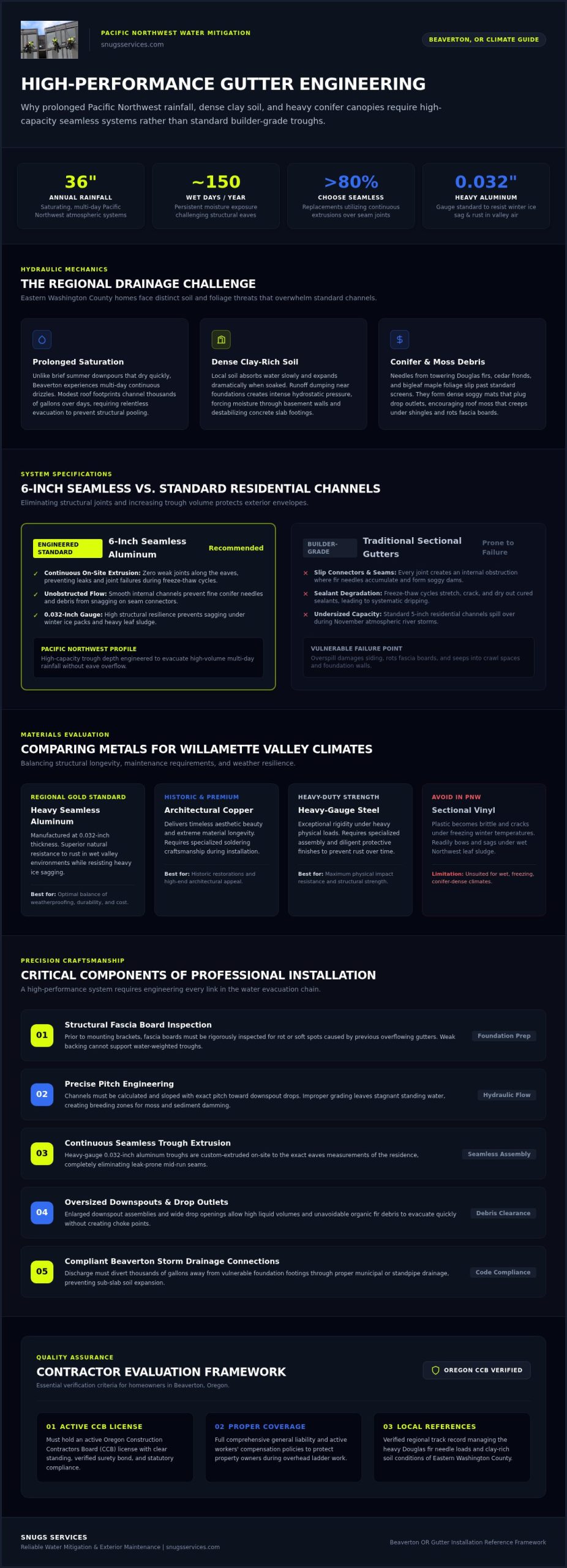
Eastern Washington County presents a distinct drainage challenge that standard residential setups struggle to survive. Beaverton endures roughly 36 inches of rainfall spread across nearly 150 wet days every year. Unlike regions subjected to quick, torrential thunderstorms that dry up within hours, our local climate delivers prolonged, multi-day saturating drizzles. That persistent moisture makes quality gutter installation Beaverton OR homes rely on an essential barrier against exterior decay. Understanding the hydraulic mechanics behind these drainage channels, as detailed in this comprehensive overview of rain gutters, shows why water volume and structural resilience must work together.
When moisture lingers without drying winds, even modest roof areas channel thousands of gallons over days. If continuous troughs fail to carry that discharge cleanly away, the overflow attacks your eaves, rots structural framing, and puddles around foundation perimeters. To visualize how these components unite into a solid residential drainage system, watch this clear demonstration:
Managing Pacific Northwest Rain Loads and Soil Saturation
Local soil composition complicates this moisture load. Much of Beaverton sits on dense, clay-rich soil that absorbs moisture slowly and expands dramatically when wet. Uncontrolled roof runoff dumping alongside foundation walls quickly creates intense hydrostatic pressure. Over time, that subsurface pressure forces seepage through basement walls, destabilizes concrete slab footings, and pools within crawl spaces.
The Threat of Conifer Needles, Moss, and Organic Debris
Mature tree canopies make water mitigation even harder. Douglas fir needles, cedar fronds, and heavy bigleaf maple foliage constantly drop across roof valleys. Fine needles slip through basic mesh screens, forming dense mats that plug drop outlets. Trapped sediment creates soggy dams, accelerating destructive roof moss that creeps under shingles and rots structural fascia boards.
Planning a tailored gutter installation Beaverton OR climate conditions demand ensures your eaves have the proper trough depth and downspout capacity to evacuate heavy runoff. When completing a new gutter installation Beaverton OR homeowners can pair their setup with routine, professional gutter cleaning in Portland and surrounding neighborhoods to safeguard their siding and foundation footings season after season.
Comparing Gutter Materials, Profiles, and Sizing for Local Homes
Selecting the right materials and dimensions transforms your gutters from a simple trim piece into an active flood barrier. More than 80% of modern replacements rely on seamless setups because traditional sectional gutters joined with slip connectors inevitably fail. Every seam creates an internal obstruction that snags pine needles, while seasonal freeze-thaw cycles stretch and crack the cured sealant. On-site extruded seamless channels eliminate weak joints along the eaves, ensuring clean, unobstructed flow.
Structural reliability hinges on meeting rigorous roof drainage guidelines, similar to resilient home construction standards that prioritize whole-envelope moisture protection. Getting that peace of mind begins with selecting the proper metal gauge and hydraulic profile for your roof plan.
Seamless Aluminum vs. Specialty Metals in the Willamette Valley
Aluminum remains the gold standard for regional homes. Using heavy-gauge 0.032-inch seamless aluminum prevents sagging under winter ice packs while offering superior resistance to rust in wet valley environments. Architectural copper and heavy-gauge galvanized steel deliver timeless beauty and extreme strength for historic restorations, yet they require specialized soldering craftsmanship. Sectional vinyl gutters should generally be avoided; brittle plastic easily cracks under freezing temperatures and bows under heavy Pacific Northwest leaf sludge.
Sizing Guidelines: When to Upgrade to 6-Inch Gutters
Standard 5-inch K-style troughs work well on gentle roof lines, but homes with complex valley intersections or steep pitches require high-capacity upgrades. Steeper slopes accelerate runoff velocity, causing fast water to sheet clean over standard 5-inch rims. Upgrading to a 6-inch seamless profile expands interior volume by roughly 40%, catching fast water from long rafter lengths without spillover.
- Trough Capacity: 6-inch troughs handle vast catchment surfaces and eliminate splash-out below high-volume roof valleys.
- Downspout Evacuation: Replacing standard 2×3-inch outlets with oversized 3×4-inch commercial downspouts dramatically improves discharge rates.
- Debris Clearance: Larger downspout drops keep conifer needles moving freely rather than choking at narrow elbows.
Planning precise trough volume protects your property investments from water-logged eaves. When planning an exterior upgrade or full gutter installation in Beaverton OR, partnering with the experienced team at Snugs Services ensures your home receives continuous channels engineered specifically for your roof’s architecture.
Critical Components: Fascia, Pitch, Downspouts, and Debris Protection
High-capacity troughs fail quickly if the underlying mounting structure and slope calculations are flawed. Fastening new metal directly to compromised exterior trim is a recipe for sagging corners, perimeter rot, and detached hardware during a wet winter storm. A professional installation treats your roofline as an integrated system, balancing solid woodworking, mechanical fasteners, and hydraulic physics.
Ensuring Proper Slope and Secure Structural Fastening
Water must move continuously toward your drop outlets rather than pooling along the run. Achieving this requires establishing a precise slope ratio of one-quarter inch drop for every ten feet of gutter run. If the grade is too flat, standing water attracts mosquitoes, fosters algae, and accelerates corrosion; if pitched too steep, the drop leaves exposed fascia and spills over downspout collars.
Mounting methods directly determine whether channels can support heavy slush and standing debris. Here is how modern installation practices safeguard your eaves:
- Fascia Integrity: Installers must inspect underlying wood for soft spots, fungal rot, or mold. Any rotted backing must be replaced before driving fasteners.
- Hidden Screw Hangers: Outdated external spikes and ferrules work loose as wood expands and contracts. Heavy-duty internal hidden hangers lock into the front lip and anchor deep into rafter tails using coarse-thread structural screws.
- Tight Spacing: Standard brackets placed 36 inches apart bow under saturated snow packs. Securing hidden hangers every 24 inches maintains continuous rigidity across seasonal temperature swings.
Downspout Placement and Ground Drainage Integration
Downspout locations dictate how smoothly water vacates your roofline. As a rule of thumb, single downspouts shouldn’t carry runs longer than 35 to 40 feet. Placing drops near natural eaves corners prevents mid-run backups during torrential atmospheric river days.
Ground discharge requires deliberate planning to keep moisture away from your perimeter footings. Downspout kickouts should route water at least five to six feet out into landscaped beds, dedicated dry wells, rain collection barrels, or underground PVC drain lines that tie cleanly into city storm mains. Connecting downspouts directly into cracked clay underground pipes will merely dump hundreds of gallons directly against your crawl space walls.
Pairing thoughtful gutter installation in Beaverton OR with proactive exterior maintenance keeps your roofline running clear year-round. Coordinating gutter updates alongside seasonal roof cleaning in Portland and surrounding communities clears away heavy moss carpets before organic decay washes down and overwhelms your new downspout outlets.
The Step-by-Step Professional Gutter Installation Process
A flawless drainage build requires methodical craftsmanship from start to finish. When investing in gutter installation Beaverton OR homeowners benefit from a systematic workflow that treats exterior trim, siding, and landscaping with absolute care. Rather than relying on guesswork, installation day unfolds through precise, engineered phases designed to deliver lasting reliability.
Site Preparation, Demolition, and Custom Fabrication
Work begins at ground level with thorough staging. Crews detach old, warped troughs and corroded brackets, carefully hauling away scrap metal to keep your yard safe for kids and pets. Technicians then inspect the exposed drip edges and wood fascia along the entire roofline to catch hidden moisture rot before placing new components.
Once measurements are verified, on-site fabrication starts right from the service truck. Heavy rolls of flat aluminum feed through an industrial roll-forming machine, custom-extruding continuous, rigid troughs cut to the fraction of an inch for every rafter line. Because the metal is shaped right at your curb, long eaves receive unbroken runs with zero mid-wall seams.
Mounting, Sealing, and Quality Assurance Verification
With custom sections prepped, the installation shifts to mechanical fastening and sealing:
- Joint Waterproofing: High-grade thermoplastic polymer sealants are applied across end caps and pre-punched outlet drops, creating watertight bonds that won’t shrink under temperature shifts.
- Rafter Anchoring: Installers chalk slope lines and screw heavy-duty internal hangers straight into solid structural framing, preserving the engineered pitch across the full span.
- Downspout Strapping: Downspouts are assembled and secured flush against exterior siding using color-matched straps anchored directly into building wall studs.
Quality assurance finishes the job. During professional gutter installation Beaverton OR technicians conduct controlled water tests, flushing gallons down the troughs to confirm smooth velocity and spot-check every drop point. Crews then perform a magnetic sweep of surrounding walkways and flower beds to capture stray screws or metal shavings.
Ready to upgrade your home with a dependable, custom-fit water management system? Protect your investment by choosing expert gutter installation Beaverton OR with the trusted specialists at Snugs Services.
Selecting the Right Gutter Contractor in Beaverton OR
Hiring a contractor to secure metal along your roofline demands more than a handshake and a casual estimate. Because Washington County homes face prolonged winter moisture, minor installation defects lead straight to hidden wood rot and crawl space flooding. You deserve a partner who respects your property, arrives on schedule, and backs their work with clear professional accountability.
Contractor Qualifications, CCB Licensing, and Insurance
Protecting your household starts by verifying contractor credentials before any tools leave the truck. Anyone performing construction work for compensation in Oregon must carry an active license with the Construction Contractors Board (CCB). This registration confirms your installer completed required state training, passed comprehensive exams, and maintains mandatory surety bonds along with general liability insurance.
Always review prospective bids against these essential protection criteria:
- CCB Verification: Check the contractor’s CCB number through the state database to confirm their status is active without open complaints or safety sanctions.
- Worker Coverage: Confirm the crew carries full workers’ compensation coverage so you aren’t held liable if an accident occurs on your roofline.
- Detailed Scope of Work: Insist on itemized written estimates detailing the exact aluminum coil gauge, bracket spacing, fastener types, and debris disposal protocols.
- Clear Workmanship Warranties: Distinguish between manufacturer material finishes and the contractor’s specific guarantee covering labor, alignment, and leak prevention.
Why Comprehensive Exterior Experience Matters
Choosing an installer with broader exterior expertise prevents costly finger-pointing between trades. Gutter specialists who also handle pressure washing, window washing, and roof care understand how siding materials, shingles, and gutters interact as a unified protective shell. They know how to position ladders safely without denting metal runs or scuffing delicate painted trim.
Snugs Services has served property owners across the Portland and Beaverton metropolitan area continuously since 1995. As a local, family-owned business with three decades of hands-on experience, we understand the specific water intrusion challenges created by western Oregon weather. You can explore our wider regional approach in our comprehensive Portland gutter installation buying guide.
When you invest in gutter installation in Beaverton OR, partnering with an experienced single-source team gives you lasting confidence. You get properly pitched channels today, paired with dependable maintenance support that keeps your roofline clear and functional for years to come.
Safeguard Your Home Against Pacific Northwest Rains
Guarding your property against prolonged valley moisture comes down to sound engineering and dependable craftsmanship. Choosing quality gutter installation Beaverton OR homeowners rely on protects your siding, foundation footings, and crawl space from severe water intrusion. High-capacity seamless troughs, heavy-duty hidden hangers, and proper ground drainage work together to handle the toughest Pacific Northwest storms.
Snugs Services has delivered expert exterior maintenance across Beaverton and the Portland metro continuously since 1995. As a family-owned and operated team, we provide full-service capabilities that span gutter installation, roof cleaning, and pressure washing. You don’t have to risk your safety on tall ladders or worry about leaking corners during heavy rainfall.
Protect your home with professional gutter installation from Snugs Services and enjoy true peace of mind through every season.
Frequently Asked Questions
How much rain capacity do gutters in Beaverton need to handle?
Gutters in Beaverton must be sized to handle approximately 36 inches of annual rainfall concentrated across 150 precipitation days. Continuous low-intensity drizzle keeps roof drainage surfaces perpetually wet, while winter storms generate substantial runoff surges. A properly calibrated system should easily process two to three inches of rainfall per hour during peak storm activity without backing up into roof decking.
What is the difference between 5-inch and 6-inch seamless gutters?
The primary difference is water volume capacity; 6-inch seamless gutters hold roughly 40% more water than standard 5-inch models. While 5-inch troughs work fine on small, low-slope roofs, 6-inch systems are essential for steep rafter runs and complex roof valleys. The larger profile also accommodates oversized 3×4-inch downspouts, significantly reducing clogs from fir needles and tree sediment.
Can new gutters be installed over rotten or damaged fascia boards?
No, new gutters should never be mounted directly onto damaged or decaying fascia. Fastening brackets into soft wood compromises the physical hold, causing heavy troughs to pull loose under seasonal rain or ice loads. Quality gutter installation Beaverton OR homeowners invest in requires inspecting the wood first and completing necessary fascia repairs so hidden hangers anchor securely into solid backing.
Do gutter guards prevent all pine needle clogs in the Pacific Northwest?
Gutter guards dramatically reduce interior debris accumulation, but no guard prevents routine maintenance entirely. Slender Douglas fir needles and cedar fronds often rest flat on top of screens, restricting water intake during sustained storms. High-quality micro-mesh blocks large blockages inside the troughs, yet periodic surface brushing remains necessary to keep continuous runoff flowing freely into your downspout outlets.
How often should new gutters be cleaned and inspected in Beaverton?
Beaverton homeowners should have their gutters inspected and cleaned at least twice a year, typically in late spring and late autumn. If your property sits directly beneath a heavy canopy of Douglas firs or bigleaf maples, quarterly cleanings may be required. Routine clearing prevents organic dams from accelerating roof moss growth or causing overflow that stains exterior siding.
What is the typical lifespan of seamless aluminum gutters in Oregon?
Seamless aluminum gutters typically last between 20 and 30 years in the Pacific Northwest when maintained properly. Heavy-gauge 0.032-inch aluminum resists rust naturally in damp climates, while factory-baked enamel finishes resist chipping and peeling. Ensuring consistent slope, clearing standing organic sludge, and keeping hidden hangers secure preserves structural integrity throughout decades of damp Willamette Valley winters.
Can you tie new downspouts directly into existing underground drainage lines?
You can tie new downspouts into existing underground lines only after verifying that the pipes are clear, intact, and compliant with Beaverton drainage standards. Older clay or corrugated pipes often collapse or choke with tree roots, forcing water back toward foundation footings. A certified crew evaluating gutter installation Beaverton OR projects will ensure sub-grade connections route runoff cleanly out to approved storm drains.
Recent Comments