
A single vertical shift of just 1/4 inch in your sidewalk is enough to trigger a federal ADA violation and an expensive liability lawsuit in 2026. If you’re managing property in the Portland-Vancouver metro area, you know that Pacific Northwest weather and shifting soil make these hazards almost inevitable. You’ve likely looked at uneven pavement and dreaded the massive quotes for a full concrete replacement. We understand that pressure. It’s why many local managers are turning to concrete grinding as a smarter, more efficient way to protect their assets and their bottom line.
You deserve a solution that’s both professional and neighborly. We’ll show you how precision grinding eliminates trip hazards and restores your surfaces without the mess or high cost of a complete tear-out. You’ll learn about the current 2026 OSHA regulations for silica dust control and the specific ADA requirements, like the 2% maximum cross slope, that keep your property compliant. This guide provides the clear roadmap you need to save money, pass inspections, and keep your community safe and looking its best.
Key Takeaways
- Discover how concrete grinding provides a seamless, cost-effective alternative to full pavement replacement while specifically addressing the PNW’s unique freeze-thaw damage.
- Identify the specific “1/4 inch rule” used by ADA inspectors to determine if your walkways are a legal liability.
- Learn why industrial HEPA-filtered vacuum systems are essential for maintaining a clean, silica-free environment during the restoration process.
- Save your budget by choosing a restoration method that offers 70-80% savings and significantly less downtime than traditional concrete pouring.
- Understand the importance of a professional site assessment to ensure your repaired surfaces remain stable and safe for years to come.
What is Concrete Grinding and Why Does Portland Need It?
Diamond grinding of pavement is a precision preservation method that uses diamond-segmented abrasives to shave down high spots on concrete surfaces. It’s essentially an industrial-grade restoration for your property’s walkways. Instead of the massive disruption and waste of a full replacement, concrete grinding targets specific flaws to create a smooth, level finish. It’s the most effective solution for Portland property managers who want to restore safety and curb appeal without the high costs of a new pour.
Our local environment presents challenges most other regions don’t face. The Willamette Valley’s heavy rainfall saturates the soil under your slabs, which leads to significant shifting during our winter freeze-thaw cycles. When the ground expands and contracts, concrete joints often heave or sink. Add in the aggressive root growth from our signature Douglas firs and maples, and you have a recipe for dangerous trip hazards. These issues don’t just look bad; they compromise the safety of your residents and customers.
The Science of Diamond Grinding
We use different equipment depending on your specific needs. Planetary grinders are excellent for creating a pristine, aesthetic finish on large commercial floors. Horizontal shaft grinders offer the power needed to level heavy heaving on outdoor sidewalks. The grit level we choose is critical because it determines how slip-resistant the final surface feels underfoot. In urban Portland environments, we prioritize dry grinding paired with high-efficiency vacuum systems. This setup captures 99.9% of dust, which keeps your storefronts clean and your tenants happy while we work.
Common Concrete Issues in the Willamette Valley
Portland’s winter maintenance often involves de-icing salts, which can lead to scaling and spalling over time. This makes your curbside appeal look degraded and professional spaces feel neglected. We’re also seeing aggressive enforcement of the ADA’s 1/4 inch rule in 2026. Any vertical change greater than 1/4 inch is a legal liability that can lead to costly lawsuits. Whether it’s a shifted joint from a 2025 winter storm or a root-lifted panel, these hazards require immediate attention. Our team identifies these spots and uses concrete grinding to bring them back into compliance, ensuring your property is both beautiful and worry-free.
How Concrete Grinding Works: The Professional Process
Professional restoration starts with a thorough site assessment. We don’t just show up and start cutting. Our technicians evaluate the depth of the hazard and the underlying stability of the slab. If a sidewalk panel is “pumping” or rocking, we address the foundation before we begin. This ensures the fix is permanent. We also prioritize health by adhering to OSHA safety standards for concrete grinding, which limits silica dust exposure to 50 micrograms per cubic meter. Using industrial vacuum systems with HEPA filtration allows us to maintain a clean environment for your tenants and customers.
Step 1: Surface Preparation and Safety
We start by clearing debris and scanning for utilities or rebar. Our team marks a precise “cut line” to ensure the finished result has a gradual, safe transition. We set up localized containment to protect your landscaping and storefronts from any stray particles. It’s about being a good neighbor while we work. This preparation phase prevents damage to your property and ensures the concrete grinding process is as efficient as possible.
Step 2: The Grinding and Leveling Phase
During the leveling phase, we use multi-segmented diamond heads to shave down high spots systematically. We monitor the slope ratio carefully throughout the work. For ADA compliance, we aim for a 1:12 slope on ramps to ensure complete accessibility. If we encounter deep structural voids or fissures, we may perform crack filling to stabilize the area before the final pass. This creates a “zero-point” transition that feels completely smooth underfoot.
Step 3: Finishing and Cleanup
The final step is all about the details. We smooth the edges to prevent “scarring” and ensure the new texture matches your existing walkway. We apply professional-grade sealants to protect the freshly exposed aggregate from the constant Oregon rain. A final inspection verifies that every hazard exceeding the 1/4 inch threshold is gone. You’re left with a pristine, safe surface that’s ready for immediate use. If you want to see how this process can transform your curbside appeal, you can schedule a professional walkthrough with our local team. Our goal is to give you total peace of mind by doing the heavy lifting for you.
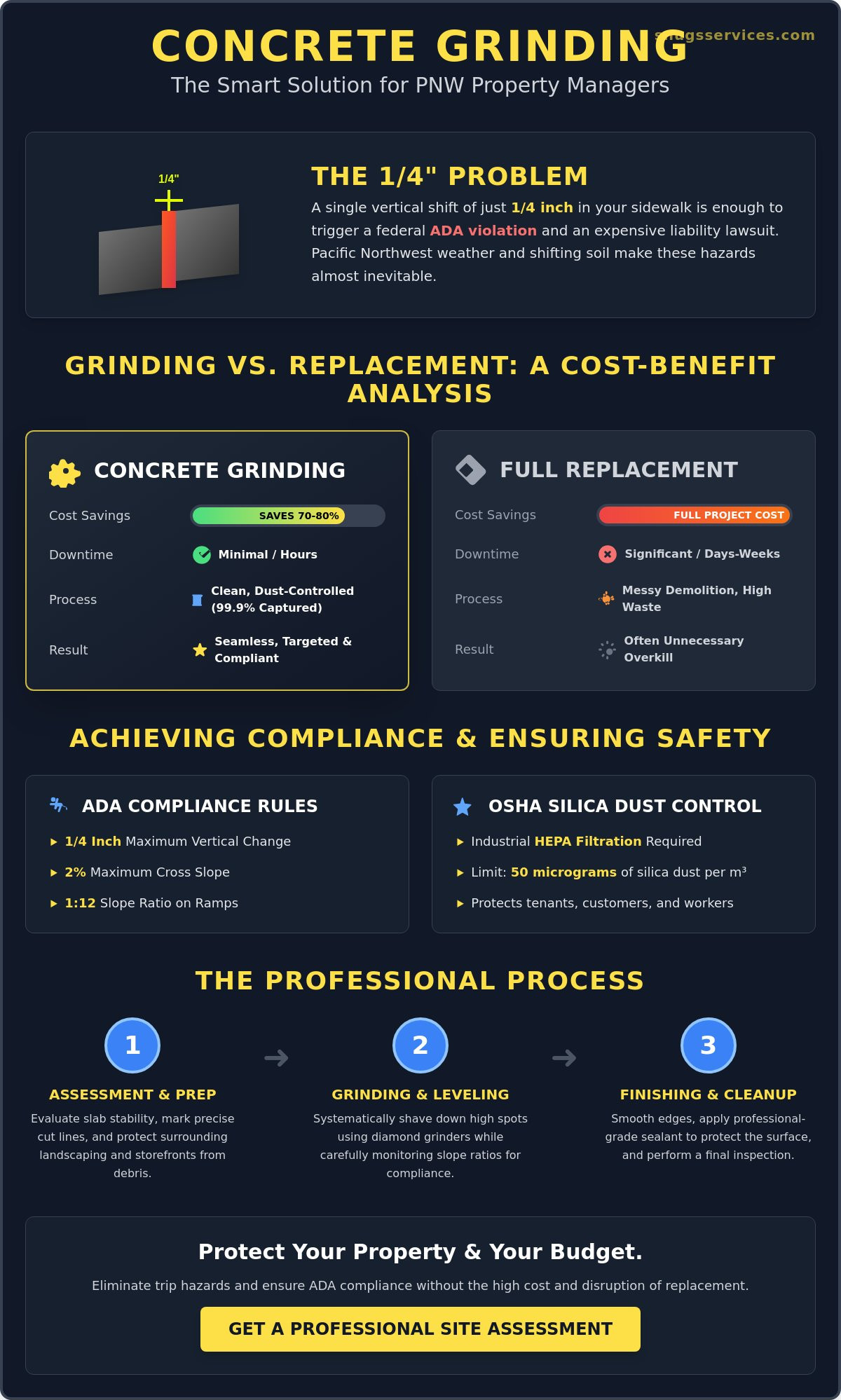
Concrete Grinding vs. Replacement: A Cost-Benefit Analysis
Most property managers face a difficult choice when a sidewalk lifts: tear it out or fix it. In 2026, the data shows that concrete grinding is the superior choice for both your budget and your schedule. Traditional replacement involves heavy machinery, hauling fees, and expensive new materials. Grinding typically costs 70% to 80% less than a full tear-out. You aren’t just saving on materials; you’re saving on the massive labor costs associated with a multi-day construction project.
The “Downtime Factor” is where the value truly shines. A full replacement is a week-long ordeal. You have to wait for the new pour to cure before pedestrians can safely walk on it. Grinding takes hours, not days. Your storefront stays open, and your residents aren’t inconvenienced by yellow tape and “wet concrete” signs. It’s also the “greener” choice for our Portland community. Keeping your existing slabs on-site prevents tons of waste from entering local landfills and reduces the carbon footprint associated with new cement production.
Grinding is a preservation tool, not a miracle cure. If a slab has deep structural failures or has completely collapsed into the soil, replacement becomes mandatory. We’ll always give you an honest assessment. If the concrete is structurally sound but simply unlevel, grinding is the professional way to restore safety without the headache of a construction site.
Financial Breakdown for Property Managers
A week of demolition and pouring can paralyze a commercial parking lot. In contrast, a single day of grinding resolves the issue with zero curing time. This efficiency extends the life of your entire sidewalk system by preventing small shifts from becoming major hazards. The ROI is clear when you consider the legal landscape. Following the ADA standards for ground surfaces is a proactive investment. It’s much cheaper to grind a joint than to settle a single slip-and-fall lawsuit.
Long-term Durability and Maintenance
Ground surfaces are remarkably resilient. Unlike thin-set mortar patches that often flake off after a single Oregon winter, a ground slab remains solid concrete. It holds up perfectly against regular commercial pressure washing without losing its level profile. We recommend regular inspections to ensure that active tree roots aren’t causing new shifts. By choosing concrete grinding over temporary patches, you ensure a stable surface that stays compliant and looks professional for years to come.
How to Ensure ADA Compliance on Your Property
Maintaining a property in the Portland-Vancouver metro area means staying ahead of aggressive 2026 ADA enforcement. The most critical benchmark for any manager is the 1/4 inch rule. Under the Americans with Disabilities Act, any vertical change in level on a path of travel exceeding 1/4 inch is legally considered a trip hazard. If an inspector or a litigious visitor spots a shifted joint that exceeds this limit, you face immediate liability. Precision concrete grinding allows you to taper these transitions back to a safe, compliant level without the disruption of a full construction crew.
Calculating the proper slope is where many DIY attempts fail. It isn’t enough to just round off a sharp edge. Current ADA standards require a cross slope of no more than 2% and a minimum clear width of 36 inches for walkways. If you’re addressing a ramp, the maximum slope allowed is 1:12, or 8.33%. A “steep” grind that doesn’t meet these specific ratios will still fail a professional inspection. We focus on creating a gradual, seamless transition that ensures every visitor can move through your property safely and comfortably.
The Audit: Identifying High-Risk Areas
We recommend starting with a simple walking audit. Grab a level and a measuring tape to check every joint, especially in high-traffic zones like bus stops, accessible parking stalls, and main entrances. In 2026, accessible parking spaces are a primary target for inspectors because their slope cannot exceed 2% in any direction. This is one of the most common violations found during inspections. Document every repair you make. Keeping a detailed log of your concrete grinding maintenance demonstrates “due diligence” to your insurance provider and provides a vital defense in the event of a liability claim.
Working with Local Municipalities
Navigating Portland’s sidewalk repair permits can be a headache for busy managers. In many parts of the Willamette Valley, the legal responsibility for maintaining the public right-of-way falls directly on the adjacent property owner. Attempting “self-performed” repairs with rented equipment often results in “scarring” or incorrect slopes that don’t meet City of Portland standards. We coordinate with local requirements to ensure your repairs pass inspection the first time. If you’re ready to clear your to-do list and protect your property from legal risks, contact our team for an ADA compliance walkthrough today. We’ll do the heavy lifting so you can have total peace of mind.
The Snugs Advantage: Expert Concrete Grinding in the PNW
For over 30 years, Snugs Services has been the trusted partner for property managers across the Portland, Salem, and Vancouver metro areas. We aren’t just a service provider; we’re your neighbors. We understand that Northwest concrete has a unique density and aggregate composition due to our local environmental factors. That’s why we use specialized concrete grinding equipment specifically designed to handle the tough, moisture-heavy surfaces found in our region. Our team brings the pride of local craftsmanship to every job, ensuring your walkways are pristine, level, and safe.
We believe in the “Snugs Standard,” which means looking at your property as a whole asset rather than just a list of chores. While we’re leveling your sidewalks to eliminate hazards, we can seamlessly coordinate with our other expert teams to handle gutter maintenance or roof care. This holistic approach saves you the stress of managing multiple vendors and ensures every inch of your exterior is protected. We take our “hassle-free” promise seriously. Our technicians show up on time, do the heavy lifting, and leave your site sparkling and worry-free.
Comprehensive Exterior Solutions
We provide more than just a quick fix for uneven joints. By combining concrete grinding with services like parking lot sweeping, we offer a total property refresh that boosts your curbside appeal instantly. Whether you manage a sprawling industrial park in Hillsboro, a university campus, or a local municipality, we develop custom maintenance plans tailored to your specific traffic patterns and budget. Our local roots mean we’re committed to doing the job right the first time because we share the same streets and sidewalks with your residents and customers.
Get Your Professional Estimate Today
Experience the relief of working with a team that values your time and your bottom line. We offer simple, transparent pricing without the corporate runaround or confusing hidden fees. If you have an emergency trip hazard that needs immediate attention in Gresham or Beaverton, our rapid response teams are ready to secure your site quickly. We pride ourselves on being the “helping hand” that keeps your property compliant and beautiful. Don’t let a minor shift in the pavement become a major legal liability. Restore your property safety with a Snugs concrete grinding quote and let our detail-oriented experts handle the hard work for you.
Secure Your Property and Protect Your Bottom Line
Managing a commercial property in Portland means staying ahead of shifting soil and strict ADA enforcement. You’ve seen how concrete grinding offers a seamless way to eliminate dangerous trip hazards while saving up to 80% compared to the cost of full slab replacement. By addressing those small 1/4 inch shifts now, you avoid costly legal liabilities and maintain the professional curbside appeal your tenants expect. It’s a smart, proactive choice that keeps your budget intact and your walkways safe.
Since 1995, we’ve helped our neighbors across the Pacific Northwest navigate these safety challenges with precision and care. We use advanced HEPA-filtered dust containment systems to keep your environment clean and healthy while we work. Our deep expertise in 2026 ADA compliance standards ensures your walkways pass inspection the first time. We’re here to do the heavy lifting so you can focus on running your business with total peace of mind. Ready to restore the safety and beauty of your surfaces? Get a Free Concrete Grinding Estimate from Snugs Services today. Let’s work together to make your property worry-free.
Frequently Asked Questions
Is concrete grinding better than replacing the whole sidewalk?
Grinding is often the superior choice because it’s approximately 70% to 80% less expensive than a full replacement. While a new pour requires days of curing, grinding is completed in hours. This preservation method keeps sound concrete out of landfills and avoids the “construction zone” feel on your property. However, if the slab has deep structural cracks or has completely crumbled, replacement is the only safe option.
How long does the concrete grinding process take for a commercial property?
Most commercial projects are completed in just a few hours rather than several days. While a full replacement paralyzes your walkway for a week, a professional concrete grinding crew can typically resolve multiple trip hazards in a single shift. This rapid turnaround minimizes tenant complaints and ensures your storefront remains accessible. You won’t have to worry about long-term barricades or yellow tape disrupting your daily operations.
Will the ground-down concrete match the color of my existing sidewalk?
The freshly ground area will initially appear lighter because the process exposes the internal aggregate of the slab. Over time, as it’s exposed to the elements and foot traffic, the color will naturally weather and blend more closely with the surrounding surface. We apply professional sealants to protect this new surface and help it integrate seamlessly. This “salt and pepper” look is a standard result of high-quality restoration.
Does concrete grinding create a lot of dust and mess?
We use advanced industrial vacuum systems with HEPA filtration to capture 99.9% of dust at the source. This ensures your property remains clean and safe for pedestrians while we work. Because we follow OSHA regulation 29 CFR 1926.1153, we maintain a clean environment that protects everyone from silica exposure. You can keep your windows open and your landscaping pristine without worrying about a layer of white powder.
What is the maximum height difference that concrete grinding can fix?
We can safely resolve vertical shifts up to 2 inches in height using precision equipment. For hazards exceeding this limit, the steepness of the required slope often makes grinding impractical for ADA compliance. Most common sidewalk lifts in Portland fall between 1/4 inch and 1.5 inches, which are perfect candidates for this method. Our technicians measure each site to ensure the final transition meets the 1:12 slope requirement.
How much does concrete grinding cost in the Portland metro area?
As of April 2026, the average cost for concrete polishing and grinding in Portland is approximately $4.47 per square foot. Prices typically range from $3.99 to $4.95 for standard projects. If your project involves a single-pass grind with patching and sealing, costs can range between $6.00 and $7.50 per square foot. Larger projects over 5,000 square feet often see reduced rates as low as $3.00 per square foot.
Can concrete grinding be done in the rain or during a Portland winter?
Yes, we perform concrete grinding year-round in the Pacific Northwest regardless of the rain. Our equipment is designed to operate effectively in damp conditions, and we adjust our methods to ensure proper dust containment and surface finishing. Since trip hazards become even more dangerous on wet, slippery surfaces, winter is often the most critical time for these repairs. We’ll ensure your property stays safe and compliant during our rainiest months.
Is concrete grinding a permanent solution for tree root issues?
Grinding is a permanent fix for the current hazard, but it doesn’t stop future root growth. If an aggressive root system continues to expand, it may lift the slab again over several years. We recommend annual inspections for properties with large maples or firs. This proactive approach allows us to perform minor adjustments before a small shift becomes a major legal liability or requires a full slab replacement.
Recent Comments