
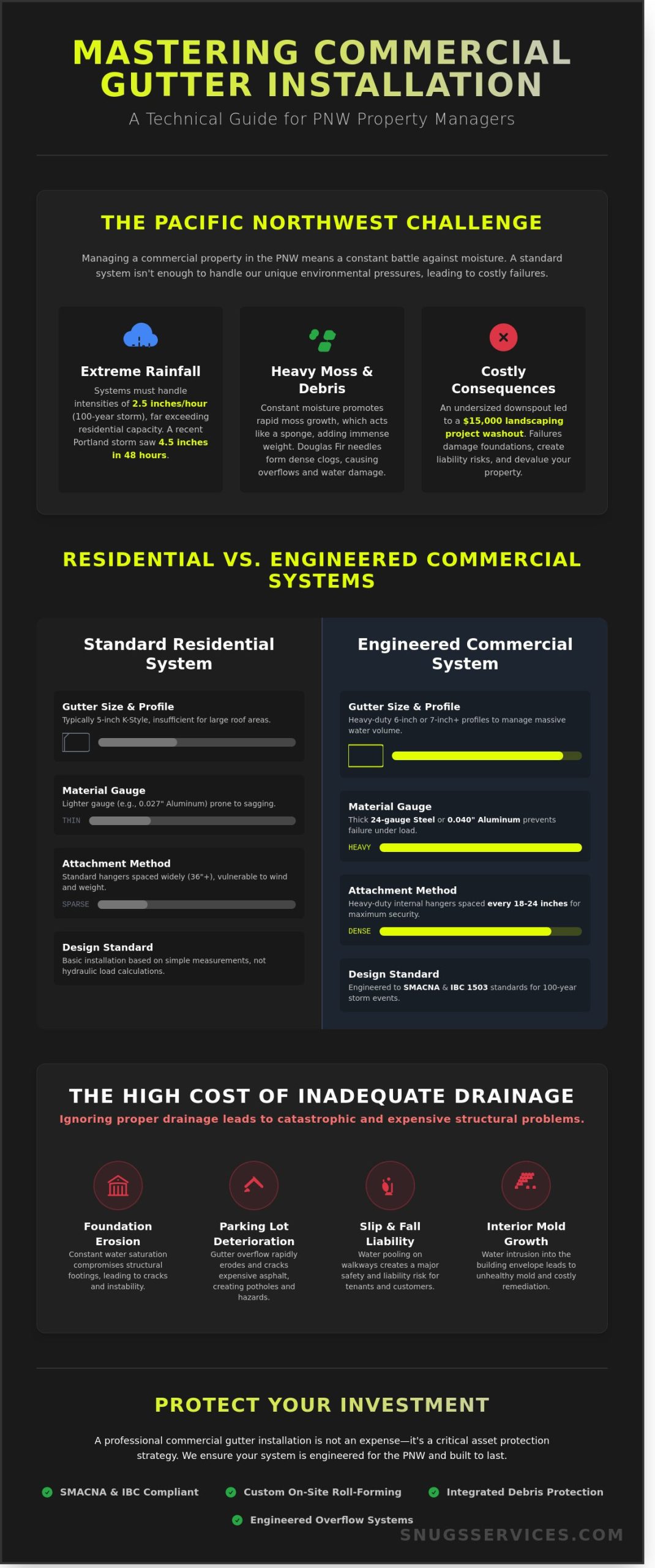
Last December, when Portland recorded 4.5 inches of rain in a single 48-hour window, one local property manager watched a $15,000 landscaping project wash away because of an undersized downspout. It’s a nightmare scenario that happens more often than you’d think in the Pacific Northwest. You already know that managing a commercial property in the PNW means fighting a constant battle against moisture. Between the heavy moss growth on Vancouver roofs and the relentless pine needles in Portland, keeping your drainage clear feels like a full-time job. You deserve the peace of mind that comes from a system designed to handle our unique environment.
This guide empowers you to master every technical requirement and material choice for your next commercial gutter installation, ensuring your system meets 2026 drainage standards. We’ve gathered the expertise you need to stop water ponding on flat roofs and prevent foundation erosion before it starts. We’ll explore the specific materials that withstand our climate, how to calculate flow capacity for large-scale buildings, and how to choose a local partner who handles the heavy lifting for you. Let’s ensure your property stays pristine and protected through every storm.
Key Takeaways
- Learn why commercial systems require specific gauges and heavy-duty attachment methods to protect your property’s foundation and parking lot from water damage.
- Discover how to use local Portland and Vancouver rainfall metrics to calculate the precise gutter volume and pitch your building needs.
- Navigate the 2026 material matrix to select the ideal profile and metal gauge for your next professional commercial gutter installation.
- Understand the step-by-step installation process, from the initial drainage load audit to custom on-site roll-forming for a perfect fit.
- Maximize your property’s ROI by implementing a proactive maintenance strategy that extends the lifespan of your drainage system.
Why Commercial Gutter Installation in Portland is a Different Discipline
Commercial gutter installation requires a level of engineering that far exceeds typical residential standards. While a home might use a standard 5-inch k-style gutter, a commercial property often manages thousands of square feet of roof area. This massive surface area demands heavy-duty 6-inch or 7-inch systems, often fabricated from 24-gauge steel or thick 0.040 aluminum to prevent sagging under heavy loads. The attachment methods also differ; we use heavy-duty internal hangers spaced every 18 to 24 inches to ensure the system remains secure during high-wind events. Poorly designed rain gutter systems can lead to catastrophic failure, including foundation erosion and the rapid deterioration of expensive asphalt parking lots.
In Portland, we design for the 100-year storm frequency. This means your system must handle a rainfall intensity of approximately 2.5 inches per hour according to local climate data. Our team follows the Sheet Metal and Air Conditioning Contractors’ National Association (SMACNA) guidelines and International Building Code (IBC) Section 1503. These standards ensure your roof drainage is sized correctly for the specific slope and square footage of your building. We take pride in getting these calculations right the first time, giving you peace of mind when the heavy rains arrive.
The PNW Climate Factor: Moss, Pine, and Rain
Portland’s unique environment presents specific challenges for any commercial gutter installation. The constant moisture leads to rapid moss growth, which acts as a sponge and adds immense weight to the gutter line. Also, Douglas Fir needles are notorious for clogging standard downspouts. Because 5-inch gutters lack the volume to flush this debris, they often overflow and cause wood rot. We recommend larger profiles and specific guard systems to handle the heavy debris loads common in the Pacific Northwest. The same damp conditions that clog gutters also colonize your building’s exterior surfaces, making commercial pressure cleaning services an essential part of any comprehensive property maintenance plan.
Impact on Commercial Property Value
Engineering the System: Sizing and Drainage Calculations
Professional commercial gutter installation starts with precise mathematics, not just a ladder and a tape measure. A warehouse with a 20,000 square foot footprint collects a massive volume of water during a typical Northwest storm. Our team calculates the adjusted roof area by factoring in the pitch; steeper roofs accelerate runoff, which requires a higher gutter volume to prevent overshooting the rim. We look at your building as a hydraulic system where every inch of metal must perform under pressure.
In the Portland and Vancouver metro areas, we design systems based on local rainfall intensity data. We specifically reference the 10-year and 100-year storm cycles to ensure your building remains protected during extreme weather events. The Portland Stormwater Management Manual serves as our primary guide for these engineering standards, ensuring every project meets municipal drainage requirements. By using these localized metrics, we prevent the common “waterfall effect” that erodes landscaping and damages foundations.
Downspouts are the most frequent bottleneck in commercial drainage. A gutter can be sized perfectly, but if the downspout cannot move the volume, the system fails. We calculate the exact number of outlets needed to keep water moving. We also prioritize secondary overflow requirements. These emergency scuppers act as a safety valve; if a primary drain becomes blocked by debris, the overflow prevents water from backing up into the building’s interior or compromising the roof’s structural integrity.
SMACNA Standards for Commercial Buildings
We strictly adhere to the guidelines set by the Sheet Metal and Air Conditioning Contractors’ National Association (SMACNA). Many contractors simply “size up” to a larger gutter by habit, but this guesswork creates a liability for property managers. Snugs uses SMACNA engineering tables to determine the correct gauge and profile for your specific architecture. This disciplined approach ensures your commercial gutter installation is legally compliant and functionally superior.
Thermal Expansion and Structural Integrity
Commercial gutters often span long distances, sometimes exceeding 100 feet. Because metal expands and contracts with temperature shifts, we install internal expansion joints to prevent the metal from buckling or tearing at the seams. Our crews use heavy-duty hangers spaced every 24 inches to secure heavy-gauge metal to steel or masonry. This robust fastening system is designed to withstand the weight of snow and ice, keeping your facility safe year-round. If you want to ensure your drainage system is built to last, our experts can provide a hassle-free gutter consultation to review your building’s specific needs; furthermore, specialists like SYNERGY ROOFING – ROOFING & SKYLIGHT SPECIALIST recommend a full evaluation of your roofing and skylight components to ensure your entire building envelope is protected.
Commercial Gutter Materials and Profiles: The 2026 Decision Matrix
Selecting the right components for your commercial gutter installation involves more than just matching a color scheme. It’s about structural integrity and long-term performance. In 2026, building owners are shifting away from standard residential-grade products toward high-capacity systems that handle the Pacific Northwest’s increasing rainfall intensity. Snugs Services provides the expertise to help you choose a system that protects your foundation while enhancing your building’s professional appearance.
Box Gutters: The Industrial Standard
Box gutters are the preferred choice for flat-roof commercial buildings and large-scale warehouses. Their rectangular profile allows them to carry a significantly higher volume of water than traditional K-style gutters. This is vital for maintaining compliance with the Portland 2025 Stormwater Management Manual, which outlines strict requirements for roof drainage and runoff control. We focus on three critical factors during installation:
- Internal Pitch: For long perimeters, we expertly manage the internal slope. This ensures water moves toward downspouts even if the exterior face appears perfectly level with the roofline.
- Volume Management: A standard 6-inch box gutter can handle up to 35% more water than a 6-inch K-style gutter, reducing the risk of overflow during flash storms.
- Modern Aesthetics: The clean, sharp lines of box gutters complement the architecture of modern office parks and industrial centers in the Pearl District and beyond.
Gauge and Finish: Beyond the Surface
The durability of your system depends on the thickness of the metal. While 0.027″ aluminum is common in residential settings, Snugs Services utilizes 0.032″ aluminum or 24-gauge steel for commercial projects. These heavier gauges resist sagging under snow loads and withstand the impact of debris. For maximum longevity, many property managers now opt for Galvalume. This material combines 55% aluminum and 43.4% zinc to provide superior corrosion resistance compared to standard galvanized steel.
Finishes also play a key role in maintenance. We recommend Kynar 500 resin-based coatings. These finishes are specifically engineered to prevent chalking and fading, ensuring your building stays pristine despite the constant cycle of PNW sun and rain. For high-end properties in Lake Oswego, copper remains a premier option. It offers a 50-plus year lifespan and develops a protective patina that eliminates the need for painting.
To eliminate the most common failure point, we offer custom fabrication of seamless gutters in lengths exceeding 50 feet. By reducing the number of joints, we provide a worry-free solution that prevents leaks and protects your siding. Snugs Services handles the heavy lifting, ensuring your commercial gutter installation is a seamless, professional experience from the first measurement to the final inspection.
The Installation Process: What to Expect on Your Jobsite
Our team follows a rigorous five-step protocol to ensure your commercial gutter installation stands up to the Pacific Northwest’s heaviest downpours. We don’t believe in guesswork; we rely on engineering and local expertise to protect your property. The process moves quickly, but we never skip the details that prevent long-term water damage.
- Step 1: Site Audit and Load Calculation. We calculate drainage loads based on the 100-year rain event standards for the Portland area. This ensures your system handles up to 2.5 inches of rain per hour without overflowing.
- Step 2: On-Site Fabrication. We bring our mobile shop to your location. On-site roll-forming allows us to create seamless runs that eliminate the leaks common in sectional systems.
- Step 3: Structural Attachment. We secure the gutters using heavy-duty structural brackets. Our crews maintain a precise pitch of 1/4 inch for every 10 feet of run to keep water moving toward the downspouts.
- Step 4: Sealing and Expansion. To handle temperature swings, we install expansion joints every 50 feet. We seal all end caps and outlets with high-grade industrial sealants and perform a flow test.
- Step 5: Final Inspection. We walk the perimeter with you to verify the work. Our team removes 100% of the installation debris, leaving your jobsite cleaner than we found it.
Minimizing Business Disruption
We know your business can’t stop just because the roof is being upgraded. Snugs manages the logistics so your customers and employees never feel the squeeze. We utilize compact 40-foot boom lifts that fit into tight alleys and parking stalls, keeping your main entrances clear and safe. Our crews follow strict OSHA safety protocols for high-traffic zones, using cones and signage to direct pedestrians. If you have painters or roofers on-site, we coordinate schedules to prevent trade stacking and keep the project moving forward without delays.
Permits and Local Compliance in the Portland Metro
Navigating the City of Portland Bureau of Development Services (BDS) requires local expertise. We ensure every downspout ties into the proper stormwater management systems as required by Title 17. For historic properties in downtown Portland or Vancouver, we match specific architectural profiles to meet local preservation codes. This attention to detail prevents costly fines and ensures your building stays compliant with regional environmental regulations. Whether it is a new build or a retrofitted warehouse, we handle the technical requirements so you don’t have to.
Protect your investment with a team that knows Portland’s unique building requirements and weather patterns. Contact Snugs Services today to schedule your professional site audit and commercial gutter installation estimate.
Maximizing ROI: Integrated Maintenance and Protection
A professional commercial gutter installation is a significant investment in your property’s infrastructure. Many building owners fall into a “set it and forget it” trap, assuming new hardware requires zero attention. This mindset often leads to premature system failure within 7 to 10 years. In the damp climate of the Pacific Northwest, stagnant water and debris act as a catalyst for corrosion and seal failure. Proper maintenance isn’t just about cleanliness; it’s about doubling the lifespan of your drainage system. This same proactive approach should be applied to your building’s climate control; to see how professional HVAC care can protect your investment, learn more about Christensen Heating and Cooling.
The Snugs Advantage: From Install to Maintenance
Our team doesn’t just hang gutters and disappear. We protect your investment by linking your new system to our professional gutter cleaning schedule. Regular debris removal prevents the heavy weight of wet leaves from pulling hangers loose or warping the trough. We also utilize our pressure washing services to keep your Kynar finish pristine. This specialized cleaning removes atmospheric pollutants and “tiger striping” that can permanently stain your building’s facade. For larger facilities dealing with moss, algae, and years of grime buildup, pairing your gutter maintenance with professional commercial pressure cleaning services in Portland and Vancouver ensures your entire building envelope stays protected and compliant with 2026 standards. Our annual inspections are designed to catch minor leaks or loose fasteners before they evolve into foundation issues or costly interior water damage.
Commercial Gutter Repair vs. Replacement
You might not always need a full commercial gutter installation to solve your drainage problems. If your current system is structurally sound but leaking at the seams, specialized repairs can often save the day. We look for specific signs to determine if a system is salvageable:
- Localized Damage: If only a specific section was damaged by a fallen limb or a vehicle, a partial replacement is a cost-effective fix.
- Loose Hangers: Sagging gutters can often be realigned and reinforced with heavy-duty hidden hangers.
- The 50% Rule: If the cost of repairing leaks and replacing sections exceeds 50% of the cost of a new system, we recommend a full replacement for better long-term value.
Don’t guess about the health of your building’s exterior. We provide free, comprehensive estimates for Portland-area facilities to help you weigh your options. Whether you need a simple tune-up or a complete system overhaul, our team shows up on time to deliver the “Snugs” standard of quality. Let us handle the heavy lifting so you can focus on running your business with total peace of mind.
Future-Proof Your Portfolio with Precision Gutter Systems
Managing a commercial property in the Pacific Northwest requires a proactive approach to water management. You’ve seen how precise drainage calculations and selecting the right profile from the 2026 decision matrix prevent costly foundation damage. Professional system design isn’t just about hanging metal; it’s about engineering a solution that handles our unique rainfall patterns while maximizing your long-term ROI. Since 1995, Snugs Services has served the Portland metro area with this exact level of detail-oriented craftsmanship.
We take the heavy lifting off your plate by utilizing specialized high-reach equipment designed for multi-story buildings. Our team is fully licensed, bonded, and insured for complex commercial work, ensuring your project is worry-free from start to finish. You can trust our local experts to provide a seamless experience that keeps your building pristine. Beyond drainage systems, maintaining your property’s professional appearance also means addressing issues like vandalism promptly with professional graffiti removal services that protect your building’s value and reputation. A well-maintained property also requires attention to ground-level surfaces; parking lot power washing in Portland and Vancouver eliminates the moss, oil stains, and algae that create slip hazards and liability risks for your business. Protect your property with expert commercial gutter installation; Get a Snugs quote today!
We’re ready to help you keep your property safe and looking its best.
Frequently Asked Questions
What is the standard size for commercial gutters?
Commercial gutters typically come in 6-inch or 7-inch sizes to handle larger water volumes. While residential homes use 5-inch gutters, commercial properties require the increased capacity of a 6-inch K-style or box gutter. This extra inch provides 40 percent more water capacity, ensuring your building stays protected during heavy Pacific Northwest downpours. Snugs ensures your system is sized correctly to prevent overflow and foundation damage.
How much does commercial gutter installation cost per foot in Portland?
Expect to pay between $4 and $30 per linear foot for commercial gutter installation in Portland, based on 2024 industry averages. Prices vary depending on whether you choose aluminum, steel, or copper. This investment protects your property from water damage that can cost $10,000 or more in foundation repairs. Our team provides a clear, hassle-free estimate so you can plan your building’s maintenance without any surprises.
What is the difference between a box gutter and a K-style gutter?
Box gutters feature a rectangular shape designed to sit under the roofline or within the building’s structure, while K-style gutters have a decorative front that mimics crown molding. Box gutters are the preferred choice for 85 percent of industrial buildings because they hold more water and offer a clean, professional look. K-style gutters are easier to install on sloped roofs. Both options provide a reliable way to direct water away from your business.
How often should commercial gutters be cleaned in the Pacific Northwest?
You should schedule professional gutter cleaning at least 2 times per year in the Pacific Northwest. Buildings near heavy tree cover, like the Douglas firs common in our area, often require 3 or 4 cleanings annually to prevent clogs. Clogged gutters lead to roof leaks and siding rot. Snugs takes the heavy lifting off your hands, keeping your system pristine and functional throughout the rainy season.
Are seamless gutters available for large commercial buildings?
Yes, seamless gutters are available for buildings over 10,000 square feet and are custom-rolled on-site to fit any length. Using a specialized gutter machine, Snugs creates continuous runs that eliminate the joints where leaks typically start. This seamless design reduces maintenance needs and provides a worry-free solution for expansive warehouses or office complexes. It’s a professional-grade upgrade that keeps your facility looking sharp and staying dry.
Do I need a permit to replace gutters on my commercial building in Vancouver, WA?
You generally don’t need a building permit for simple gutter replacement in Vancouver, WA, according to current city building codes. However, if your project involves structural modifications to the roofline or changes to the stormwater system, a permit is required. Snugs stays up to date on local regulations to ensure your installation meets all 2024 compliance standards. We handle the technical details so you can enjoy total peace of mind.
How long do commercial-grade steel gutters typically last?
Commercial-grade galvanized steel gutters last an average of 20 to 30 years with proper maintenance. If you choose stainless steel, that lifespan can extend beyond 50 years because of its superior rust resistance. Regular inspections and cleanings are essential to reaching these milestones. Our expert team helps you maximize this lifespan, protecting your asset and ensuring your investment in commercial gutter installation pays off for decades.
Can commercial gutters be installed on buildings with flat roofs?
Commercial gutters are expertly installed on flat roofs using a combination of scuppers, collector boxes, and downspouts. Because flat roofs don’t have a natural slope, water is directed toward the edges where the gutter system captures it. We use specialized flashing and high-grade sealants to create a water-tight transition. This setup prevents ponding water, which can cause roof collapses or leaks in as little as 48 hours.
Recent Comments