
If a single October downpour can turn your commercial sidewalk into a slip-and-fall hazard, is your drainage system actually doing its job? You already know that managing a property in the Pacific Northwest means a constant battle against moss, pine needles, and the type of relentless rain that tests every seam of a building. It’s stressful to watch water pool near your foundation or overflow onto walkways, creating structural risks and liability headaches that you simply don’t have time to manage.
We’re here to help you move past the cycle of temporary fixes and reactive repairs. This guide will show you how to master commercial gutter installation to ensure your facility remains bone-dry and fully compliant with the latest 2026 regional building codes. You’ll learn about the mandatory transition to the 2025 Oregon Structural Specialty Code, the impact of rising metal costs on your 2026 budget, and how to select a durable system that stands up to Portland’s heaviest seasons. We will preview the engineering requirements for industrial warehouses and the specific noncombustible material regulations now in effect across Washington, giving you the clarity needed to protect your investment and restore your peace of mind.
Key Takeaways
- Understand why commercial drainage needs to handle vastly more water than a home to prevent costly foundation erosion and parking lot damage.
- Identify the specific material gauges and profiles required for a commercial gutter installation to survive the Pacific Northwest’s heaviest rain events.
- Learn how to solve the unique drainage challenges of flat roofs, including the proper way to integrate scuppers and parapet walls.
- Discover why thermal expansion and heavy-duty hangers are the secret to preventing gutter buckling and structural failure during temperature swings.
- Find out how a professional bi-annual inspection schedule keeps your facility compliant and protects your long-term investment from moss and debris.
Why Commercial Gutter Installation Demands a Different Standard than Residential
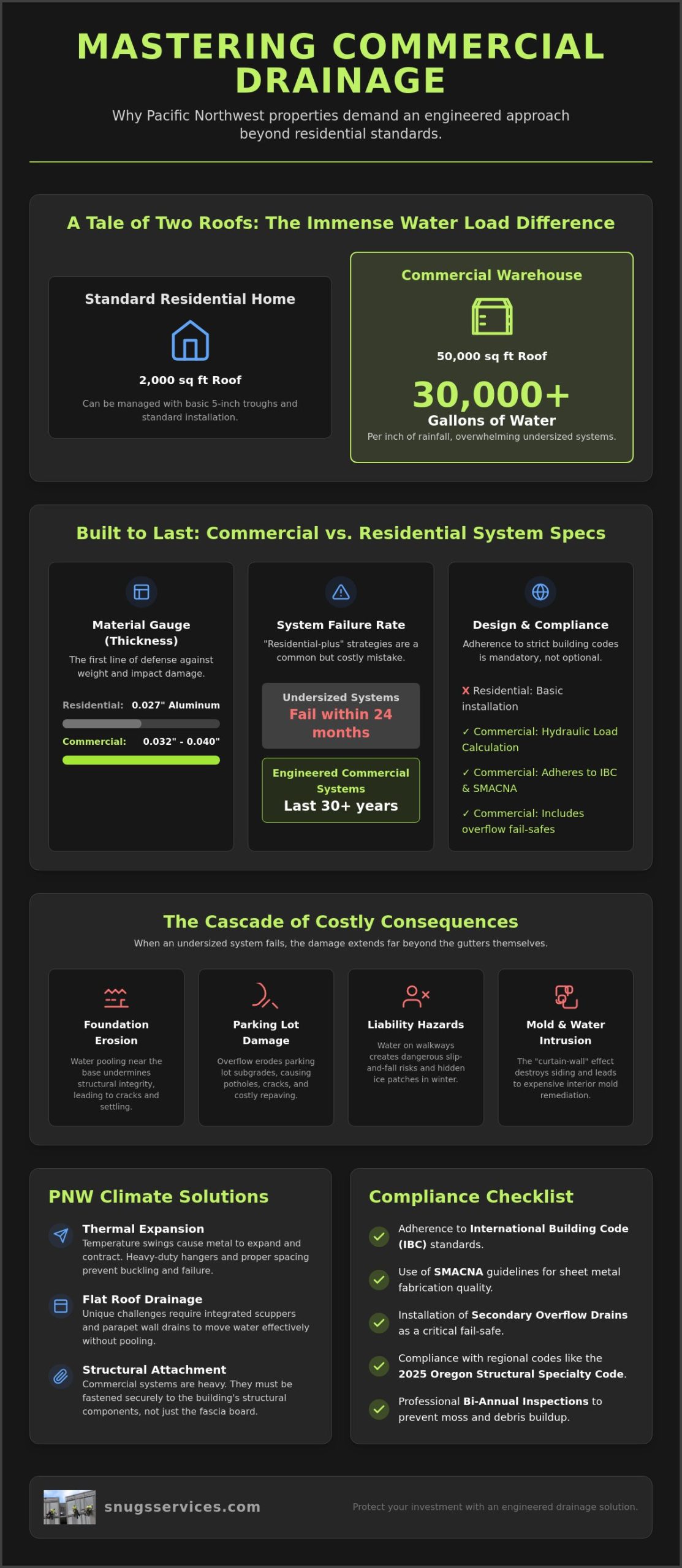
A 50,000 square foot warehouse in Portland isn’t just a large building; it’s a massive water catchment system. During a typical Pacific Northwest storm, a roof of this size can collect over 30,000 gallons of water for every inch of rainfall. While a standard 2,000 square foot home can get away with basic five-inch troughs, a professional commercial gutter installation requires a sophisticated engineering approach. Using a “residential-plus” strategy, where a contractor simply installs slightly larger residential gutters, almost always leads to system failure within 24 months. These undersized systems quickly buckle under the sheer weight of the water or become choked by the heavy debris common in our region.
The stakes for commercial properties involve much more than a leaky joint. When drainage fails, the resulting water volume can undermine parking lot subgrades, erode expensive landscaping, and cause foundation settling. We often see “Liability Drainage” issues where overflowing water creates dangerous splash zones on entryways or hidden ice patches on sidewalks. Professional Rain gutter systems for commercial facilities are designed to move this water safely away from high-traffic areas, protecting your customers and your bottom line from avoidable accidents.
To better understand this concept, watch this helpful video:
The High Cost of Undersized Drainage Systems
When gutters overflow, they create a “curtain-wall” effect where water sheets directly down the building’s siding. This constant moisture intrusion destroys commercial finishes and can lead to interior mold that’s incredibly costly to remediate. The sheer weight of trapped water also puts immense stress on the structural fascia and roof edges, often pulling the gutters away from the building entirely. Hydraulic load represents the total volume of water a drainage system must carry away from the roof surface during a peak intensity 10-year storm event without causing backup or overflow. If your commercial gutter installation isn’t calculated for this specific load, the system is essentially a ticking clock.
Liability and Code Compliance: IBC & SMACNA Standards
Staying compliant means adhering to the International Building Code (IBC), which dictates strict requirements for how roof drainage must be handled to ensure occupant safety. In the Pacific Northwest, we also look to SMACNA guidelines as the gold standard for sheet metal fabrication to ensure every transition and joint is durable. A critical part of this compliance is the integration of secondary overflow drains. These act as a fail-safe, ensuring that if the primary gutters become blocked by pine needles or moss, the water has a designated exit point that won’t result in a roof collapse or catastrophic interior flooding.
Selecting the Right Materials and Profiles for PNW Commercial Facilities
Choosing the right hardware for a commercial gutter installation is about more than just matching the building’s color. In the Portland and Vancouver metro area, the constant cycle of heavy rain and high humidity means your material choice determines whether your system lasts thirty years or starts failing in five. For commercial properties, we look at the “gauge” or thickness of the metal as the first line of defense. While residential gutters often use thin 0.027 aluminum, a professional commercial standard requires at least 0.032 or 0.040 gauge aluminum. This extra thickness provides the structural integrity needed to support heavy water weight and resist denting from maintenance ladders or falling debris.
Every material choice must align with the latest International Building Code (IBC) requirements for roof assemblies. These standards ensure that your drainage system is legally compliant and physically capable of protecting the building’s envelope during extreme weather events. If you’re feeling overwhelmed by these technical specifications, our team at Snugs Services can walk you through a professional assessment to find the most cost-effective and durable match for your facility.
Box Gutters vs. K-Style: Which Profile Fits Your Facility?
The profile of your gutter dictates its water-carrying capacity. Box gutters are the undisputed workhorse of industrial parks and warehouses. Their rectangular shape allows for a much higher volume of water flow compared to other styles, making them ideal for the massive roof spans found on logistics hubs. They’re often tucked behind a parapet wall or integrated into the roofline for a clean, industrial look.
K-Style gutters remain a popular aesthetic choice for retail strips, modern office buildings, and multi-family complexes. They mimic the look of crown molding while providing excellent strength due to their curved design. However, for commercial gutter installation on large-scale facilities, custom fabrication is often necessary. When standard “off-the-shelf” profiles can’t meet the specific drainage requirements of a complex roofline, we fabricate custom solutions that bridge the gap between architectural beauty and high-capacity performance.
Material Durability in the Wet Pacific Northwest
Galvalume is frequently our top recommendation for industrial durability in our rainy climate. It’s a steel substrate coated with an aluminum-zinc alloy, offering the strength of steel with superior corrosion resistance. Heavy-gauge aluminum is another excellent choice for the PNW because it naturally resists rust, which is vital in our high-moisture environment. Investing in high-quality custom rain gutters is a smart move for long-term property preservation, especially when dealing with the unique architectural demands of older Vancouver buildings or coastal-adjacent facilities.
Seamless fabrication is the final piece of the durability puzzle. For long-run commercial buildings, every seam is a potential leak point. By roll-forming gutters on-site to the exact length of your building, we eliminate those weak spots. This creates a continuous, sleek drainage path that moves water efficiently and requires far less maintenance over the life of the system.
System Design: How Building Type Dictates Your Gutter Strategy
Every building in the Portland-Vancouver metro has a unique personality, and that personality dictates how it handles our region’s relentless rain. A one-size-fits-all approach to commercial gutter installation is a recipe for long-term structural issues. Designing a system for a flat-roofed retail center requires a completely different set of hydraulic calculations than a pitched-roof apartment complex. We focus on the specific structural profile of your facility to ensure water moves away from the building envelope efficiently without creating secondary problems like sidewalk puddles or dangerous ice patches in common areas.
Flat roofs are common in our urban centers, but they present the specific challenge of integrating gutters with parapet walls and scuppers. If a scupper is too small or the transition to the gutter is poorly sealed, water backs up onto the roof membrane. This leads to standing water and leaks that can eventually shut down a business. High-rise buildings add another layer of complexity, requiring vertical drainage systems that can handle high-velocity drops without rattling or failing under the pressure of a sudden downpour. Proper downspout placement is also a major safety concern; we strategically position exits to avoid high-traffic pedestrian areas, keeping your sidewalks dry and your liability low.
Warehouses and Industrial Parks: Managing Massive Runoff
Industrial facilities often feature massive roof spans that generate incredible volumes of runoff. For these structures, we design long gutter runs that must include expansion joints. Without these joints, the metal will buckle and warp as it expands and contracts with Oregon’s temperature swings. Metal roofs are particularly slick, meaning water moves with incredible speed. Because of this velocity, oversized downspouts are essential to prevent water from simply overshooting the gutter entirely. Regular industrial park cleaning is also a vital part of this strategy, as it prevents the buildup of silt and debris that can quickly choke these high-capacity systems.
Apartment Complexes and Multifamily Housing
For multifamily housing, the challenge is balancing aesthetic curb appeal with the high-volume needs of a multi-unit building. Property managers often face a unique pain point: tenant noise complaints. Standard metal downspouts can create a loud, repetitive “pinging” sound during light rain that keeps residents awake. We solve this by implementing “quiet” drainage designs, using specific material thicknesses and angled transitions to minimize noise. In heavily wooded neighborhoods like Beaverton or Tigard, heavy-duty leaf protection is a necessity rather than an upgrade. These systems keep pine needles and deciduous leaves out of the troughs, ensuring the commercial gutter installation continues to protect the building’s foundation without requiring monthly maintenance calls.
The Installation Process: Structural Attachment and PNW Considerations
A professional commercial gutter installation is a structural project that requires precise engineering to handle the unique physical stresses of the Pacific Northwest. Unlike residential systems, commercial troughs must support hundreds of pounds of water, slush, and debris during our heavy winter storms. We don’t just screw a gutter to a board; we integrate the drainage system into the building’s structural envelope. This process involves a meticulous assessment of the substrate, whether it’s steel, masonry, or wood, to ensure the fasteners can withstand the constant vibration and weight of high-velocity water flow.
One of the most overlooked aspects of large-scale installation is thermal expansion. Long runs of steel or aluminum can expand and contract several inches as temperatures swing between a frosty Vancouver morning and a sunny Portland afternoon. Without expansion joints and the “room to breathe,” these gutters will eventually buckle, pop their seals, or pull away from the fascia. Our team at Snugs Services has been refining these techniques since 1995, ensuring that every foot of metal is installed with the foresight to handle decades of regional weather cycles without warping.
Why Proper Fastening Prevents System Failure
The choice between fascia-mounted and roof-mounted hangers depends entirely on your building’s architectural design and the expected snow load. For industrial facilities with minimal overhangs, roof-mounted hangers provide superior leverage against the weight of heavy ice. While residential contractors might space hangers every three feet, commercial standards are much tighter, often requiring heavy-duty fasteners every 18 to 24 inches to ensure maximum stability. Heavy-duty brackets play a vital role in preventing “gutter sag” during PNW ice storms by distributing the immense weight of frozen runoff across multiple structural points. This rigorous spacing ensures the system remains level and functional when you need it most.
Planning for the PNW Climate: Moss and Heavy Debris
Our local climate presents a specific challenge: the “sludge factor” caused by moss and evergreen needles. Moss growth on commercial roofs can slow down water velocity, meaning we often install gutters with a slightly steeper pitch than the national average to keep water moving toward the outlets. To prevent the inevitable evergreen debris from causing a backup, we utilize oversized outlets and downspouts that are significantly larger than standard residential versions. Proper commercial gutter installation is only the first step. To protect this investment, we highly recommend regular gutter maintenance services to clear out the heavy silt that can accumulate in the troughs over time.
We understand that as a property manager, your priority is keeping your facility operational. Our installation crews focus on safety and efficiency, utilizing professional rigging and lifts to minimize business disruption. We work around your schedule to ensure that tenants and customers aren’t inconvenienced while we secure your building’s future. If you’re ready to upgrade your facility’s drainage, contact us today for a professional commercial gutter installation quote that addresses your property’s specific needs.
Comprehensive Maintenance: Protecting Your Investment with Snugs Services
A successful commercial gutter installation represents a significant capital investment in your property’s longevity. However, even the highest-quality system will fail if it isn’t managed throughout its full lifecycle. In the Pacific Northwest, the question isn’t if your gutters will collect debris, but how quickly they’ll become overwhelmed. Portland and Vancouver property managers face a unique environmental load that requires bi-annual inspections to ensure drainage remains clear before the heavy fall rains and spring snowmelt. We position ourselves as your long-term facility partner, providing the “One-Call” reliability you need for everything from the initial install to ongoing care and emergency repairs.
Choosing a partner who understands the entire lifespan of a drainage system saves you from the headache of coordinating multiple contractors. We don’t just walk away once the last bracket is tightened. Our team monitors how your system performs over time, identifying small issues before they turn into foundation-threatening emergencies. This proactive approach restores the functional integrity of your building and removes the stress of reactive maintenance from your busy schedule. We take pride in being the expert you call to ensure your facility remains a safe, well-maintained environment for your tenants and customers alike.
Beyond Installation: The Importance of Routine Cleaning
When debris sits in a commercial trough, it creates a heavy, acidic sludge that leads to structural rot and can eventually void your roof warranties. There is a critical synergy between professional gutter cleaning and moss treatment; by removing the organic material that moss feeds on, we extend the life of your entire roof assembly. For high-rise facilities or complex industrial parks, we utilize advanced drone technology to perform safe, efficient inspections. This allows us to spot potential failures in your commercial gutter installation without the need for expensive scaffolding or risky manual climbs, giving you a detailed view of your system’s health in minutes.
Why Portland Property Managers Trust Snugs
Property managers across the region choose Snugs Services because we’ve been a part of this community since 1995. We combine the pride of a local, family-owned business with the advanced tools and industry-standard training of a modern service provider. Our neighborly approach means you can expect clear communication, punctuality, and a thorough cleanup after every job. We understand that your reputation depends on the safety and appearance of your property, which is why we treat every facility as if it were our own. We take the hazardous physical labor and technical guesswork off your plate so you can focus on your core operations. Ready to secure your facility’s drainage for the long haul? Schedule your commercial gutter assessment with Snugs today and experience the relief of a professionally maintained property.
Secure Your Facility Against the Next Big Storm
Managing a commercial property in the Pacific Northwest means you’re always one heavy rainfall away from a potential drainage disaster. We’ve explored how a professional commercial gutter installation requires specialized engineering, heavy-duty materials, and a deep understanding of local 2026 building codes. By focusing on structural attachments and thermal expansion joints, you can prevent the buckling and foundation erosion that plague standard systems. Since 1995, we’ve helped property managers across the Portland metro protect their high-rise facilities and industrial parks with reliable, expert service.
Our team is fully licensed, bonded, and insured for commercial work, giving you the peace of mind that your facility is in expert hands. We take pride in being a neighborly partner that handles the hazardous physical labor so you don’t have to. It’s time to stop worrying about overflowing troughs and start enjoying the satisfaction of a well-maintained building. Let’s work together to restore the aesthetic and functional integrity of your property.
Get a Professional Commercial Gutter Quote from Snugs Services
We look forward to helping you protect your investment and keep your facility dry for years to come.
Frequently Asked Questions
How is commercial gutter sizing calculated for large roofs?
Gutter sizing is calculated by measuring the total square footage of the roof and multiplying it by the local rainfall intensity factor for the Portland metro. We also account for the roof’s pitch, as steeper slopes move water faster and require deeper troughs. This ensures that your commercial gutter installation can handle peak flow during a heavy 10-year storm event without overflowing or backing up into the building envelope.
What are the main differences between residential and commercial gutter codes?
Commercial gutter codes are significantly more stringent than residential standards, focusing on fire safety and high-capacity drainage. The 2025 Oregon Structural Specialty Code, which becomes mandatory on April 1, 2026, requires specific noncombustible materials for many commercial structures. These codes also mandate secondary overflow systems to prevent structural collapse if the primary drains become blocked, a safety requirement you won’t find in standard residential building guidelines.
How often should commercial gutters be cleaned in the Portland area?
Commercial gutters in the Portland area should be cleaned at least twice a year to account for our heavy seasonal debris. We recommend a late spring cleaning to remove winter silt and a late autumn service to clear out fallen needles and leaves. Facilities near heavy tree canopy or those with high moss growth may require quarterly inspections to prevent the sludge buildup that leads to structural rot and voided warranties.
Does Snugs Services provide custom-fabricated box gutters?
Yes, Snugs Services specializes in the custom fabrication of box gutters to meet the specific architectural demands of industrial and retail buildings. We break metal to create specific profiles that fit your facility’s unique dimensions and drainage needs. This custom approach ensures a perfect fit for parapet walls and scuppers, providing a high-capacity drainage solution that off-the-shelf profiles simply can’t match for large-scale warehouses and industrial parks.
What material is most durable for commercial buildings in Vancouver, WA?
Galvalume and heavy-gauge aluminum are the most durable choices for commercial buildings in Vancouver, WA, due to their superior corrosion resistance. Galvalume offers the structural strength of steel with a protective zinc-aluminum coating that stands up to constant moisture. Heavy-gauge aluminum is also an excellent option because it’s naturally rust-proof and lightweight, making it ideal for long-run installations on multi-family complexes or coastal-adjacent facilities.
How long does a typical commercial gutter installation take?
A typical commercial gutter installation can take anywhere from a single day for a small retail strip to a week for a large industrial complex. The timeline depends on the building’s height, the complexity of the roofline, and the total linear footage required. We prioritize minimal business disruption by using specialized rigging and efficient crew coordination, ensuring the project stays on schedule while maintaining a safe environment for your tenants.
Can Snugs install gutters on high-rise buildings or stadiums?
Snugs Services has the specialized equipment and training required to install gutters on high-rise buildings, stadiums, and large-scale industrial parks. We utilize professional lifts, rigging, and drone technology to handle high-stakes exterior maintenance at any height. Our crews are experienced in the unique safety protocols and engineering requirements of these massive structures, ensuring a code-compliant drainage system that protects even the most complex facility from water damage.
Is there a warranty on commercial gutter installation?
We provide a professional warranty on our commercial gutter installation services that covers both the materials and our expert workmanship. While specific terms can vary based on the material chosen, such as Galvalume or aluminum, we stand behind the integrity of every system we install. Our goal is to provide a long-term drainage solution that restores your property’s functional integrity and gives you lasting peace of mind.
Recent Comments