
What if your most expensive asset is actually losing you money just by sitting in a wash bay line? You already know that every minute a driver spends off the road is a direct hit to your bottom line. It’s a constant struggle to balance a professional image with the logistical nightmare of scheduling washes and the looming fear of local fines for illegal runoff. Managing heavy equipment cleaning shouldn’t feel like a second job, but in 2026, the regulatory pressure on fleet managers is higher than ever.
At Snugs, we believe fleet maintenance should be a source of pride, not a logistical burden. We’ve spent decades helping Portland and Vancouver managers restore the aesthetic and functional integrity of their vehicles without the typical downtime. This guide will show you how mobile truck washing saves time, ensures total environmental compliance, and protects your fleet’s ROI right from your own lot. We’ll walk through the latest discharge permit requirements and show you how to achieve a clean, professional look with zero effort from your drivers.
Key Takeaways
- Eliminate driver downtime and logistical headaches by bringing professional industrial-grade cleaning directly to your fleet’s location.
- Discover how specialized heavy equipment cleaning uses environmental barriers and biodegradable degreasers to protect your property and the local ecosystem.
- Stay ahead of strict DEQ and EPA standards in Multnomah and Clark counties to ensure full compliance and avoid expensive discharge fines.
- Enhance your brand’s “rolling billboard” effect while preventing corrosion from PNW winter de-icing through regular, thorough maintenance.
- Learn the critical insurance and permit benchmarks required to choose a trustworthy local service provider with decades of regional expertise.
What is a Mobile Truck Wash and How Does It Work?
A mobile truck wash is a specialized professional service that brings an entire industrial cleaning infrastructure directly to your fleet’s location. Unlike a traditional wash bay where you bring the vehicle to the equipment, this model reverses the logistics. It involves a fully equipped rig featuring high-pressure units, large-capacity water tanks, and specialized detergent injectors. For local managers, it’s a way to maintain the aesthetic and functional integrity of their assets without the operational headache of moving them across town.
There is a fundamental difference between a standard pressure washing process and specialized heavy equipment cleaning. While a basic wash might remove surface dust, professional fleet washing uses industrial-grade chemistry and heat to break down stubborn road film, oils, and hydraulic fluids. Snugs Services utilizes advanced equipment that handles the grit of a construction site while remaining gentle enough for sensitive vehicle sensors and paint finishes.
To see how industrial power transforms maintenance efficiency, watch this video on modern cleaning techniques:
On-Site vs. Off-Site Fleet Washing
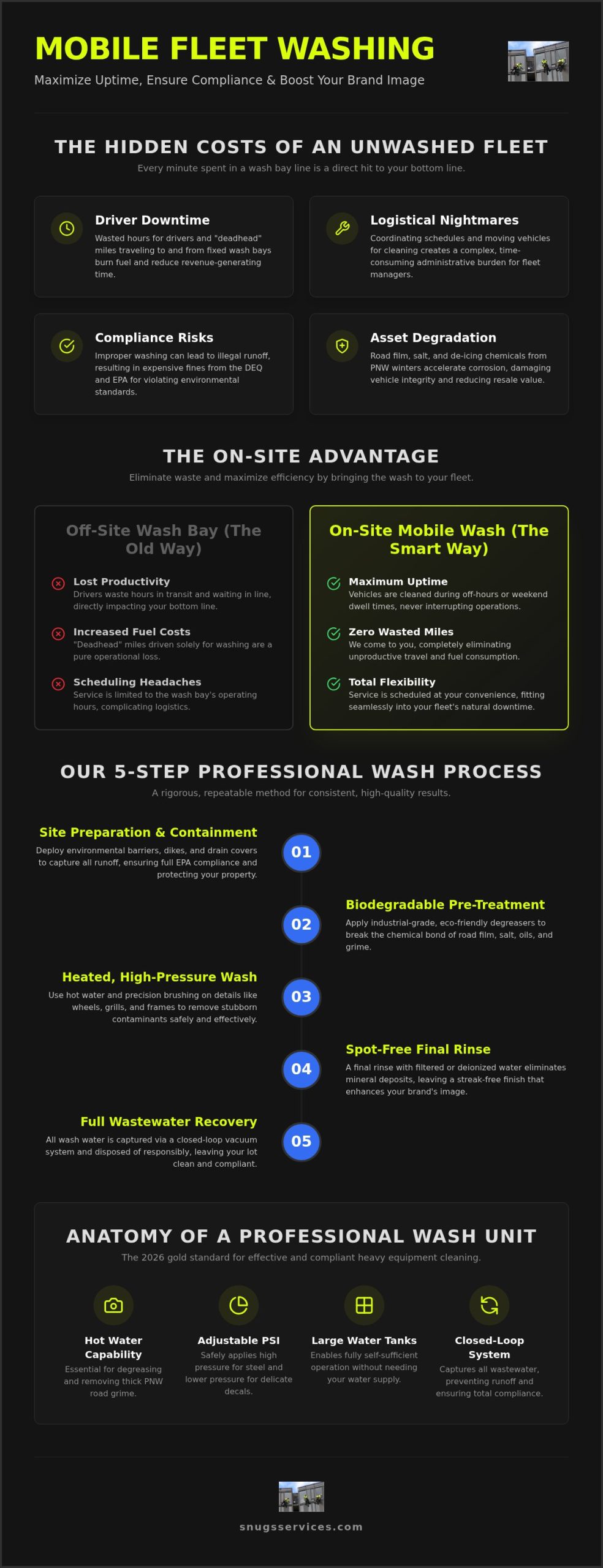
Logistics managers in 2026 are increasingly moving away from fixed wash bays to eliminate “deadhead” miles. These are the unproductive miles driven solely to reach a cleaning facility, which burn fuel and waste expensive driver hours. For logistics hubs in Salem and Eugene, recovering these lost hours can significantly impact the bottom line. By choosing on-site washing, you can schedule service during off-hours or weekend dwell times. This ensures your vehicles are cleaned while they are already stationary, maximizing your fleet’s uptime and revenue potential.
The Anatomy of a Professional Wash Unit
A professional mobile rig is built for versatility and power. The most effective units offer hot water capabilities, which are essential for degreasing engines and removing the thick road grime common in the Pacific Northwest. Cold water simply can’t achieve the same level of cleanliness on heavy-duty frames. We also look for adjustable PSI settings; this allows our technicians to use high pressure for steel frames and lower, safer pressure for aluminum trailers or delicate decals. A closed-loop mobile wash system serves as the 2026 gold standard for fleet maintenance by capturing all wastewater to prevent environmental runoff. This level of technical precision ensures your heavy equipment cleaning is both effective and fully compliant with local regulations.
The 5-Step Process of a Professional Mobile Fleet Wash
Getting a truly professional result requires more than just a hose and some soap. It requires a disciplined, repeatable sequence of events that prioritizes the safety of your vehicles and the integrity of your property. At Snugs, we follow a rigorous five-step method to ensure every inch of your fleet meets our high standards for cleanliness. This structured approach eliminates the guesswork and provides a level of consistency that generic vendors simply cannot match.
The process begins with comprehensive site preparation. Before a single drop of water hits your trucks, our technicians deploy environmental barriers like dikes and drain covers. This ensures that all runoff is captured and managed according to EPA environmental compliance standards. This proactive step protects your business from heavy fines and keeps the local waterways in Portland and Vancouver clean. It’s a neighborly way to do business that respects our shared environment.
Next, we apply a pre-treatment of biodegradable degreasers. These specialized formulas are designed to break the chemical bond between road film, salt, and your vehicle’s surface. Once the chemistry has done its work, we move into high-pressure agitation. During this phase of heavy equipment cleaning, we use precision brushing on detail areas like wheels, grills, and mirror housings where grime tends to hide. We treat every vehicle with the pride of a local craftsman, ensuring no corner is overlooked.
Our fourth step involves a spot-free rinse using filtered or deionized water. This is crucial for protecting modern paint finishes and expensive company graphics from mineral deposits and streaks. Finally, we perform full water recovery and site cleanup. Whether we are working on a lot in Beaverton or Hillsboro, we leave the area pristine and ready for your next shift. If you want to experience this level of detail firsthand, our team can provide professional fleet washing that keeps your operations running smoothly.
Pre-Wash Inspection and Safety
Safety starts before the power units are even engaged. Our technicians perform a thorough walk-around to check for loose seals, open windows, or damaged graphics that could be compromised by high-pressure water. In busy Vancouver industrial parks, we maintain strict safety protocols to work effectively around moving yard equipment and personnel. We also take extra care to protect sensitive electronics and reefer units from water ingress, ensuring your equipment stays in top working order without any functional setbacks.
Detergent Science for 2026 Trucks
Modern trucks require modern chemistry to stay in peak condition. We utilize a “two-step” washing method, which remains the gold standard for removing magnetic road film without aggressive scrubbing that can scratch paint. This involves applying a specific pre-soak followed by a complementary alkaline detergent. The resulting reaction lifts dirt away safely and efficiently. We use pH-balanced soaps specifically chosen to protect expensive vinyl wraps and company decals. For those with aluminum trailers, we apply non-corrosive brighteners to maintain that “Snugs-clean” professional image that reflects the quality of your brand.
Environmental Compliance: DEQ and EPA Standards in the PNW
Operating a fleet in the Pacific Northwest means answering to some of the strictest environmental regulations in the country. In Multnomah and Clark counties, the high cost of non-compliance isn’t just a hypothetical risk; it’s a financial reality that can result in thousands of dollars in fines for illegal discharge. Local agencies are increasingly vigilant about runoff entering protected waterways. Choosing a partner for heavy equipment cleaning who understands these local nuances is the only way to protect your business from unnecessary liability.
At Snugs Services, we manage wastewater according to the rigorous standards set by the Oregon Department of Environmental Quality (DEQ) and the Washington Department of Ecology. In Portland, for example, mobile washers must obtain a specific Discharge Authorization to release water into the sanitary or combined sewer system. We ensure all discharge meets the required pH levels of 5.0 to 11.5 and stays within the 50 gallon per minute limit. This technical precision removes the stress from your plate and ensures your operations remain above board.
Understanding the difference between storm drains and sanitary sewers is critical in industrial zones like Gresham and Tualatin. Storm drains lead directly to our rivers and streams, while sanitary sewers lead to treatment plants. Discharging wash water into a storm drain is strictly prohibited. We take the guesswork out of the equation by identifying the correct disposal points on your property. Beyond the wash itself, we provide the detailed disposal records you’ll need for your 2026 audit trail, giving you peace of mind that every drop was handled legally.
Water Reclamation and Recovery Systems
We utilize advanced vacuum booms and specialized wash mats to capture every drop of runoff before it can reach a drain. This closed-loop approach is essential for modern heavy equipment cleaning on your own lot. Once captured, the water undergoes a filtration process to remove oils, heavy metals, and suspended solids. This level of care is a legal requirement for wash water disposal in Multnomah County to avoid severe environmental penalties. It’s a professional standard we’ve upheld since 1995 to keep our community’s water safe.
Biodegradable vs. Eco-Friendly Chemicals
Not all “green” cleaners are created equal. We prioritize “readily biodegradable” detergents that meet the high 2026 environmental standards for rapid breakdown. Phosphate-free formulas are non-negotiable for protecting PNW watersheds and maintaining local compliance. By balancing industrial-strength cleaning power with genuine environmental stewardship, we help you maintain a professional fleet while simultaneously protecting your brand’s local reputation. We don’t just clean your trucks; we safeguard your standing as a responsible member of the Portland and Vancouver business community.
ROI and Brand Image: Why Clean Trucks Move Faster
Your fleet is your most visible marketing asset in the Portland metro area. Think of every vehicle as a rolling billboard. When your trucks are caked in road grime, they tell a story of neglect to every potential customer on the I-5 corridor. Conversely, a spotless fleet projects a standard of excellence that builds immediate trust. Beyond the visual appeal, professional heavy equipment cleaning is a fundamental maintenance task. PNW winters bring heavy de-icing salts that cling to undercarriages, causing rapid corrosion if left unaddressed. Keeping these areas clean prevents premature rust and ensures that critical safety markings, VIN plates, and lights remain clearly visible for DOT inspections. When safety officers can see that a vehicle is well-maintained, it often reduces the friction and time spent during roadside stops.
Fleet Longevity and Resale Value
Regular maintenance is the best way to prevent the oxidation of paint and the pitting of chrome. By utilizing professional truck washing services, you’re effectively extending the life of your equipment. A clean engine and undercarriage also make it much easier to identify hydraulic leaks or structural damage early. Integrating cleanliness into your broader fleet washing strategy is a proactive move for long-term asset protection. It preserves the resale value of your trucks, ensuring you get the highest possible return when it’s time to cycle out older models.
The Psychology of a Clean Fleet
There’s a powerful psychological component to a well-maintained fleet. When a gleaming truck arrives for a delivery at a high-end facility in Wilsonville or Camas, it reinforces your brand’s reliability. This attention to detail doesn’t just impact customers; it significantly boosts driver morale. Drivers take more pride in operating equipment that reflects the Snugs standard of excellence. This pride often translates into better driving habits and improved safety records. Industry studies suggest that drivers who operate clean, well-kept vehicles are more likely to follow safety protocols and treat their equipment with greater respect.
Investing in your fleet’s appearance is a direct investment in your company’s future. It’s about more than just aesthetics; it’s about operational efficiency and professional pride. If you’re ready to see the difference a professional touch can make, you can schedule your fleet wash consultation with our local team today.
Choosing a Mobile Truck Wash Partner in Portland & Vancouver
Selecting the right vendor determines whether your fleet maintenance is a seamless process or a constant source of logistical stress. You need a provider with deep localized experience who has navigated the unique climate and regulatory challenges of the Pacific Northwest for decades. A company serving the Portland and Vancouver area since 1995 brings a level of reliability that national startups simply can’t match. They understand the technical nuances of heavy equipment cleaning in our damp environment and maintain the specific environmental permits required by Oregon and Washington state laws. This local expertise ensures that your wash schedule remains consistent, even when the weather doesn’t cooperate.
Capacity is another critical factor to evaluate before you sign a contract. Your partner must possess the equipment and manpower to handle your entire fleet within a single dwell-time window. It doesn’t matter if you have five trucks or five hundred; the work must be completed thoroughly and on time to avoid disrupting your routes. A truly professional partner will also offer a broader range of facility maintenance, such as commercial pressure cleaning services to keep your loading docks and bay doors as clean as your vehicles. This holistic approach ensures your entire property reflects a high professional standard that your customers will notice.
The Importance of Local Roots
National franchises often struggle with the unpredictable PNW weather and the specific regional runoff regulations that vary between counties. A local partner knows the logistics corridors of Salem, Eugene, and Longview intimately. By supporting family-owned businesses like Snugs Services, you ensure community stability and local accountability. You aren’t just another account number in a national database; you’re a neighbor whose business success matters to the people doing the work. This personal connection leads to better communication and a higher level of pride in the final result.
Questions to Ask Before You Sign a Contract
Before finalizing any agreement, ask direct questions to verify their operational standards and technical competence. Do they provide manifest reports for water disposal to prove your environmental compliance during a 2026 audit? What is their specific backup plan for extreme PNW winter weather to ensure your fleet stays on schedule? You should also ask if they can integrate parking lot sweeping into your fleet wash schedule for total facility care. Finally, ensure they have documented experience with heavy equipment cleaning for municipality or industrial park contracts; for businesses aiming to expand further into the federal marketplace, Capital Reps (dba Just GSA) provides essential GSA MAS Schedule preparation and submission services. This level of coordination is what separates a basic cleaning vendor from a true professional partner who is invested in your fleet’s longevity.
Secure Your Fleet’s Future on Your Own Lot
Managing a modern fleet requires balancing operational speed with strict environmental accountability. By transitioning to a mobile on-site model, you eliminate the hidden costs of driver downtime and “deadhead” miles while ensuring your vehicles project a high professional standard. Our specialized approach to heavy equipment cleaning uses advanced water reclamation technology to capture every drop of runoff, keeping you fully compliant with DEQ and EPA regulations. It’s a way to restore the aesthetic and functional integrity of your assets without the stress of logistical coordination.
Since 1995, Snugs Services has provided reliable, neighborly expertise to the Portland and Vancouver business communities. We take the physical labor and regulatory guesswork off your plate, allowing you to focus on what you do best: moving your business forward. Let us help you protect your ROI with a cleaning schedule that works around your dwell time and keeps your equipment in peak condition. Your fleet is the face of your company; let’s make sure it reflects the quality of your work.
Get a Professional Fleet Wash Quote from Snugs Services today and experience the relief of a well-maintained environment.
Frequently Asked Questions
How much does a mobile truck wash cost per vehicle in the Portland area?
Pricing for our services depends on your fleet size, the type of vehicles involved, and how often you need them cleaned. We provide custom quotes tailored to your specific operational needs to ensure you receive the most accurate and fair value. Generally, larger fleets benefit from a lower per-unit rate, and we’re happy to discuss these options during your initial consultation to find a plan that fits your budget.
Is mobile truck washing legal in Portland and Vancouver without a wash pad?
Yes, mobile truck washing is perfectly legal in both cities as long as the service provider uses professional water reclamation technology. Snugs utilizes specialized dikes, drain covers, and high-powered vacuum systems to capture every drop of runoff on any flat surface. This process ensures your business stays in full compliance with DEQ and EPA regulations without the need for a permanent, expensive wash pad installation on your lot.
Do I need to provide a water hookup for the Snugs mobile wash team?
No, you don’t need to provide a water hookup because our mobile rigs are completely self-contained. Each unit carries its own high-capacity water tanks and independent power supply to handle the entire job from start to finish. This flexibility allows us to perform heavy equipment cleaning in remote sections of your property or at facilities where external water access is limited or difficult to reach.
How long does it take to wash a full tractor-trailer unit on-site?
A standard exterior wash for a full tractor-trailer unit typically takes between 20 and 40 minutes. This timeframe can shift slightly depending on the amount of road grime present and whether you’ve requested specialized services like aluminum brightening or engine degreasing. Our technicians work efficiently during your fleet’s scheduled dwell time to ensure your equipment is ready for the next shift without causing any unnecessary delays for your drivers.
Can you wash my fleet during the night or on weekends in Beaverton?
We offer flexible scheduling that includes off-hours and weekend windows to maximize your fleet’s uptime. Many of our partners in Beaverton prefer service during these times so their vehicles are clean and ready to roll by Monday morning. Our team coordinates closely with your yard managers to ensure a smooth, neighborly process that doesn’t disrupt your standard business operations or loading dock traffic.
What happens to the dirty water after the mobile wash is finished?
All captured wash water is recovered using our advanced vacuum systems and transported to an authorized disposal facility. We maintain strict manifest records to document the entire filtration and legal disposal process, which protects you from environmental liability. This closed-loop system effectively removes oils, heavy metals, and solids, ensuring your property remains pristine and the local Pacific Northwest watersheds stay protected from industrial runoff.
Do you offer specialized heavy equipment cleaning for construction machinery?
How often should my fleet be washed to prevent corrosion from road salt?
We recommend washing your vehicles at least every two weeks during the winter to prevent corrosion from de-icing salts and magnesium chloride. If your trucks frequently travel through mountain passes or heavy snow zones, weekly cleaning is the best way to protect brake lines and undercarriages from premature rust. Consistent maintenance is a small investment that significantly extends the lifespan of your equipment while keeping your brand looking professional.
Recent Comments