
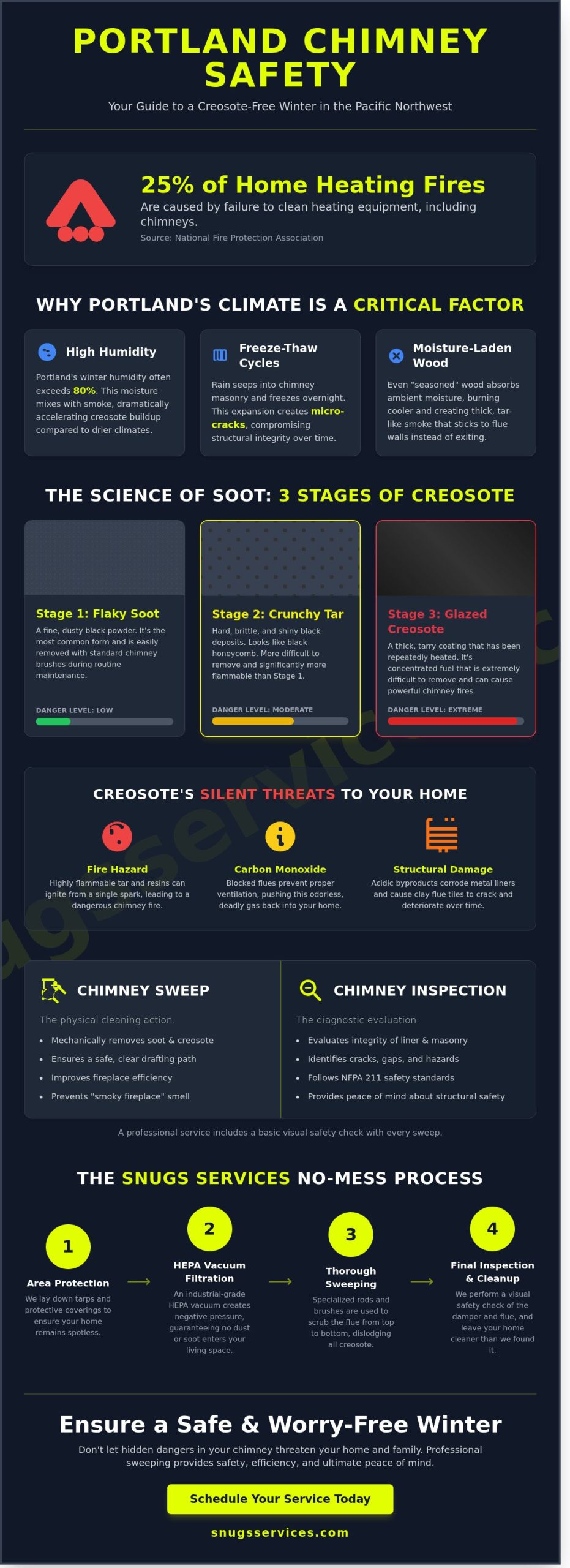
According to the National Fire Protection Association, failure to clean home heating equipment like your fireplace accounts for 25% of all home heating fires. For Portland homeowners, that statistic isn’t just a number; it’s a vital reminder that a cozy evening can turn dangerous without proper maintenance. Professional chimney sweeping is the most effective way to remove the three types of dangerous creosote that threaten your home’s safety. At Snugs Services, we believe you shouldn’t have to choose between a warm home and a safe one.
We understand the anxiety that comes with fireplace maintenance. You want to enjoy a crackling fire without worrying about hidden hazards or a living room covered in soot. It’s frustrating to deal with the mystery of what’s happening inside your flue. This guide provides everything you need to know about keeping your Portland fireplace safe, efficient, and creosote-free throughout the 2026 winter season. We will explain the professional cleaning process, help you identify structural risks early, and show you how to achieve total peace of mind for your family. By the end, you’ll have a clear roadmap to a worry-free winter by the hearth.
Key Takeaways
- Learn why Portland’s unique humidity levels demand a specific maintenance schedule to prevent rapid creosote accumulation in your masonry flue.
- Understand the chemical risks of soot and how to eliminate flammable deposits before they become a silent threat to your family’s safety.
- Identify the ideal frequency for professional chimney sweeping based on your fireplace type and the specific woods you burn this winter.
- Discover how expert technicians utilize industrial HEPA vacuums to ensure a pristine, mess-free cleaning process that leaves your home spotless.
- See how coordinating your chimney care with other essential exterior maintenance can restore your home’s safety and provide ultimate peace of mind.
Understanding Chimney Sweeping in the Pacific Northwest
A professional chimney sweep does much more than just brush away dust. It’s the mechanical removal of soot and creosote to ensure your home maintains a safe, clear drafting path. Portland’s climate presents unique challenges, as humidity levels often stay above 80% throughout the winter months. This moisture enters masonry flues and mixes with combustion byproducts, causing creosote to accumulate significantly faster than in drier climates. Scheduling a cleaning now prepares your home for the 2026 winter season, ensuring your heating system operates with maximum efficiency and pristine air quality.
To better understand how this process works in a residential setting, watch this helpful video:
Portland’s 40-degree rain often turns into 30-degree ice overnight. This creates a destructive freeze-thaw cycle. When water seeps into your chimney’s mortar and freezes, it expands and creates micro-cracks. Our team uses the cleaning process to expertly identify these structural issues before they become safety hazards. A clean flue also prevents the “smoky fireplace” smell that plagues many PNW homes during damp weather. Removing these deposits allows your fireplace to draw air properly, which keeps your indoor environment healthy and free of fine particulates.
Why Portlands Rain Makes Chimney Care Critical
Burning wood with a moisture content above 20% leads to incomplete combustion and thick, tar-like creosote. In the Pacific Northwest, even seasoned wood absorbs ambient moisture quickly. This damp fuel creates cooler smoke that sticks to the flue walls instead of exiting the home. External moisture also erodes chimney crowns and mortar joints over time. Heavy, moisture-laden air creates a dense atmospheric pressure that significantly reduces flue draft speed and prevents smoke from rising effectively.
Chimney Sweep vs. Chimney Inspection: What is the Difference?
It’s vital to understand that a sweep is a cleaning action, while an inspection is a diagnostic tool. A sweep removes the physical buildup, but an inspection evaluates the integrity of the liner and masonry. Professionals follow the NFPA 211 standards, which outline three distinct levels of chimney inspections based on the home’s needs. A standard sweep should always include a basic visual safety check to ensure your damper and flue are ready for a worry-free fire. This dual approach provides the relief of a clean home and the confidence of a safe structure.
The Science of Soot: Why Creosote is a Silent Threat
Every time you light a fire, a complex chemical reaction takes place inside your flue. Creosote is the carbonaceous byproduct that forms when wood smoke, water vapor, and gases condense on the cool interior surfaces of your chimney. This substance is highly flammable because it consists mostly of concentrated tar and resins. When homeowners run slow-burning fires to conserve wood, the smoke moves slower and stays cooler. This leads to a rapid accumulation of deposits that can ignite at any moment. According to safety experts, this buildup represents a significant potential fire hazard for residential properties.
Restricted airflow does more than just hinder your fire’s performance. When layers of soot choke the flue, it creates a backdraft effect. This pressure imbalance can push invisible, odorless carbon monoxide back into your living room. Beyond the immediate respiratory risks, creosote is naturally acidic. Over time, these chemicals eat away at metal liners and cause clay tiles to flake and crack. Professional chimney sweeping removes these corrosive elements, preserving the structural integrity of your home and saving you from expensive masonry repairs later on.
The Three Stages of Creosote Explained
Creosote transforms as it accumulates, becoming more dangerous with every burn. Our team identifies which stage your chimney is in to determine the best cleaning method:
- Stage 1: This is a flaky, dusty soot. It’s the most common form and is easily brushed away during routine maintenance.
- Stage 2: This stage looks like crunchy, black honeycombs. It contains high levels of tar and requires specialized scraping tools to remove effectively.
- Stage 3: This is a hard, glass-like coating that resembles obsidian. It’s concentrated fuel that is extremely difficult to remove and poses the highest risk of a house fire.
How Chimney Fires Start and How to Spot One
A chimney fire can be a terrifying experience. Many homeowners describe the sound as a low-frequency rumble, similar to a freight train passing through the house or a loud, aggressive crackling. You might notice intense heat radiating from the walls around the fireplace. Watch for dense, oily smoke billowing from the top of the stack or flaming debris landing on your shingles. In the PNW, these sparks are especially dangerous if your roof is covered in dry debris. Scheduling a professional Portland Roof Cleaning ensures that stray sparks don’t find easy fuel on your roof deck.
Regular chimney sweeping is the most reliable way to prevent these emergencies. We handle the dirty work so you can enjoy a warm, worry-free evening by the hearth. If you haven’t had your flue inspected in the last 12 months, you can schedule a professional assessment to ensure your system is clean and clear for the season.
How Often Should You Schedule Chimney Sweeping?
Most homeowners wait until they smell smoke or see soot before calling a professional. However, the National Fire Protection Association (NFPA) Standard 211 dictates that chimneys, fireplaces, and vents must be inspected at least once per year. For active wood-burning systems in the Pacific Northwest, this inspection usually leads to a necessary chimney sweeping to remove dangerous creosote. If you primarily burn softwoods like pine or Douglas Fir, your system accumulates flammable deposits 25 percent faster than systems using seasoned hardwoods. These resinous woods are abundant in our region, making regular maintenance a safety priority rather than a luxury.
Timing matters just as much as frequency. For 2026, we advise Portland residents to secure their service appointments before the first frost, which historically arrives by October 15. Scheduling early prevents the winter rush and ensures your home is ready for the first cold snap. Even seasonal users who only light a fire on holidays need an annual check. During the spring and summer, local birds or squirrels often build nests in the flue. These obstructions create immediate smoke-back hazards and carbon monoxide risks when you finally strike that first match in December.
Signs Your Chimney is Overdue for a Cleaning
You can perform a basic “Soot Test” to gauge your risk level. Take a fireplace poker and scratch the surface of the flue wall. If the groove you leave is 1/8 of an inch deep or more, you should stop using the fireplace until it is cleaned. Pay attention to your nose during the summer months too. A strong campfire smell when the fireplace isn’t in use indicates that humidity is reacting with heavy creosote deposits. You might also see black, oily gunk dripping down the back of the firebox. This is a sign of Stage 3 creosote, which is the most difficult and dangerous type of buildup to remove.
Frequency Guidelines by Fireplace Type
Different heating appliances have unique maintenance cycles. Wood stoves run at higher internal temperatures and often require chimney sweeping after every two cords of wood burned. Open masonry fireplaces are less efficient and may last a full season, but they still require a professional look to check for mortar cracks. Gas fireplaces are cleaner but still face issues with venting. Roughly 30 percent of gas fireplace failures stem from spider webs or debris blocking the burner or pilot light. Pellet stoves produce a very fine ash that can quickly choke narrow 3-inch vent pipes. These systems generally need a thorough cleaning after every ton of pellets consumed to maintain proper airflow and efficiency.
What to Expect During a Professional Chimney Sweeping Service
Professional chimney sweeping isn’t just about a brush and a bucket. It’s a high-tech maintenance routine designed to keep your PNW home safe and clean. When our team arrives, we follow a rigorous protocol to ensure every inch of your flue is clear without leaving a single speck of soot on your carpet. We treat your property with the respect of a neighbor while applying the technical expertise of a master craftsman. Our goal is to leave your home safer than we found it, providing you with total confidence in your fireplace.
Preparing Your Home for a Dust-Free Service
We want your experience to be entirely stress-free. To help us work efficiently and maintain a clean environment, we recommend a few simple steps before we arrive:
- Clear the area: Please move furniture or toys to provide a 5-to-6-foot radius around the hearth for a safe workspace.
- Cool down: Refrain from using your fireplace for at least 24 hours prior to the appointment so the masonry is safe to touch.
- Protect valuables: While we take every precaution, removing fragile items from the mantel ensures they stay protected.
Snugs Services uses heavy-duty drop cloths and specialized sealants to guarantee a pristine living room. We create a pressurized seal around the fireplace opening, ensuring that every particle of dust stays contained within our vacuum system rather than floating into your home.
Tools of the Trade: Beyond the Simple Brush
Modern chimney care relies on precision technology rather than just manual scrubbing. We utilize rotary power sweeping tools that spin at high speeds to safely break away stubborn Stage 2 creosote, which traditional wire brushes often miss. Because soot particles are microscopic, we employ industrial-grade HEPA vacuums that capture 99.97% of dust and allergens. Our high-definition chimney cameras identify hidden cracks in the flue liner that are invisible to the naked eye. This video technology allows us to show you the exact condition of your chimney interior in real-time, removing the guesswork from the inspection.
Depending on your home’s architecture, we choose between top-down and bottom-up sweeping methods. Top-down sweeping involves working from the roof to push debris toward our vacuum system at the base. Bottom-up sweeping allows us to clean the entire length of the flue from inside the hearth, which is often safer and more effective for homes with steep PNW rooflines. Both methods are designed to be thorough and non-invasive. You’ll receive a detailed report of our findings, giving you the peace of mind you deserve.
Don’t let soot buildup compromise your home’s safety this season. Contact the local experts at Snugs Services to schedule your professional chimney sweeping today.
Protecting Your Portland Home with Snugs Services
Since 1995, Snugs Services has operated as a family-owned pillar of the Pacific Northwest community. We understand that your home is your most significant investment and your sanctuary. Our “good neighbor” philosophy means we show up on time, communicate clearly, and treat every property with the professional care it deserves. We don’t just clear away soot; we restore the peace of mind that comes with a safe, functional hearth. Our technicians bring decades of local experience to every job, ensuring that your chimney sweeping is performed to the highest safety standards.
Efficiency is key for busy homeowners. By integrating your annual maintenance with other essential tasks like gutter cleaning in Portland, you save time and ensure your home’s exterior is fully prepared for the rainy season. This holistic approach allows our team to inspect the transition points between your roof, gutters, and masonry, catching small issues before they evolve into expensive repairs. We take pride in being the reliable experts who do the job right the first time.
A Holistic Approach to Home Safety and Maintenance
A clean Portland home is more than just an aesthetic choice. It is a safer environment for your family and a more valuable asset in our competitive market. We often recommend bundling chimney care with pressure washing in Portland to remove the moss, algae, and grime that frequently trap moisture against your siding and masonry. This total home refresh protects your curb appeal and your structural integrity simultaneously.
Safety maintenance should extend beyond the fireplace. Our team also provides expert dryer vent cleaning to address a common but overlooked fire hazard. According to the National Fire Protection Association, nearly 16,000 home fires are caused by clothes dryers annually, with 27 percent of those fires triggered by simple lint buildup. Adding this service to your maintenance plan creates a comprehensive fire prevention strategy for your household.
Ready for a Worry-Free Winter?
The 2026 burning season will arrive quickly. Don’t wait until the first frost to realize your fireplace isn’t ready for use. Snugs Services makes the entire process seamless with hassle-free scheduling and professional execution. We handle the heavy lifting, the soot disposal, and the dangerous heights so you can stay safely on the ground. Our goal is to leave your home pristine and your family protected.
Our team is ready to provide the expert care your home needs to stay warm and safe. Contact Snugs Services today to book your safety inspection and chimney sweeping before the winter rush begins. Experience the relief of working with a local partner who has been dedicated to PNW home health for nearly three decades.
Secure Your Portland Hearth for the 2026 Season
Don’t let creosote buildup turn your cozy fireplace into a hidden hazard. Keeping your home safe requires more than just a quick glance up the flue; it demands the precision of chimney sweeping performed by experts who understand the unique damp climate of the Pacific Northwest. Since 1995, Snugs Services has provided Portland homeowners with the peace of mind that comes from meticulous maintenance and neighborly care. Our family-owned team uses HEPA-filtered dust containment systems to ensure your interior stays pristine while we remove dangerous soot and obstructions.
You deserve a worry-free home where the only thing you focus on is the warmth of the fire. Our expertly trained technicians bring over 30 years of local experience to every job, handling the heavy lifting so you don’t have to. We pride ourselves on being the reliable professionals who show up on time and restore the safety of your most valuable asset. Take the hassle out of home maintenance and enjoy the relief of a job done right the first time.
Schedule Your Professional Chimney Sweeping with Snugs Services Today
We look forward to helping you keep your home bright and safe for years to come.
Frequently Asked Questions About Chimney Sweeping
How much does chimney sweeping cost in Portland for 2026?
Professional chimney sweeping in Portland for 2026 typically ranges between $175 and $450 depending on the flue’s condition and the height of your roof. This price usually includes a full safety inspection to identify cracks or dangerous creosote buildup. While local rates vary, investing in a yearly sweep prevents costly structural repairs that can exceed $5,000 for a full flue relining.
Do chimney sweeping logs actually work as a replacement for professional cleaning?
Chimney sweeping logs do not replace a professional cleaning because they only loosen a small portion of creosote rather than removing it from the home. These logs use chemical additives to flake off deposits, but the debris still sits on your smoke shelf or hearth. You still need a technician to physically brush the flue and vacuum out the soot that poses a fire hazard.
Is chimney sweeping a messy process that will ruin my carpets?
Professional chimney sweeping is a clean, worry-free process that uses HEPA-filtered vacuums and industrial drop cloths to protect your living space. Technicians seal the fireplace opening with specialized shrouds before they start. This ensures that 100% of the soot stays contained, leaving your carpets and furniture in pristine condition. You won’t have to lift a finger or worry about dust.
Can I sweep my own chimney to save money?
You can sweep your own chimney, but 1 in 10 DIY attempts results in overlooked blockages or accidental damage to the flue liner. Professional equipment reaches angles that standard consumer brushes miss entirely. We handle the heavy lifting and provide a certified inspection report. This documentation is often vital for your records and ensures your home stays safe throughout the damp PNW winters.
What happens if I never get my chimney swept?
Neglecting your chimney leads to creosote accumulation, which is the primary cause of over 25,000 chimney fires in the United States annually. These fires can reach 2,000 degrees Fahrenheit and melt mortar or ignite your roof framing. Regular chimney sweeping removes this fuel source. It also prevents carbon monoxide from backing up into your living room due to restricted airflow or hidden bird nests.
How long does a professional chimney sweeping appointment take?
A standard professional appointment takes between 45 and 90 minutes to complete properly. This timeframe allows our experts to set up protective gear, sweep the entire flue, and perform a detailed safety check. If we find heavy Stage 3 creosote or structural issues, the process might take slightly longer. We work efficiently to restore your home’s warmth without disrupting your daily schedule.
Are chimney sweeps required by law or insurance in Oregon?
Oregon law doesn’t mandate annual sweeps for residential homes, but most homeowner insurance policies require regular maintenance to cover fire-related claims. If a fire occurs and you can’t prove the chimney was maintained, the provider may deny your claim. Keeping your 12-month service receipts ensures you remain compliant with policy terms. It provides a seamless path to safety and financial protection.
What is the best time of year to schedule a chimney sweep in the PNW?
The best time to schedule your sweep is between April and August before the rainy season begins in October. Scheduling during the spring or summer ensures your system is ready for the first cold snap of the year. You’ll avoid the 3-week wait times that typically occur during the peak fall rush. Our team can work in better weather to ensure your chimney is sparkling and ready.
Recent Comments