
The lowest exterior-cleaning bid can be difficult to budget for when its scope is vague. A practical exterior cleaning budget for commercial property starts with the areas that need attention, not a headline price. Windows, concrete, roofs, and parking areas can require different cleaning methods, access arrangements, and schedules.
To get proposals you can compare, define the same tasks, surfaces, and service frequency for each estimate. Then set priorities based on the property’s condition and how people use it. A clear scope also helps you plan work around tenants, customers, deliveries, and daily operations.
This guide shows how to inventory exterior areas, compare proposals on consistent terms, and prioritize recurring cleaning and targeted maintenance. Snugs Services supports commercial properties in the Portland and Vancouver metro areas with services including pressure washing, high-rise window washing, parking garage cleaning, and parking lot sweeping. The company serves properties in Portland, Gresham, Salem, Eugene, Vancouver, Beaverton, Tualatin, Tigard, Hillsboro, Longview, Richfield, Battle Ground, Camas, Wilsonville, and Keizer.
Key Takeaways
- Build an exterior cleaning budget for commercial property around defined tasks, access needs, scheduling, and recurring maintenance, not an assumed price.
- Account for building size, surface types, soil conditions, access, and daily activity when defining the scope.
- Compare proposals using the same areas, tasks, scheduling assumptions, preparation, access arrangements, cleanup, and deliverables.
- Use a repeatable process to inventory exterior areas, assess their condition, rank priorities, schedule work, and review the plan.
- Snugs Services serves the Portland and Vancouver metro areas with commercial exterior services such as pressure washing and parking garage cleaning.
What belongs in an exterior cleaning budget for a commercial property?
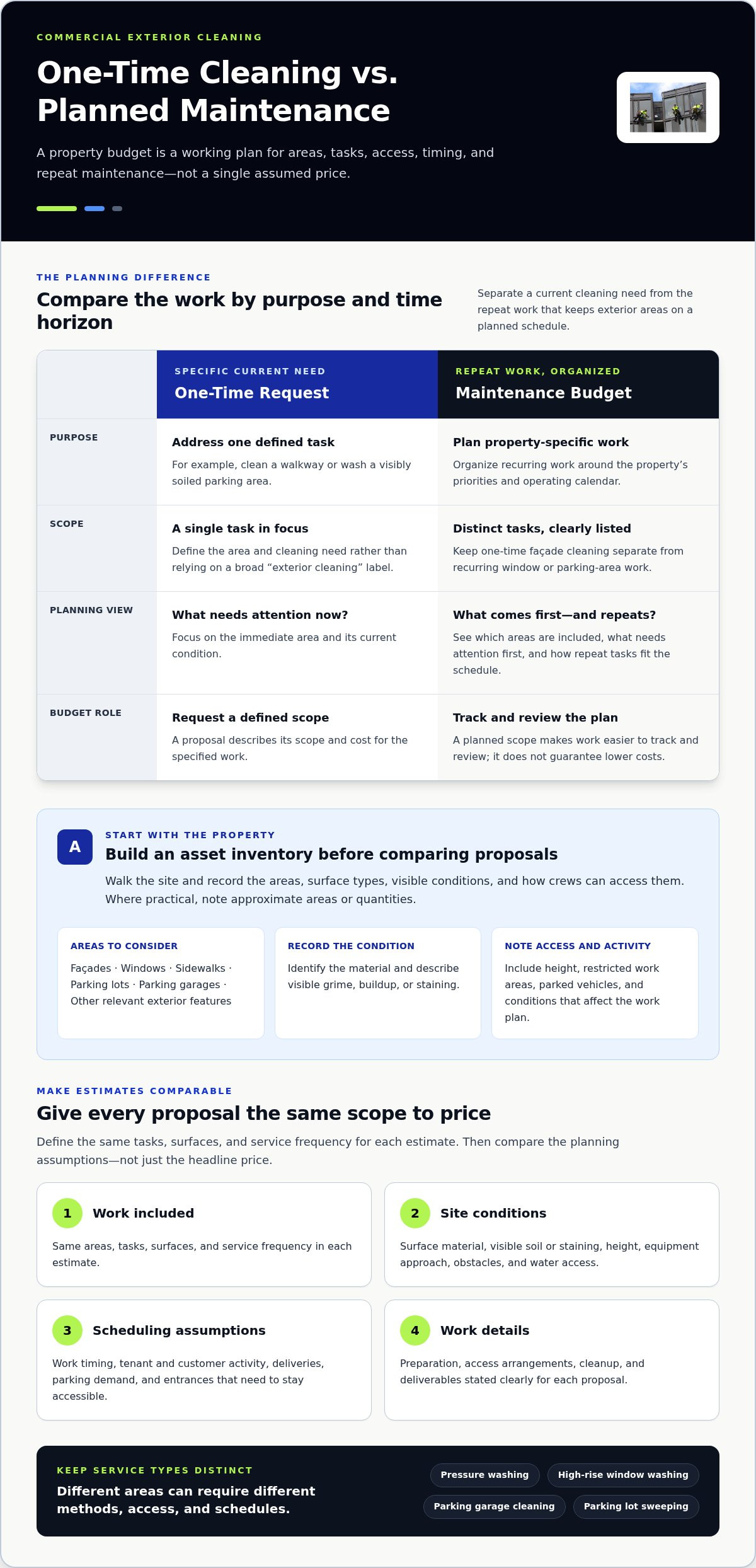
An exterior cleaning budget for commercial property is a working plan for the areas, tasks, access requirements, timing, and repeat maintenance a building needs. It is not a single assumed price. A proposal describes its scope and cost; your budget defines the property-specific work you want to plan and fund.
Two properties of similar size in Portland or Vancouver can have different surfaces, access conditions, tenant activity, and cleaning needs. An inventory of your site makes those differences visible before you compare proposals or set priorities. It also separates routine exterior cleaning from specialized tasks.
For a visual look at pressure washing as one part of exterior maintenance, watch this video:
Which exterior areas should a commercial budget cover?
Start with an asset inventory, not a general line labeled “exterior cleaning.” Walk the property and list the areas that may need attention, their surface types, visible conditions, and how crews can access them. Consider façades, windows, sidewalks, parking lots, parking garages, and other relevant exterior features. Where practical, record approximate areas or quantities, along with visible grime, buildup, or staining.
- Surface and condition: Identify the material and describe the cleaning need, such as visible buildup on concrete or soiling on glass.
- Access: Note height, restricted work areas, parked vehicles, and other conditions that could affect the work plan.
- Service type: Distinguish routine sidewalk or parking-area cleaning from specialized work such as high-rise window washing.
This inventory gives you a clearer basis for defining the scope. For broader context, Property maintenance includes ongoing work that helps keep a building and its surroundings in usable condition.
How does a maintenance budget differ from a one-time cleaning request?
A one-time request addresses a specific current need, such as cleaning a walkway or washing a visibly soiled parking area. A maintenance budget looks beyond that task. It organizes repeat work around the property’s priorities, so managers can see which areas are included, what needs attention first, and how recurring tasks fit the operating calendar. Comprehensive property care providers like Service King Commercial take a similar approach by structuring scheduled trade services and building maintenance into ongoing operational plans.
A planned scope does not guarantee lower costs, but it can make the work easier to track and review. For example, separate a one-time façade cleaning from recurring window or parking-area work instead of grouping everything under a vague exterior line item. Snugs Services provides commercial pressure washing, high-rise window washing, parking garage cleaning, and parking lot sweeping, which can be defined as distinct tasks in a property scope.
What factors shape a commercial exterior-cleaning budget in Portland and Vancouver?
A building’s footprint is only one part of the planning picture. Surface type, soil condition, height, access, and site activity all affect the scope. A broad concrete apron with open equipment access presents different planning needs from a multi-story façade beside busy entrances. For a useful exterior cleaning budget for commercial property, record the conditions that shape the work instead of relying on building size alone.
A clearly defined site scope shows which areas, methods, access needs, and timing assumptions the work covers. That clarity helps property managers identify gaps and compare proposals on equal terms.
How do surfaces and access change the cleaning scope?
Different materials and conditions need to be assessed separately. Concrete, masonry, glass, and other surfaces should not be grouped into one generic cleaning task. Soil also varies across a property: a sheltered entrance, an exposed walkway, and a busy parking area can collect different kinds and levels of buildup. Professional exterior specialists such as Ultimate Clean Solutions emphasize evaluating paved surfaces individually to ensure the right washing methods and treatments are applied to each area.
- Surface: Identify the material and area, then distinguish pressure washing from soft washing or window cleaning when the work differs.
- Condition: Describe visible buildup or staining so the scope reflects the site, not just a service label.
- Access: Note height, equipment approach, obstacles, and available water access. Parked vehicles, landscaping, narrow service lanes, and occupied entrances may affect how work areas are coordinated.
These details matter for both ground-level and elevated work. High-rise windows need a separate scope from accessible ground-floor glass because their height and access conditions differ. A site walk-through can turn observations into defined areas, tasks, and planning assumptions.
How should Portland-Vancouver scheduling affect budget planning?
Build the schedule around how the property operates. Note business and tenant hours, customer traffic, deliveries, parking demand, and entrances that need to remain accessible. A retail property may need cleaning coordinated around customer movement; an office or industrial site may have different busy periods and work-area constraints.
Weather and seasonal buildup also deserve attention in the Portland and Vancouver area, but there is no single schedule for every site. Consider how recent conditions affect the surfaces, whether the work is weather-sensitive, and what access crews will need. Record preferred work windows and operational limits, then revisit them as the property’s needs change.
- Mark high-traffic entrances and areas where cleaning could interrupt normal use.
- Identify work windows that fit tenant activity, deliveries, and parking needs.
- Separate weather-sensitive tasks from work that can be scheduled more flexibly.
For more detail on defining pressure-washing work, see the commercial pressure cleaning services guide. Snugs Services helps property managers across Portland, Gresham, Salem, Eugene, Vancouver, Beaverton, Tualatin, Tigard, Hillsboro, Longview, Richfield, Battle Ground, Camas, Wilsonville, and Keizer organize exterior-maintenance needs around site conditions. A property-specific exterior cleaning plan can help clarify scope and scheduling.
How can property managers compare exterior-cleaning proposals fairly?
Proposals are comparable only when they describe the same job. If one scope covers sidewalks and the parking area while another also includes garage cleaning and windows, the quoted amounts represent different work. Give each provider the same property areas, tasks, and scheduling assumptions. This lets you assess what is included and what your exterior cleaning budget for commercial property is intended to cover.
A comparison sheet can keep the review consistent. Use one row per area or task and record what each proposal specifies:
- Coverage: Areas and surfaces included, with exclusions identified.
- Work plan: Cleaning approach, preparation, and sequence.
- Access: Equipment and site-access assumptions, including coordination around obstacles.
- Operations: Proposed timing and how work areas will be coordinated with property activity.
- Closeout: Cleanup responsibilities and clearly described deliverables.
This format makes missing details visible without assuming the broadest scope is always the right one. A narrow proposal may suit a single, well-defined need; a broader proposal may address more of the property. The right fit depends on your priorities and whether the included work matches them.
What should a commercial cleaning proposal spell out?
Look for a clear description of areas and surfaces rather than a label such as “general exterior cleaning.” A useful proposal explains the work method and sequence, access assumptions, and included preparation or cleanup. It should also state the proposed timing and how the work relates to tenant or customer activity.
Completion expectations matter, too. The proposal should describe deliverables in practical terms, so you can tell which areas are included and what work is planned. Record details that affect the scope, such as a blocked garage section or restricted access near an entrance, in your comparison sheet. Shared assumptions help prevent you from comparing a clearly defined task with one that leaves important work unspecified.
How can managers weigh value beyond the quoted amount?
Assess how complete and property-specific each proposal is. Consider whether the described approach fits the surfaces and access conditions, whether the schedule works for site operations, and whether the deliverables are clear. Specialized needs such as parking garages or high-rise windows should appear as distinct parts of the scope.
For exterior lots, compare sweeping coverage and the areas included, not just the service label. The parking lot sweeping guide can help clarify what to include in that part of the plan. Snugs Services provides commercial exterior maintenance across the Portland and Vancouver metro areas. A property-specific scope discussion can help organize related needs into a clearer proposal framework.
How should you prioritize and schedule a commercial exterior-cleaning budget?
A useful maintenance plan does more than list tasks. It explains why each task matters, when it fits the property’s calendar, and what condition should prompt a review. This keeps decisions grounded in observed site needs instead of assumptions about cost. It also gives managers a practical way to adjust the exterior cleaning budget for commercial property as building conditions and operations change.
Use a repeatable sequence to turn observations into a workable plan:
- Inventory: List exterior areas and the cleaning tasks they may need.
- Assess: Record visible condition, access concerns, foot traffic, and operational impact.
- Rank: Separate immediate concerns from appearance work and longer-term maintenance.
- Schedule: Place tasks on the operating calendar and coordinate overlapping work where practical.
- Review: Document completed work and update future priorities based on what you observe.
How can teams rank cleaning needs without guessing at costs?
Use consistent written criteria rather than trying to judge importance by price. Note urgency, visibility, foot traffic, safe access, and effects on daily operations. For example, an obstructed or heavily used route may deserve attention before a low-traffic area with a routine appearance concern. Record the reason for each ranking so decision-makers can understand and review it.
Keep immediate concerns distinct from routine appearance work and longer-term maintenance. A note such as “customer entrance, visible buildup, high foot traffic” makes the decision easier to explain. If conditions change, update the ranking instead of carrying an outdated assumption into the next planning cycle.
How can recurring work fit a property’s operating calendar?
Start with the calendar the property already follows. Mark tenant activity, customer access patterns, deliveries, events, and periods when certain work areas are in use. Then identify tasks that overlap or share access needs. Coordinate them when the site scope and timing make it practical, without creating avoidable disruption or obscuring what each task includes.
For elevated-building work, include access and operational coordination in the schedule. A review of drone pressure washing approaches can help managers consider how an elevated exterior-cleaning task may fit the property plan.
After each service, record the areas completed, any access or scheduling issues, and conditions that may affect the next round of work. This history helps distinguish recurring needs from one-time conditions and gives the next planning review a useful starting point. It also makes it easier to adjust timing when tenant schedules, events, or site use change.
Group compatible tasks only when work areas and schedules align. For example, coordinating exterior work around a shared access area may be practical, while tasks with different access needs may be clearer as separate schedule entries. Snugs Services supports commercial exterior maintenance across the Portland and Vancouver metro areas. Review a commercial exterior-cleaning scope to see how related work can be organized.
Plan your commercial exterior-cleaning scope with Snugs Services
A clear plan starts with the property, not a generic list of services. Snugs Services is a family-owned exterior maintenance provider serving the Portland and Vancouver metro areas. For a commercial property, a useful planning discussion connects each area with its condition, access requirements, and operating needs, then identifies which tasks need attention first.
A short property brief can help shape an exterior cleaning budget for commercial property around actual site priorities. Include enough detail to distinguish one-time work from recurring maintenance, and note where cleaning could affect tenants, customers, or routine operations.
What information should you prepare for a property-specific discussion?
Start with a practical property outline. A perfect facilities report is not necessary; clear observations and priorities provide a useful foundation. List the buildings and exterior areas in scope, then describe surface, access, or scheduling conditions that may influence the work.
- Areas and surfaces: List façades, windows, sidewalks, parking lots, garages, and other requested exterior work. Note surface types and visible cleaning needs.
- Access conditions: Describe height, obstacles, equipment access, restricted areas, and relevant water-access considerations.
- Operations: Share operating hours, tenant needs, customer access patterns, deliveries, events, and preferred work windows.
- Priorities: Identify what needs attention first and whether you are planning a one-time task or recurring maintenance.
Specific notes distinguish tasks that may sound similar but need different planning. Parking garage cleaning and parking lot sweeping involve separate areas, while high-rise windows call for a scope that accounts for building height and access. Keep these needs visible rather than combining them into a vague “exterior cleaning” request.
How can Snugs Services support regional commercial properties?
Snugs Services provides commercial exterior services including pressure washing, high-rise window washing, parking garage cleaning, and parking lot sweeping. A clearly defined scope connects each task to the relevant property area and operational considerations. The result is a plan based on your building rather than a one-size-fits-all checklist.
When planning work for properties in Portland, Gresham, Salem, Eugene, Vancouver, Beaverton, Tualatin, Tigard, Hillsboro, Longview, Richfield, Battle Ground, Camas, Wilsonville, or Keizer, bring forward the details that matter: which areas need attention, what access looks like, when the property is active, and whether you are planning recurring maintenance. These details support a focused conversation about scope, priorities, and scheduling.
Ready to outline your property’s needs? Discuss a commercial exterior-cleaning plan with Snugs Services.
Make your next maintenance cycle easier to manage
A useful exterior cleaning budget for commercial property can serve as a working reference, not a document filed away after approval. As building use shifts, tenants change, or site conditions develop, revisit the plan and adjust the next work cycle. That habit keeps priorities visible and carries lessons from one round of exterior care into the next.
Start with one practical step: choose the exterior area that most needs attention, note the operating constraints around it, and list the details needed to define its scope. Then shape a plan that supports the property’s appearance while respecting how people use the site. Keep the notes with maintenance records so future decisions start with what the property needs, not a blank page.
Snugs Services provides commercial exterior maintenance and property-specific planning. Use the commercial exterior-cleaning plan to turn your priorities into a workable next step.
Frequently Asked Questions
How do you create an exterior cleaning budget for a commercial property?
Define the work before assigning funds to it. List each building area, describe its condition, and identify the service needed, such as washing a walkway or cleaning exterior glass. Add access and scheduling considerations, then separate one-time requests from planned repeat work. For a Portland or Vancouver property, a marked site plan or annotated photos can help decision-makers agree on which areas belong in the scope.
What factors affect a commercial exterior-cleaning proposal?
A proposal reflects the property’s scope, surfaces, access, and schedule. A wide paved area differs from textured masonry or elevated glass, and buildup can vary across one site. Height, obstacles, equipment approach, and water access may also shape the work plan. Include tenant activity and customer access in the planning assumptions so the proposal reflects how the property operates, not just its physical dimensions.
How often should a commercial property be cleaned?
There is no single schedule for every commercial property. Cleaning needs depend on site conditions, how people use the property, and which areas matter most to operations or appearance. A busy entrance may need attention sooner than a lightly used exterior area. Track visible buildup and changing site conditions, then adjust the schedule based on those observations rather than applying the same frequency to every surface.
Should commercial property managers budget separately for window and pressure washing?
Usually, separate scope lines make planning clearer because window cleaning and pressure washing address different surfaces and tasks. A window scope can specify which glass is included, while a pressure-washing scope can identify areas such as sidewalks or paved surfaces. Access arrangements and preferred work windows may differ, too. Keeping the tasks distinct helps managers adjust one without losing track of the other.
Can exterior cleaning be scheduled around tenants and business hours?
Yes. Build the schedule around site operations and include relevant constraints in the planning. Identify busy entrances, delivery periods, tenant events, parking demand, and areas that need continued access. Then plan suitable work windows and sequence tasks near occupied spaces. Advance coordination helps staff communicate changes to tenants and customers and reduce surprises while work is underway.
What should I compare in commercial exterior-cleaning proposals?
Compare proposals against the same property areas and tasks, then review methods, access assumptions, timing, preparation, cleanup, and stated deliverables. Check that exclusions are clear so an omitted area is not mistaken for included work. Two proposals may both mention exterior cleaning but cover different walkways or window sections. A side-by-side checklist reveals those differences before you decide.
Does a commercial exterior-cleaning budget include parking lots and garages?
It can if those areas are part of the planned scope. State separately whether the work covers a parking lot, a parking garage, or both, and identify the task requested for each. Sweeping a lot and cleaning a garage are distinct needs. Clear boundaries, such as entrances or connected walkways, help show which exterior areas are included in the budget.
Recent Comments