
Imagine arriving at your Vancouver property on a cold January morning to find your walkways covered in a sheet of invisible black ice just as your first tenants pull into the lot. You know that our Pacific Northwest winters are notoriously fickle, and the high liability from a single slip-and-fall incident can be devastating. Securing reliable commercial de-icing contracts Vancouver WA is the most effective way to protect your property and mitigate risk before the first freeze of 2026 arrives.
It’s frustrating to deal with unreliable contractors who only show up after the damage is done. You deserve the peace of mind that comes from a proactive strategy and predictable pricing. In this guide, we’ll show you how to secure your facility with a professional plan tailored for our unique local climate. You will learn how to evaluate service agreements for essential documentation and pre-treatment standards, ensuring a zero-incident winter that keeps your community safe and your insurance provider satisfied.
Key Takeaways
- Understand why the “Black Ice” phenomenon in the Vancouver metro area makes proactive planning essential for reducing property liability.
- Learn how liquid brine pre-treatments prevent ice-to-pavement bonds, keeping your walkways safer than reactive methods alone.
- Navigate the differences between seasonal fixed-fee and per-occurrence models when reviewing commercial de-icing contracts Vancouver WA.
- Ensure your property meets safety standards by prioritizing high-traffic entrances and ADA-compliant paths of travel.
- Gain peace of mind by leveraging the specialized equipment and local experience of a trusted maintenance partner for a zero-incident winter.
Vancouver, WA Winter Liability: Why Commercial De-icing Contracts are Essential
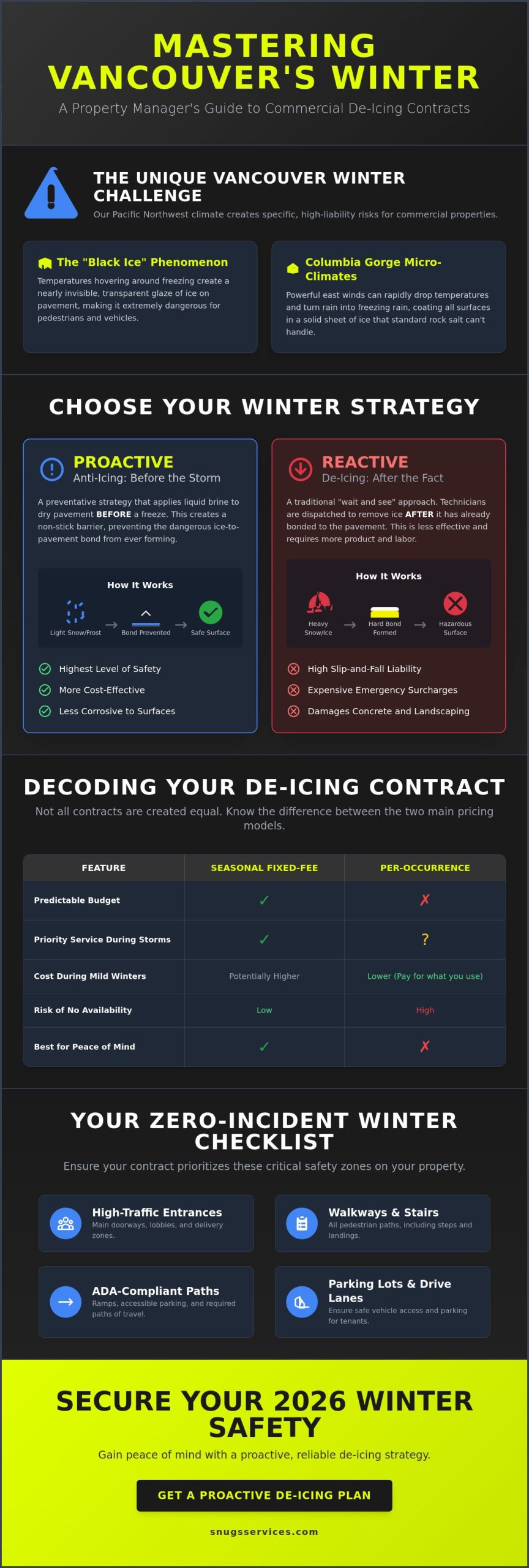
A professional de-icing contract isn’t just another line item on your property maintenance budget; it’s a proactive safety agreement that shields your business from the unpredictable Pacific Northwest winter. In Clark County, temperatures often hover right at the freezing mark, creating the perfect conditions for “black ice.” This transparent glaze forms when light moisture freezes on cold pavement, making it nearly invisible to pedestrians and drivers alike. Relying on commercial de-icing contracts Vancouver WA ensures that a dedicated team is monitoring these subtle shifts in weather so you don’t have to.
While municipal crews work tirelessly to clear I-5 and main arterials like Mill Plain Boulevard, they rarely touch commercial side streets or private parking lots. This leaves local business owners responsible for their own safety and accessibility. De-icing is the process of removing existing snow or ice, but a robust contract focuses on preventing that bond from ever forming. Without a formal agreement in place, you’re left competing with every other property manager in town for the few remaining contractors available during a storm.
To better understand how professional contracts protect your interests, watch this helpful video:
The True Cost of a ‘Wait and See’ Approach
Waiting until the ice has already formed often leads to steep emergency service surcharges. Reactive calls are expensive because they require immediate mobilization during peak demand. Beyond the immediate bill, the risk to your tenant relationships is high. If a retail shop or office park remains a skating rink during business hours, it reflects poorly on your management. Vancouver property managers have a legal “duty of care” to maintain safe premises. A single slip-and-fall claim can cost tens of thousands of dollars in legal fees and settlements, far outweighing the cost of a seasonal safety strategy.
Vancouver’s Unique Micro-Climates and Freezing Rain
Our region faces specific challenges due to the Columbia River Gorge. Powerful East winds can drop temperatures in East Vancouver and Camas significantly faster than in downtown or Salmon Creek. These winds often turn rain into hazardous freezing rain that coats everything in ice. Standard rock salt often fails in these conditions because it can be washed away by the rain before it freezes. Effective commercial de-icing contracts Vancouver WA utilize liquid brines and specialized treatments that adhere to the surface. Success depends on a narrow timing window; being thirty minutes late can mean the difference between a clear walkway and a dangerous liability.
Proactive vs. Reactive De-icing: Protecting Your Property Before the Freeze
Most property managers in Vancouver wait for the first snowflake before they pick up the phone. This reactive approach is risky and expensive. By the time you see ice on your walkways, the bond between the frozen water and your pavement is already established. This makes removal twice as difficult and twice as costly. Professional commercial de-icing contracts Vancouver WA emphasize a proactive strategy called anti-icing, which stops the problem before it starts.
Anti-icing involves applying a liquid brine solution to dry pavement before a forecasted freeze. An effective anti-icing program prevents that dangerous bond from forming in the first place. Think of it like a non-stick coating for your parking lot. Instead of scraping away thick ice, your maintenance team can easily clear away slush, maintaining a safe environment for your tenants and visitors. Using professional-grade magnesium chloride also offers significant advantages over generic rock salt. It’s less corrosive to structural steel and concrete, and it’s much safer for the landscaping that lines your walkways.
The Science of Anti-Icing for Commercial Lots
Applying treatments before a frost event isn’t just safer; it’s more efficient. Research indicates that pre-treatment can reduce the total volume of chemicals needed by up to 50 percent. This efficiency saves money and protects the local watershed from excessive runoff. Liquid brines also offer a vital residual effect. They stay in the pores of the concrete, remaining active through several light freezing cycles or multi-day cold snaps. This means your property stays protected even if a storm lingers longer than expected.
Choosing the Right Materials for Concrete and Landscaping
Not all melting agents are equal. While rock salt is cheap, it often damages commercial concrete and high-traffic parking structures over time. For retail areas where pets and heavy foot traffic are common, magnesium chloride provides a safer alternative that won’t burn paws or kill expensive ornamental plants. Calcium chloride is the industry standard for sub-zero performance when temperatures drop below the effective range of other chemicals. If you want to ensure your property stays clear regardless of the temperature, consider a professional de-icing strategy that utilizes the right materials for each specific surface.
Large-scale commercial lots require more than a hand-spreader. A professional response team uses specialized trucks equipped with calibrated spray bars and high-capacity tanks. This equipment ensures an even, precise application of liquid brine across thousands of square feet in minutes. This level of precision is only possible when you have the right tools and a dedicated team ready to deploy before the storm arrives.
Evaluating Commercial De-icing Contracts: Key Clauses for Vancouver Managers
Choosing the right structure for commercial de-icing contracts Vancouver WA is about balancing financial predictability with operational safety. Most managers settle on one of two primary models. A ‘Per-Occurrence’ contract means you pay only when the team arrives to treat your lot. This is often cost-effective during mild winters, but your expenses can climb quickly during a severe cold snap. Conversely, a ‘Seasonal Fixed-Fee’ model offers a set price for the entire winter. This provides total budget certainty and usually guarantees the highest priority when a storm hits.
For the truly unpredictable events common in our region, many property owners utilize ‘Time and Materials’ (T&M) billing. This model is often reserved for extreme conditions that exceed standard contract limits. Regardless of the pricing model, your agreement must include clear ‘Trigger Depths’ or ‘Automatic Response’ thresholds. You shouldn’t have to call your contractor at 4 AM to ask for service. A professional contract defines exactly when the team deploys, such as when the temperature hits 34 degrees with moisture present.
Service Level Agreements (SLAs) and Response Times
A reasonable response time for a Vancouver business typically means having all primary entrances and walkways clear before the morning commute begins. Your contract should specify that 24/7 weather monitoring is included. This ensures the team is ready to move before the freeze settles in. If you manage essential facilities like medical offices or grocery stores, your SLA should reflect priority scheduling to maintain public access and safety without delay.
Documentation and Reporting for Insurance Defense
In the event of a slip-and-fall claim, your service logs are your most powerful defense. Modern contracts utilize GPS tracking and timestamped reporting to prove exactly when and where the de-icing occurred. Detailed service reports, often accompanied by ‘before and after’ photos, provide the documentation insurance companies require to mitigate liability. Maintaining a clean surface is also vital for chemical performance. Professional commercial pressure cleaning services and regular sweeping help remove the grime and organic debris that can prevent de-icers from bonding correctly with the pavement.
Risk Mitigation and Safety Standards for Clark County Businesses
Managing risk during a Vancouver winter requires a structured approach to safety. When ice accumulates, your response team follows a strict hierarchy of clearing to ensure the highest level of protection for your tenants. Primary building entrances receive immediate attention, followed by high-traffic walkways. Only after these pathways are secured does the focus shift to ADA parking stalls and loading zones. This prioritized sequence isn’t just about efficiency; it’s about addressing the areas with the highest density of foot traffic where slip-and-fall incidents are most likely to occur.
Downtown Vancouver presents unique challenges, particularly for properties with multi-level parking garages. Open-air top decks and steep ramps are often the first surfaces to freeze and the last to melt. Proper drainage is the unsung hero of winter safety in these structures. If your drains are clogged with autumn debris, melting snow will pool and create dangerous “refreeze” patches as soon as the sun goes down. Effective commercial de-icing contracts Vancouver WA account for these specific architectural vulnerabilities, ensuring that water has a clear path off the property before it can turn back into ice.
ADA Compliance in Icy Conditions
Accessibility is a year-round legal requirement. Under the Americans with Disabilities Act, wheelchair ramps, handrails, and van-accessible stalls must remain clear and navigable. Because chemical de-icers take time to work, professional crews often use traction agents like sand or grit to provide immediate stability on slick surfaces. While these materials are lifesavers in January, they can become a nuisance once the weather warms up. This is why professional parking lot sweeping is a necessary post-winter service to remove accumulated grit and keep your property looking its best.
Liability Transfer and Indemnification
A well-structured contract does more than melt ice; it acts as a legal shield. By hiring a professional service, you can often transfer a portion of the operational liability to the provider through indemnification clauses. You should ensure your contractor carries comprehensive general liability insurance that meets or exceeds local industry standards. Certificate of Insurance (COI) verification is a non-negotiable step because it confirms your contractor is financially prepared to stand behind their work. If you’re ready to secure your facility for the 2026 season, you can request a professional de-icing strategy that prioritizes both safety and compliance.
Secure Your 2026 Winter Safety with Snugs Services
Snugs Services has been a fixture in the Vancouver and Portland metro area since 1995. We understand the specific quirks of the I-5 corridor, from the sudden Gorge winds to the persistent freezing rain that often catches out-of-town contractors off guard. Our neighborly approach means we treat your property with the pride of a local craftsman while utilizing the efficiency of a modern service provider. When you sign one of our commercial de-icing contracts Vancouver WA, you aren’t just hiring a vendor; you’re gaining a partner dedicated to your property’s safety and functional integrity.
We maintain a specialized fleet of trucks and equipment specifically designed for large-scale commercial applications. Our team utilizes constant weather monitoring to ensure we deploy before the ice has a chance to bond with your pavement. This proactive stance is what sets us apart from reactive services. We take the hazardous physical labor off your plate so you can focus on managing your tenants and business operations without the stress of unpredictable winter weather.
The Snugs Difference: Professionalism and Reliability
Every member of our de-icing crew undergoes rigorous training on safety protocols and specialized equipment operation. We use high-grade, low-corrosion de-icing agents that protect your concrete and landscaping while delivering superior melting results. This expertise is a core part of our comprehensive maintenance philosophy. De-icing works best when it’s integrated into a year-round plan that includes services like parking lot sweeping and pressure washing. By keeping your surfaces clean throughout the seasons, we ensure our winter treatments are as effective as possible.
Get Your Vancouver Commercial Quote Today
Onboarding your property is a simple, direct process designed to reduce friction and get you protected quickly. We start with a thorough property walk-through to identify your specific needs, from high-priority medical entrances to complex drainage areas. Based on this assessment, we develop a custom plan that fits your budget and safety requirements. Booking early is essential to ensure your property receives priority status before the first frost of the 2026 season arrives. Our goal is to provide a sense of relief and satisfaction, knowing your property is in expert hands.
Don’t wait for the first freeze to realize you’re unprotected. Request a Commercial De-icing Quote from Snugs Services today and experience the peace of mind that comes with professional, local expertise.
Secure Your Property and Peace of Mind for 2026
A proactive approach to winter weather is the only way to truly protect your Clark County property from the risks of invisible ice and unexpected storms. By prioritizing anti-icing science and clear service level agreements, you can transform a hazardous season into a zero-incident winter. Documentation and ADA compliance aren’t just checkboxes; they’re your strongest defense against liability claims and tenant dissatisfaction. Securing reliable commercial de-icing contracts Vancouver WA allows you to focus on your core business while local experts handle the heavy lifting.
Snugs Services has been a trusted neighbor in the Vancouver and Portland area since 1995. With our specialized commercial-grade de-icing fleet and 24/7 storm monitoring, we provide the rapid response you need to keep your walkways safe and your business accessible. It’s time to replace winter stress with the satisfaction of a well-maintained environment. Secure Your Vancouver Business with a 2026 De-icing Contract and enjoy a worry-free season. We’re ready to help you keep your community moving safely, no matter what the Pacific Northwest weather brings.
Frequently Asked Questions
When is the best time to sign a commercial de-icing contract in Vancouver?
The ideal time to finalize your agreement is in late summer or early autumn, specifically by October. Signing early ensures that your property receives a thorough walk-through and is placed on the priority list before the first frost arrive. This proactive planning prevents the stress of searching for a contractor during a mid-winter emergency when demand is at its peak.
What is the difference between rock salt and professional de-icing chemicals?
Rock salt is raw sodium chloride, which is highly corrosive and loses its effectiveness once temperatures drop below 15 degrees. Professional de-icing agents, such as magnesium chloride, are engineered to work at much lower temperatures while being gentler on your property. These advanced materials provide a more reliable safety result for high-traffic commercial areas without the harsh side effects of traditional salt.
Are de-icing chemicals safe for my commercial landscaping and concrete?
High-quality professional de-icing agents are designed to be significantly safer for structural concrete and sensitive landscaping. We utilize specialized products that minimize the pitting and scaling often caused by cheaper alternatives. This careful selection helps protect the health of your ornamental plants and preserves the long-term integrity of your parking structures and walkways.
How do de-icing contractors monitor the weather in Clark County?
Local crews utilize 24/7 monitoring systems that track regional weather stations and atmospheric data in real time. In Clark County, we pay particular attention to the Columbia River Gorge winds, as these can cause temperatures to plummet faster than standard forecasts predict. This constant oversight allows our teams to mobilize and apply treatments before moisture has a chance to turn into dangerous ice.
Does a de-icing contract guarantee I won’t be sued for a slip-and-fall?
While no service can prevent a lawsuit from being filed, commercial de-icing contracts Vancouver WA provide a robust legal defense. Professional maintenance shows that you have met your legal “duty of care” to keep the premises safe for the public. Our detailed, timestamped service logs serve as vital evidence of your proactive safety efforts in the event of a claim.
What is ‘anti-icing’ and why is it better than just salting after a storm?
Anti-icing is a proactive liquid treatment applied to dry pavement before a freeze to prevent ice from bonding to the surface. It is far more effective than reactive salting because it stops the ice from ever forming a dangerous grip on your walkways. This method uses fewer chemicals overall and ensures that your property remains navigable throughout the duration of a cold snap.
Can Snugs Services handle large parking garages and high-traffic retail lots?
Snugs Services maintains a specialized fleet specifically equipped for the challenges of multi-level parking garages and expansive retail centers. Our professional-grade equipment allows us to cover large square footages quickly and precisely. We understand the operational requirements of high-traffic facilities and have the capacity to maintain safety standards even during severe weather events.
What documentation will I receive after each de-icing visit?
You will receive comprehensive service reports that include GPS timestamps and detailed logs of the treatments applied to your property. These documents provide a clear record of exactly when our crews were on-site and which areas were treated. This level of transparency is essential for insurance defense and gives you the confidence that your property is being managed to the highest professional standard.
Recent Comments