
A single patch of moss on a public sidewalk isn’t just an eyesore; it’s a liability that can cost your city more than an entire year of professional maintenance. We know that managing municipality cleaning in 2026 feels like a constant balancing act between shrinking budgets and strict new environmental regulations. From Portland’s nine-month ban on gas-powered leaf blowers starting January 1, 2026, to Washington’s updated Construction Stormwater General Permit, the rules for keeping public spaces pristine are shifting. You’re likely feeling the pressure of maintaining community pride while avoiding the slip-and-fall accidents that lead to costly legal claims.
It’s time to stop reacting to problems and start protecting your city’s most valuable assets with a proactive strategy. This guide will show you how to build a scalable, safety-first exterior maintenance plan that preserves infrastructure and boosts resident satisfaction. We’ll provide a clear framework for prioritizing tasks, from graffiti removal to parking lot sweeping, so you can reduce long-term repair costs and keep your streets sparkling. Let’s look at how to restore beauty and safety to your community through efficient, professional care that does the heavy lifting for you.
Key Takeaways
- Define the full scope of municipality cleaning to ensure every public asset, from local monuments to major stadiums, stays in pristine condition.
- Master a 4-step framework for building a scalable maintenance plan that prioritizes public safety and reduces long-term infrastructure repair costs.
- Evaluate the hidden costs of in-house labor and learn how specialized partners can streamline your operations while reducing liability.
- Follow a seasonal roadmap designed for the unique PNW climate to proactively manage moss, winter debris, and high-traffic summer cleaning needs.
- Discover how modern tools like drone pressure washing provide a safer, high-tech solution for maintaining high-rise city halls and public infrastructure.
What is Municipality Cleaning? Defining the Scope of Public Space Care
When we talk about the specialized maintenance of public-owned exterior assets and infrastructure, we’re looking at the heavy lifting that keeps a city functional and beautiful. This isn’t your standard janitorial work; municipality cleaning involves high-stakes preservation of the physical environment that taxpayers use every day. This specialized field sits at the intersection of facility management and public works, ensuring that the physical environment remains safe and welcoming for everyone. The technical requirements for these projects vary wildly, ranging from routine sidewalk pressure washing to complex stadium cleaning and the delicate preservation of historical monuments.
Vibrant public curb appeal acts as a primary catalyst for local economic growth by driving foot traffic to downtown merchants and increasing overall property values across the district. Beyond the visual benefits, professional maintenance is a non-negotiable requirement for public safety. In our damp Pacific Northwest climate, a single season of neglect can lead to thick moss growth that turns a standard walkway into a dangerous slip hazard. Keeping these surfaces clean is a critical component of ADA compliance, ensuring that all citizens can navigate their city without facing unnecessary risks or barriers.
Key Assets in the Municipal Cleaning Portfolio
A comprehensive municipality cleaning strategy covers several distinct categories of infrastructure. Administrative buildings like city halls and courthouses require expert window washing and facade care to maintain a professional appearance. Transit hubs and multi-level parking garages need frequent sweeping and pressure washing to manage oil buildup and exhaust soot. Finally, recreational facilities, including parks and large-scale sports venues, demand specialized sanitation to handle high-volume crowds safely and efficiently.
The Triple Bottom Line of Clean Public Spaces
Investing in exterior care provides three distinct layers of value to a community. From an economic standpoint, pristine streets and parks attract tourism and support the vitality of local business districts. Regarding safety, regular concrete cleaning significantly reduces public liability concerns by eliminating moss and algae that cause slip-and-fall accidents. Socially, well-maintained spaces foster deep civic pride and discourage vandalism. By applying the “Broken Windows” theory, we know that a clean, cared-for environment signals that a community is active and engaged, which naturally deters graffiti and property damage.
How to Build an Exterior Maintenance Plan: A 4-Step Framework for Cities
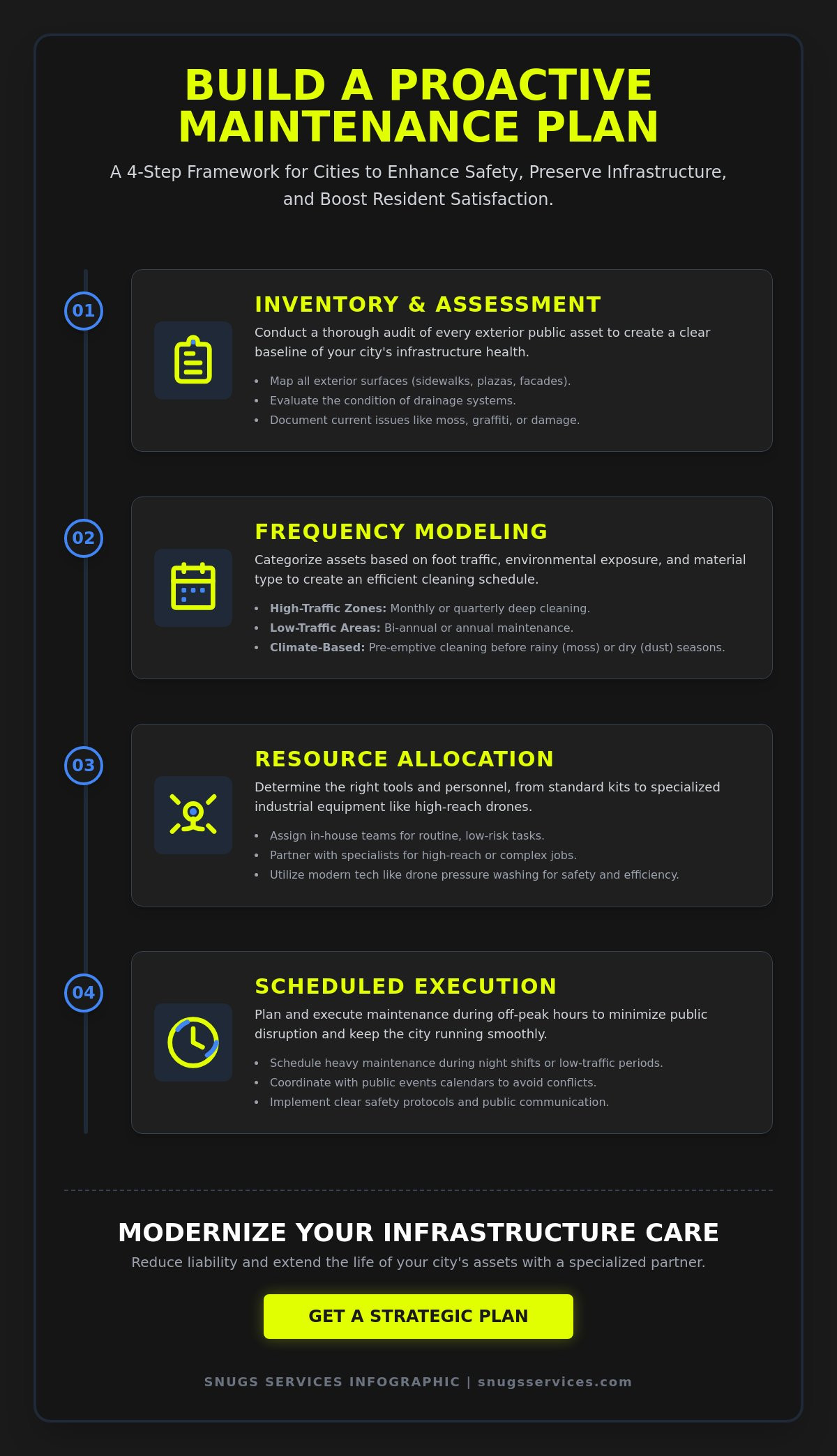
Creating a reliable strategy for municipality cleaning requires moving beyond reactive “spot cleaning” and toward a structured, data-driven approach. A well-designed framework ensures that every dollar spent on public works actually extends the life of your infrastructure. We recommend a four-step process to bring order to the massive scope of city-wide maintenance. First, you must conduct a thorough inventory and condition assessment of every exterior surface and drainage system. This baseline tells you exactly what you own and what state it’s in before you deploy a single crew.
Second, implement frequency modeling. This step involves categorizing assets based on foot traffic, environmental exposure, and material type. A downtown plaza might need monthly pressure washing, while a suburban park path might only require an annual deep clean. Third, determine your resource allocation. You’ll need to decide which tasks can be handled by standard kits and which require specialized industrial equipment, such as high-reach drones or high-PSI surface cleaners. According to the American Public Works Association, professional management of these resources is vital for maintaining the integrity of public spaces. Finally, schedule your execution for minimal public disruption. Performing heavy maintenance during night shifts or off-peak hours keeps the city moving while your team does the heavy lifting.
Inventorying Your City’s Exterior Assets
Effective mapping is the backbone of a pristine city. Start by identifying high-traffic zones that demand frequent attention and separate them from areas that only need seasonal care. You should also pinpoint specific “problem areas” that are prone to rapid moss growth or frequent graffiti tagging. For cities managing educational precincts, integrating university cleaning standards ensures that public campus environments remain safe and welcoming for students and faculty alike. This level of detail prevents small issues from turning into expensive repairs.
Prioritizing Safety and Liability Reduction
Safety is the primary driver of any municipality cleaning plan. Focus your immediate efforts on ingress and egress points, as well as emergency vehicle access routes, to ensure they’re always clear of debris and moss. It’s also essential to prioritize roof and gutter health; clogged systems lead to structural water damage that can cost thousands to fix. Always maintain detailed logs of every cleaning task. These records serve as vital protection against insurance claims and liability disputes. If you’re ready to see how a professional team handles these complex logistics, you can explore our full range of exterior solutions for a worry-free approach to city care.
In-House Labor vs. Specialized Partners: Evaluating the Best Model
Deciding between using city staff and hiring a professional partner for municipality cleaning is a choice that impacts both your budget and your liability profile. Many cities assume that using existing grounds crews is the most frugal path. However, the overhead of purchasing and maintaining city-owned heavy equipment can quickly eclipse the cost of an on-demand service contract. Beyond the initial purchase price, you’re responsible for specialized equipment maintenance, storage, and the constant cycle of technician training to keep up with modern standards.
There are several “hidden costs” associated with in-house labor that often go unnoticed during budget season. These include specialized insurance riders for high-risk work and the administrative burden of staying compliant with evolving environmental regulations. For instance, managing pressure washing in Portland, Oregon requires strict adherence to wastewater recovery laws. Specialized partners already have the equipment and certifications to handle these requirements, taking the “heavy lifting” off your plate and ensuring your city avoids hefty fines for improper runoff.
We often hear the objection, “We can just have our grounds crew do it.” While your team is excellent at daily upkeep, technical tasks like moss remediation or high-PSI surface cleaning require a specific level of expertise. Using the wrong nozzle or pressure setting on delicate stone can cause permanent damage to a historic courthouse or monument. By outsourcing, you also benefit from a direct liability transfer. When a specialized partner handles the work, they carry the insurance risk for both property damage and worker safety, providing a layer of protection for the city’s general fund and reducing your total risk exposure.
When to Keep it In-House
In-house teams are most efficient when focused on high-frequency, low-complexity tasks that keep the city running day-to-day. Your grounds crew is the best choice for:
- Daily litter removal and keeping walkways clear of immediate debris.
- Minor graffiti removal in low-security or easy-to-access areas using standard cleaners.
- Routine management of trash receptacles and basic landscaping upkeep.
When to Hire a Specialized Commercial Partner
Certain municipality cleaning projects require industrial-grade tools and specialized training that aren’t practical to maintain in-house. You should look for an expert partner for:
- High-rise window washing and drone-assisted cleaning for tall administrative buildings.
- Large-scale infrastructure projects involving complex environmental runoff management and recovery.
- Technical surface treatments like concrete grinding to fix trip hazards or deep moss remediation on public plazas.
Managing the PNW Climate: A Seasonal Roadmap for 2026
The Pacific Northwest presents a unique set of challenges that national cleaning companies often overlook. Effective municipality cleaning in our region requires a schedule that respects the biological growth cycles of moss and the intensity of our rain seasons. We’ve developed a roadmap for 2026 to help city managers stay ahead of the weather and protect public assets. This proactive approach ensures that maintenance isn’t just a reaction to a problem, but a strategic investment in the community’s longevity.
Spring is the season of renewal and recovery. After the winter storms subside, public spaces are often covered in grit, silt, and organic debris. This is the ideal window for post-winter debris removal and comprehensive roof cleaning in Portland to eliminate moss that took hold during the wet months. Removing these biological loads early prevents structural damage and keeps city halls looking their best. When the sun finally breaks through in the summer, tourism peaks. High-visibility areas require sparkling windows and debris-free parking lots. Regular parking lot sweeping during these months prevents dust buildup and ensures that visitors have a positive first impression of your city’s cleanliness.
Preparation is everything in autumn. Before the “Big Rain” season arrives, aggressive gutter cleaning and drainage inspections are mandatory for every municipal building. Clearing out fallen leaves and sediment prevents localized flooding on city streets and protects basement levels from water intrusion. Winter shifts the focus to emergency response. Keeping essential services operational requires a reliable plan for rapid-response de-icing and snow plowing. Our team prioritizes transit stairs and emergency routes, ensuring the community stays safe even during the harshest freeze events.
The Moss and Algae Battle in Portland and Vancouver
Portland and Vancouver are notorious for rapid moss growth. These green patches aren’t just an aesthetic issue; they create significant slip hazards on municipal sidewalks that increase public liability. To combat this, we use eco-friendly moss treatment methods that comply with strict 2026 local environmental regulations, protecting our waterways while cleaning the concrete. Applying professional-grade preventative coatings to stone and concrete can also reduce the frequency of regrowth, significantly cutting down on long-term maintenance costs for the city.
Winter Readiness and Public Safety
Public safety during a freeze relies entirely on timing and preparation. Pre-treating surfaces with anti-icing agents before a predicted freeze event prevents ice from bonding to the pavement in the first place. We coordinate city-wide de-icing for public walkways and transit stairs to maintain accessibility for all residents, including those with mobility challenges. Coordinating snow plowing for municipal parking lots and emergency routes ensures that first responders can move through the city without delay. If you want to ensure your city is prepared for whatever the weather throws our way, schedule a seasonal maintenance consultation with Snugs Services today and let us do the heavy lifting for you.
Modernizing Infrastructure Care with Snugs Services
Snugs Services has been a reliable fixture in the Pacific Northwest for over 30 years. We’ve spent three decades serving Portland, Vancouver, and the surrounding metro areas with the pride of a local craftsman and the efficiency of a modern service provider. When it comes to municipality cleaning, we understand that city managers need a partner who shows up on time and gets the job done right the first time. Our team doesn’t just wash surfaces; we restore the beauty and safety of your community’s most valuable assets. We manage every project with strict environmental compliance, ensuring all wastewater runoff meets local PNW ordinances so you don’t have to worry about regulatory fines.
Beyond fixed structures, your mobile assets deserve the same level of care. We provide expert truck washing services for municipal vehicle fleets to keep your service trucks and emergency vehicles in pristine condition. A clean fleet isn’t just about appearance. It’s about professional representation and preventing long-term corrosion from road salts and grime. We take the hassle out of fleet maintenance by bringing our specialized equipment directly to your facility, saving your team time and effort.
Drone Cleaning: The Future of Municipal Maintenance
Traditional methods for cleaning high-rise city halls or stadium structures often involve expensive scaffolding or risky lift operations. We’ve modernized this process by utilizing drone pressure washing technology. This high-tech solution allows us to clean large-scale public building exteriors with much faster execution times than traditional crews. Drones provide precision cleaning for fragile historic monuments and complex stadium geometries without the physical impact of heavy machinery. It’s a safer, more efficient way to maintain your city’s skyline while reducing the footprint of our equipment on the ground.
Partnering for a Safer, Cleaner Community
We know that municipal budgets are often tight and planning happens months in advance. That’s why we offer customizable service contracts designed to fit within your annual municipal budget cycles. Whether you need a one-time deep clean or a recurring seasonal maintenance plan, we provide a seamless experience from the first quote to the final walkthrough. Our team also maintains emergency response capabilities for rapid graffiti removal and storm debris cleanup, ensuring your streets stay safe and welcoming 24/7. Contact Snugs Services today for a comprehensive municipal facility assessment and let us take the heavy lifting off your plate.
Secure Your City’s Legacy with Proactive Care
Building a resilient strategy for municipality cleaning ensures your public spaces remain safe, welcoming, and vibrant for decades to come. You now have a clear framework to assess your assets, manage unique PNW seasonal challenges, and leverage modern technology to reduce liability. By choosing a partner that understands the technical nuances of infrastructure care, you protect your budget from the high costs of reactive repairs and property damage. It’s about more than just aesthetics; it’s about preserving the heart of your community through expert maintenance.
Snugs Services has proudly served the Pacific Northwest since 1995. We are fully licensed, bonded, and insured for government contracts, providing you with the peace of mind that the job will be done right the first time. Our specialized drone cleaning technology allows us to maintain high-rise assets and delicate monuments with surgical precision and zero hassle. Don’t let moss or debris compromise your city’s safety and public perception. Request a Professional Municipality Cleaning Assessment today and experience the relief of a pristine, expertly maintained environment. Let’s work together to keep our local streets and public spaces sparkling for everyone.
Frequently Asked Questions
How often should municipal sidewalks be pressure washed?
High-traffic municipal sidewalks should be pressure washed at least once per month to prevent the buildup of gum, grime, and organic slip hazards. For residential or lower-traffic areas, an annual deep clean is typically sufficient to maintain safety and curb appeal. We recommend a staggered schedule that prioritizes downtown business districts and transit hubs during peak foot traffic seasons to ensure these areas remain pristine and welcoming for all residents.
What are the environmental regulations for wastewater during city cleaning?
Environmental regulations require that all wastewater from municipality cleaning activities be captured and properly disposed of to prevent pollutants from entering local storm drains. Per the Clean Water Act and local PNW ordinances, contractors must use specialized recovery systems to filter out oils, heavy metals, and chemicals. Our team utilizes high-grade vacuum recovery tools to ensure every project remains 100% compliant with current environmental protection standards, protecting our local rivers and streams.
Can drone cleaning be used on historic municipal buildings?
Drone cleaning is an excellent choice for historic municipal buildings because it eliminates the risk of heavy equipment or scaffolding damaging delicate masonry and architectural details. By using low-pressure soft wash techniques, drones can expertly apply cleaning solutions to high facades without the physical impact of traditional methods. This technology provides a seamless way to restore the original beauty of courthouses and monuments while keeping technicians safely on the ground.
How does professional moss treatment reduce city liability?
Professional moss treatment reduces city liability by removing the biological growth that turns concrete into a dangerous slip hazard during the wet PNW months. By applying specialized inhibitors, we prevent moss from regrowing, which keeps walkways safe for pedestrians and helps cities avoid costly legal claims. Regular treatment also preserves the structural integrity of the concrete, preventing cracks and uneven surfaces that could lead to additional trip hazards and insurance concerns.
What is the best way to manage graffiti removal on public property?
The best way to manage graffiti removal is through a rapid-response strategy that addresses tags within 24 to 48 hours. Quick removal discourages vandals by taking away their visibility and helps maintain the community’s sense of safety and pride. We use specialized chemicals and pressure settings tailored to the specific surface material, ensuring that paint is completely removed without etching or shadowing the underlying stone, brick, or metal infrastructure.
Does Snugs Services provide emergency snow plowing for city facilities?
Snugs Services provides 24/7 emergency snow plowing and de-icing for city facilities, prioritizing essential service routes and emergency vehicle access points. We coordinate with city managers to ensure that parking lots, transit stairs, and public walkways remain clear during winter freeze events. Our team uses professional-grade equipment and pre-treatment strategies to keep your city moving safely, even when the weather takes an unexpected turn for the worse.
How do city managers track the ROI of professional exterior cleaning?
City managers track the ROI of professional municipality cleaning by measuring the reduction in long-term infrastructure repair costs and the decrease in public liability claims. Clean public spaces also correlate with higher foot traffic in business districts, which supports local tax revenue. By documenting maintenance logs and asset conditions over time, cities can see the direct financial benefit of preventative care versus the high cost of emergency structural restoration or legal settlements.
What certifications should a municipal cleaning contractor hold?
A municipal cleaning contractor should be fully licensed, bonded, and insured, with specific coverage for high-risk public works projects. It’s also essential they hold certifications for lead-safe work and environmental wastewater management to ensure compliance with local and federal laws. Look for a partner with a proven track record of serving government agencies, as they will understand the specific reporting and safety requirements necessary for successful public sector collaborations.
Recent Comments